
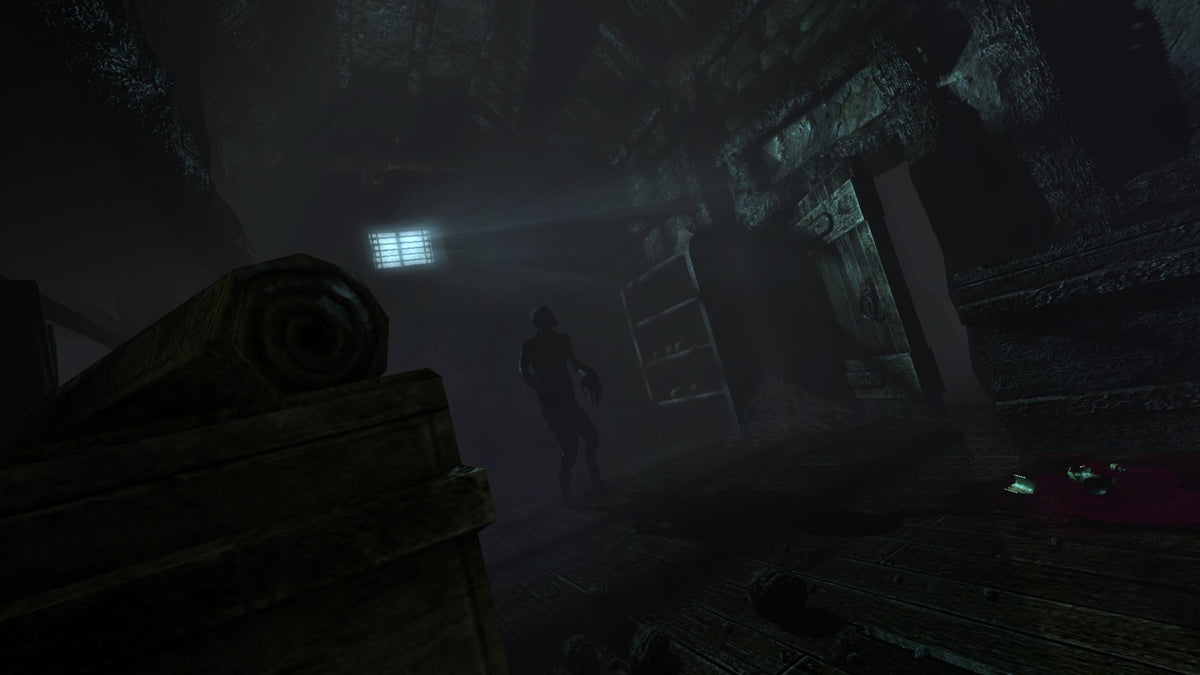
A horror game can give you a monster and ask how you will kill it. Amnesia: The Dark Descent asks a less comfortable question: what will you do with your hands while you are trying not to be noticed? Open a door, move something heavy, reach for a light. Ordinary actions become the work of staying alive.
Frictional Games released the original PC game on September 8, 2010. Its enduring design idea is not simply that Daniel lacks a gun. It is that taking combat away makes the room itself more important. A doorway, a patch of shadow and a movable object become things to assess rather than scenery on the way to the next fight.
Hiding is a temporary arrangement
The original manual describes a specific set of advantages: crouching, staying still and remaining in darkness make Daniel harder for creatures to spot. It also gives that protection a cost. Darkness lowers his sanity, so a hiding place is not somewhere to settle indefinitely.
That creates an interesting problem without needing a weapon comparison screen. The place that offers concealment is also a place you may need to leave. Read as design, the tension comes from deciding when to change your situation, not merely finding the correct hiding spot and waiting for the game to declare you safe.
This is why describing Amnesia as passive misses something. Retreating can be an active choice, with its own timing and route planning. You are still making decisions; they are just decisions about exposure rather than damage output.
Your mouse has to finish the job
Physical interaction gives those decisions a tactile vocabulary. In the PC manual, opening an ordinary door means holding the interaction button and moving the mouse in the direction you want the door to travel. Drawers use a similar motion. Wheels ask for circular movement, while movable objects can be carried, rotated or thrown.
A door is therefore more than a prompt that disappears after a button press. The player supplies the movement. In our reading, that matters because the same interaction can belong to calm investigation or an urgent attempt to put a barrier between Daniel and danger. The control does not become a different minigame just because the situation becomes frightening.

There is a useful distinction between helplessness and limited means. A game can deny you combat while still giving you ways to act on the environment. Amnesia's physical controls support that distinction. Moving, inspecting and manipulating things remain your business even when defeating the creature is not.
Light does not solve every problem
The lantern illuminates Daniel's surroundings, but it uses oil. Tinderboxes light suitable environmental light sources and are also limited. The manual connects those resources to the sanity cost of darkness, rather than presenting illumination as a purely decorative preference.
The resulting choice is easy to understand and harder to make comfortable: lighting a space addresses one concern, while hiding addresses another. That is the design relationship worth noticing. It does not require us to claim that every candle alerts every enemy, or that one universal trick works through the whole game.

Resource pressure also changes the meaning of a familiar horror image. A lit corridor can be reassurance, a useful landmark or simply somewhere to think about the next move. Its value comes from what the player needs at that moment, not from a promise that light makes a room permanently safe.
The mystery begins with a missing point of view
Daniel wakes in a castle with much of his past missing. That premise gives exploration two jobs: finding a way through the building and learning about the person moving through it. The setting is not only an obstacle course outside the character. It is also the place where his incomplete understanding is challenged.
That is a different attraction from the combat-led horror discussed in our Hellraiser: Revival analysis. Players choosing between horror games should look beyond the shared genre label. Wanting to investigate under pressure is not necessarily the same preference as wanting to fight under pressure.

Approach the original on its own terms
The current Steam listing identifies The Dark Descent as single-player and includes commentary and a level editor. Frictional separately lists Amnesia: Collection as containing The Dark Descent, Justine and A Machine for Pigs. Those names should not be treated as interchangeable games or as evidence that every package has identical platform features.
This spotlight concerns the original PC design, not a test of modern hardware compatibility or a console-port comparison. Its age is no reason to copy old operating-system requirements into a present-day buying promise. Check the exact current listing for your platform, and take the publisher's mature-content description seriously.
For another approach to making exploration carry the tension, our Silver Pines analysis examines navigation through a hostile town. Amnesia's particular appeal is closer to hand level: a room can become compelling because using it requires a little more commitment than passing through it.
The developer's original gameplay teaser
Watch Amnesia: The Dark Descent's 2010 gameplay teaser on YouTube. Frictional's developer blog links this video and explains that its demonstration map was assembled for the teaser, not lifted unchanged from a campaign level. This is a direct-link fallback; YouTube playback may include provider advertising.
Sources and media credit
Design and historical details: Frictional Games' original-game press kit, the official PC instruction manual linked by Steam, and Thomas Grip's February 2010 developer explanation. Current package features and content advisory: the publisher's Steam listing. Checked October 16, 2026.
Featured and inline images are original-game PC press screenshots from Frictional Games' Dark Descent media folder. © Frictional Games. Presented unaltered apart from responsive display sizing. This is researched design commentary, not a claim of a new Zypher playthrough.


