
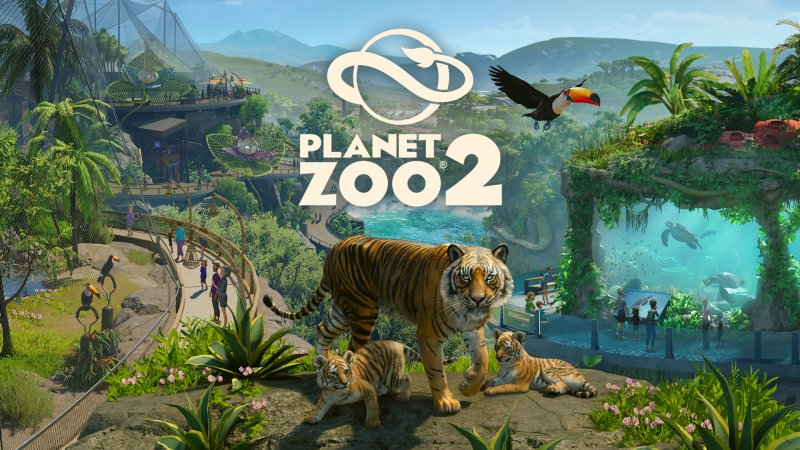
Planet Zoo 2 asks a useful question before you draw the first path: what kind of habitat are you building? Aviaries, aquariums and Wildlife Reserves broaden that decision beyond choosing an animal and finding an empty corner of the park.
Frontier confirms an October 13, 2026 launch on PC, PS5 and Xbox Series X|S. This is a source-based preview, not a hands-on review. The images are publisher promotional material.
Build one habitat before planning the entire park
The official Steam listing confirms fully aquatic animals and flying birds, housed in customizable aquariums and aviaries. These additions make enclosure design a central decision rather than simply another item on a species list.
For planning purposes, separate the space occupied by the animal, the way visitors see it, and the paths around it. An aquatic habitat can inspire an underwater viewing area, while an aviary encourages you to think vertically. Those are ideas to explore, not promises that every design will work without constraints.
The construction screenshot below shows the aviary's mesh roof as part of the build. Before spending an evening decorating an entrance, learn what the enclosure tools actually require. Our advice is to prototype one habitat, check its needs, and then decide how the paths and scenery should fit.

A modest first build has a practical advantage: fewer moving parts when something needs fixing. If you immediately combine a complicated enclosure, elaborate scenery and several visitor routes, it can be harder to understand which decision caused the problem. Start with a layout you can explain, then make it ambitious.
The animal should guide the project
The publisher describes species with individual needs and behaviors. A flying bird is a reason to investigate an aviary, not proof that any attractive enclosure will suit it. An aquatic animal is likewise more than a moving decoration in a tank.
Pick an animal that interests you and learn its requirements before designing around a promotional image. Once its habitat works, expand the idea. That is a planning recommendation, not a claim about a tested optimal strategy or guaranteed welfare score.

The toucan scene is a good visual introduction to the idea of a flying habitat. It cannot establish the performance of a large park, the responsiveness of console controls, or the exact limits of a construction system. Those questions need the finished game and exact-platform testing.
A zoo can support a project outside its gates
Frontier's September 16 announcement describes restoring natural habitats and releasing animals into Wildlife Reserves. It also confirms collaboration with BIAZA, the British and Irish Association of Zoos and Aquariums.
That changes the goal worth considering: are you expanding only to make a larger attraction, or to support work outside the zoo? The reserve system gives the second idea a place in the sequel. Whether that loop is demanding or satisfying remains a question for actual play.
The July 28 Scottish Highland Reserve feature highlights Red Deer and Golden Eagle in that setting. It is a concrete example of Frontier's announced environments. A real conservation partnership supplies development context, but it does not make a game a scientifically exhaustive model of wildlife management.

Choose a mode, then check the platform
Career, Franchise and Sandbox are confirmed modes. Franchise includes animal trading; the Frontier Workshop shares player-created blueprints across platforms. Steam identifies the game as single-player. Those connected features should not be mistaken for a promise that a friend can join your zoo and build beside you.
Decide what you want from your first save. Someone looking for direction should investigate Career. Someone focused on construction should investigate Sandbox. Before choosing Franchise, read its current requirements rather than assuming every connected feature works like a private sandbox.
The Steam description says Deluxe adds six animal species and animal signs through its upgrade pack. Compare those extras with the animals you actually want to build around. A larger edition name does not tell you which purchase fits your plans.
On PC, compare your hardware with the current requirements. Console buyers should look for PS5 or Xbox evidence before assuming PC footage establishes their performance. Platform availability is confirmed; identical results on every machine are not.
The strongest confirmed change is the range of environments Planet Zoo 2 asks you to consider. Your first plan can stay small: one enclosure, one clear viewing route and an animal whose needs you understand. Build the enormous dream zoo once you know why the smaller one works.


