
Resident Evil has spent three decades finding new ways to make a person reconsider opening a door. Sometimes the problem is what the camera refuses to show. Sometimes it is the crowd already in view. Sometimes you have a partner, a large weapon and absolutely no excuse for how badly the evening is going.
The series that began in 1996 is often described as a fight between survival horror and action. That explains part of its history, but it misses the more interesting question: how much control should the player have before feeling safe? A clearer view, a second character or a stronger attack can change the answer without removing the fear.
This deep dive follows the mansion games, the Raccoon City remakes, the action and co-op years, and the first-person reinvention. It is a guide to the major changes and useful entry points, with our editorial recommendations separated from publisher descriptions. It contains premise-level details, without revealing endings.
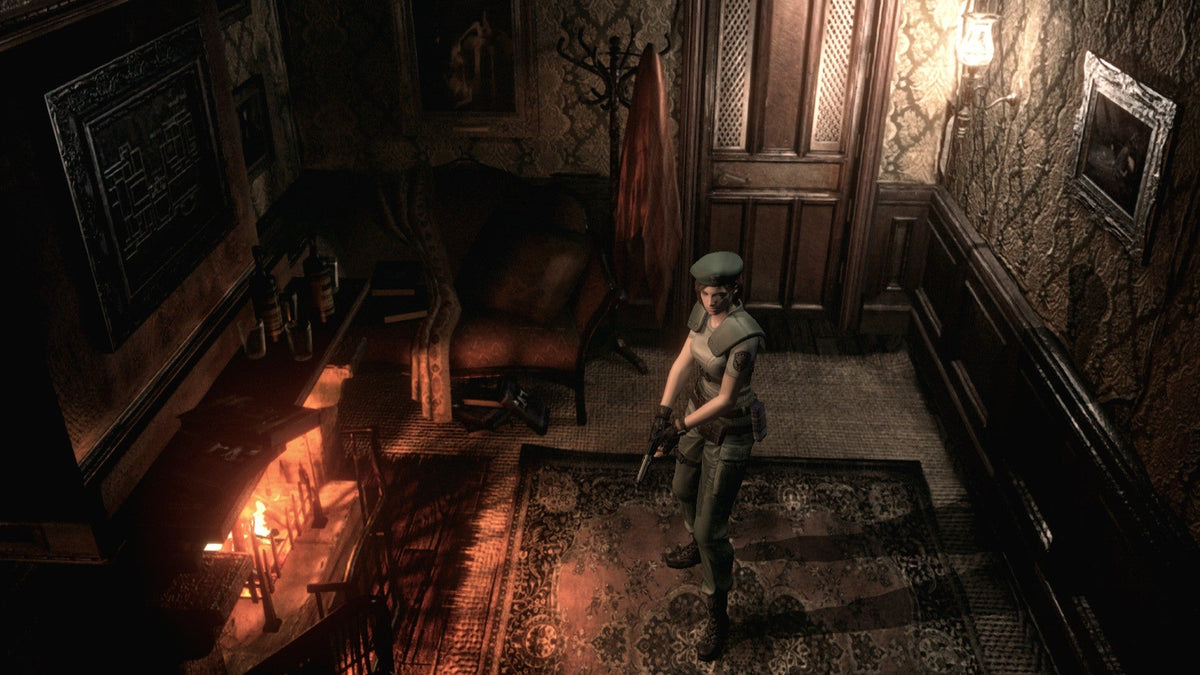
Featured image: Jill Valentine in the mansion in Resident Evil HD Remaster. Official PC gameplay screenshot supplied by Capcom on Steam. All images below depict their named PC versions; they are not evidence of console performance.
The mansion made knowledge feel like equipment
In the original Resident Evil's setup, a special-forces investigation near Raccoon City ends at an isolated mansion. Capcom's 2016 retrospective places that first release in 1996. The HD Remaster offers a readily identifiable version of the mansion adventure, with fixed viewpoints and choices between original and alternative movement controls.
The important part of that design is the relationship between a room and your memory of it. A fixed camera gives you a composed view, but it also decides where your information stops. Walking through a familiar space becomes a small calculation: what is ahead, what supplies remain, and whether this route still seems sensible.
That is why a mansion can carry an entire game. Repeated rooms need not be empty repetition if your understanding changes. A door you could not use becomes a possibility. A corridor becomes a resource problem. Knowledge starts doing some of the work that a bigger weapon would do in another series.
Our pick: choose HD Remaster if you want to understand that original design language. Its camera is part of the experience, so approaching it solely as a control scheme to overcome misses half the appeal. The alternative movement option can make the first steps easier while preserving those deliberately limited views.
Resident Evil 0 changes the calculation with two people

Resident Evil 0 moves the premise to Rebecca Chambers, Billy Coen and the Ecliptic Express before the mansion incident. Its defining distinction is control of two characters, with switching used for exploration and puzzles. This is a single-player partnership, not a promise that a friend can take the second controller.
That difference matters when choosing a starting point. A pair of protagonists creates another layer of planning: deciding who should do something is a separate question from deciding what to do. For a newcomer, learning the series' approach to space and supplies while also managing two people can be a lot to ask of the first evening.
We would start with the mansion game, then try Zero for the variation. Story chronology is useful context, but it is a poor substitute for choosing an introduction that suits how you like to play. A prequel can make more sense after you understand the game it is standing beside.
Raccoon City: the camera moves, but uncertainty stays

The Resident Evil 2 remake puts Leon S. Kennedy and Claire Redfield into an over-the-shoulder presentation, with separate campaigns and a rebuilt version of the Raccoon City crisis. Capcom's Xbox launch post records its January 25, 2019 release and the move from the 1998 game's presentation to the RE Engine remake.
A camera behind the character seems like a straightforward increase in power. You can look and aim more directly. Yet a useful horror space still has corners, multiple approaches and decisions that compete for attention. Knowing where the camera points does not tell you whether spending ammunition now is the right choice.
This is why we recommend the RE2 remake as a broad starting point for someone who wants a contemporary viewpoint with exploration and resource pressure. It offers a way into the series' recurring concerns without first requiring affection for fixed cameras. That is a recommendation about design fit, not a claim that everyone will find it easy.

Resident Evil 3's remake changes the dramatic emphasis. Jill Valentine is trying to escape Raccoon City while Nemesis is sent after her. A place being systematically searched and a city being escaped make different promises to the player, even when both involve Umbrella's disasters.
Think of the two remakes as neighboring perspectives rather than interchangeable products. RE2 is our first suggestion for someone interested in learning an environment under pressure. RE3's pursued-escape premise is the reason to consider Jill's game. Buying both because the numbers sit beside each other is optional. The zombies will survive your sensible purchasing decision.
Resident Evil 4 asks what happens when the threat is visible

The 2005 Resident Evil 4 follows Leon on a mission to rescue the president's daughter in rural Europe. Its hostile villagers and Las Plagas premise move the encounter away from another simple zombie outbreak. The later remake revisits that mission with updated gameplay and a reworked telling.
For understanding the franchise, the crucial change is the kind of attention an encounter demands. Fear can come from a threat that you cannot locate, but it can also come from several threats you can see and cannot comfortably manage at once. A clear view of trouble is still trouble.
That makes the fourth game's action turn more interesting than merely giving Leon more confidence. The player is invited to assess pressure, choose priorities and keep moving through a dangerous situation. Being capable becomes part of the tension because capability creates an expectation that you should be able to handle this.
Choose between the original and remake deliberately. They are different releases of the same central adventure, not an edition label that can be ignored. For a modern first visit, our suggestion is the remake; for a closer look at the series' historical pivot, seek the release explicitly identified as Resident Evil 4 (2005). Collectors have an excellent excuse for both. Wallets may have a dissenting opinion.
Five and six turn isolation into coordination and scale

Resident Evil 5 pairs Chris Redfield and Sheva Alomar in a bioweapon investigation in Africa. Its publisher listing supports solo and co-op play. That changes a foundational horror question: what happens when the person beside you can help?
A partner reduces solitude, but introduces coordination. Two people can agree on a plan, misunderstand each other or make different decisions at the worst possible moment. The result is a different kind of appeal from exploring the mansion alone. If shared action is the reason you are buying a Resident Evil game, this branch deserves a look.
Resident Evil 6 expands the scale again through four interwoven campaigns involving Leon, Chris, Ada and Jake, with outbreaks across several regions. Capcom's description emphasizes broader movement and combat options as well as the connected stories.
Our read is that the fifth and sixth games are useful evidence that Resident Evil is not a single mood. The more capable and connected its heroes become, the further the series can travel from the feeling of being alone in an unfamiliar house. That does not erase their place in its history; it explains why a player seeking co-op action and a player seeking intimate horror can want different entries.
Check the precise platform and edition for multiplayer details before arranging a session. A general co-op label does not establish every local, online or account requirement for the copy in front of you.
Resident Evil 7 makes the space personal again

Resident Evil 7 brings the main series into first person and a rural American setting. Capcom's game description emphasizes exploration, atmosphere and the closer viewpoint. The camera now makes the player inhabit the threatening space more directly.
That shift is more substantial than changing where the character model appears. A third-person body can act as a small point of separation between player and scene. First person removes that particular buffer. A doorway fills your own view, and looking behind you becomes an active decision.
The Baker household also demonstrates the value of scale. A horror premise does not need a larger geographical disaster every time it returns. A contained place can make small details and nearby people carry more weight. After discussing global outbreaks, returning attention to a house is a striking way to change the conversation.
Choose RE7 if an intimate setting and first-person exploration sound like the version of horror you want. You do not need to treat its viewpoint as the correct answer for the entire franchise. Its effectiveness as a reinvention is precisely that it asks a different question.
Village widens the view without giving up first person

Village follows Ethan Winters several years after RE7. Capcom's original announcement presents it as the eighth major installment, retaining first person while increasing the action emphasis. The snowy landscape and imposing architecture give this chapter a different visual identity from the previous game's house.
The continuity makes RE7 followed by Village our recommendation if Ethan's story is the attraction. Starting a connected pair in order gives its changing situations room to mean something. Village is also an example of how retaining a viewpoint does not require retaining the same scale or atmosphere.
That is a useful correction to the habit of labeling the series only by camera type. First person can frame different kinds of fear, just as an over-the-shoulder camera can support both careful exploration and more forceful action.
Requiem brings the argument into the same game
The material released around Resident Evil Requiem makes the franchise's contrasting instincts unusually explicit. Xbox's January preview describes Grace Ashcroft and Leon as different playable perspectives, and the choice between first- and third-person views. Producer Masato Kumazawa's interview discusses perspective choice and the connection back to Raccoon City.
Those are documented design intentions, rather than our own hands-on assessment of the finished game. They are still useful for reading the series: an inexperienced or vulnerable perspective and an experienced protagonist need not make the same space feel alike. A camera option alone cannot explain that difference.
For this history, Requiem is a useful endpoint because it makes the old debate visible. Resident Evil has room for both a character struggling to understand danger and a character who has faced it before. The interesting work is deciding what each of them should fear.
Which Resident Evil should you actually start with?
| What you want | Our starting suggestion | Why it fits |
|---|---|---|
| The mansion and fixed-camera roots | Resident Evil HD Remaster | Learn the relationship between routes, supplies and limited viewpoints. |
| A modern viewpoint with exploration pressure | Resident Evil 2 remake | A useful introduction to the Raccoon City branch. |
| An action-oriented solo adventure | Resident Evil 4 remake | A clear route into Leon's rescue mission and the action branch. |
| Partner-based action | Resident Evil 5 | Consider its co-op structure, then verify the exact version's requirements. |
| First-person horror and a connected follow-up | Resident Evil 7, then Village | Follow Ethan's story through a change in setting and emphasis. |
These picks are editorial guidance, not a requirement to buy the whole series. Decide which experience interests you, identify the exact release and check the platform. Story chronology can come later. Starting with something you actually want to play beats turning the franchise into homework.
For physical copies, distinguish original releases, remakes, remasters and collections before comparing prices. Check the contents and condition of the actual item, including any edition-specific extras being advertised. A familiar cover character does not tell you which game or package is in the case.
Resident Evil's lasting trick is that it keeps changing the relationship between knowledge and confidence. The mansion asks whether you understand a place. The city asks whether that understanding is enough. The action games ask how you manage a threat you can see, while the first-person games pull the danger closer. Pick the fear that interests you. The door will still need opening.
Sources and image credits: Capcom's publisher listings linked above; the linked Xbox historical and preview coverage; and PlayStation's producer interview. Images depict PC releases and are supplied through Capcom's official Steam listings. Recommendations and historical interpretation are Zypher's editorial analysis.


