
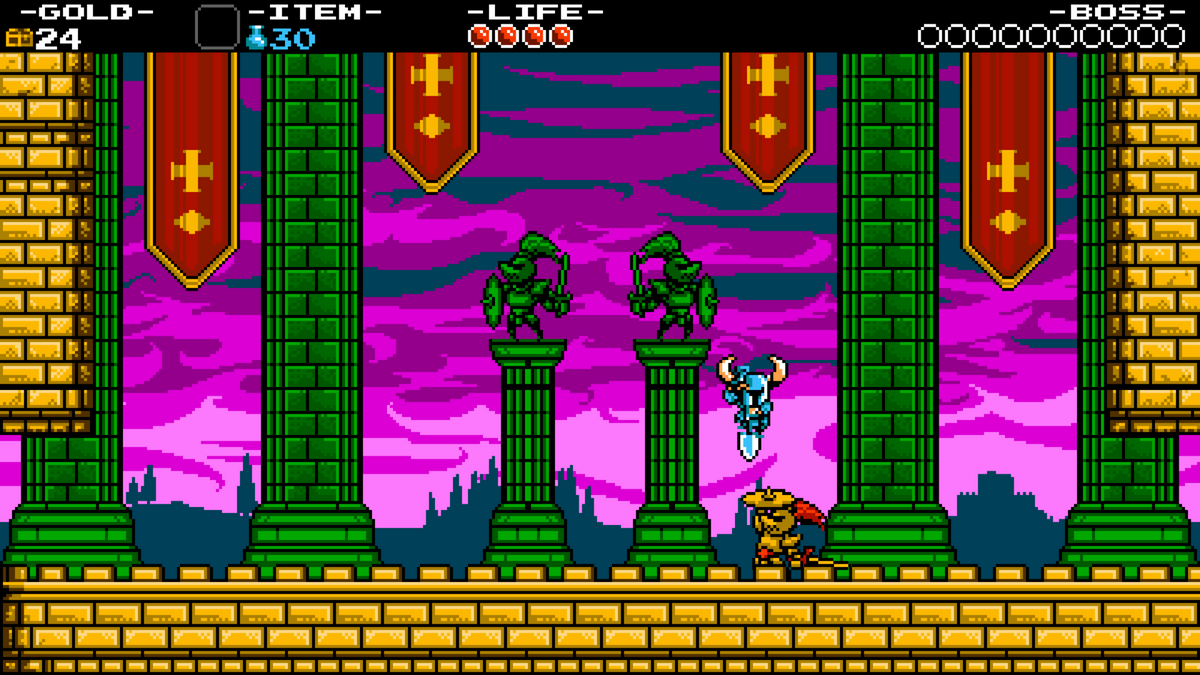
Shovel Knight: Treasure Trove is a collection, not a hands-on review target here. This spotlight looks at how Yacht Club Games kept changing the way its shared world moves.
Shovel Knight begins with a wonderfully plain instruction: jump, then point the Shovel Blade down. That move can hurt an enemy, crack a block, or turn a hazard into temporary footing. It is easy to read in a screenshot and easy to understand with a controller, but it keeps asking a useful question: is the thing below you a threat, a platform, or both?
That is the reason Shovel Knight: Treasure Trove matters more than its deliberately chunky pixels suggest. The package does not merely preserve one 2014 platformer. Yacht Club Games identifies it as the complete edition, with Shovel of Hope, Plague of Shadows, Specter of Torment, King of Cards, and the local multiplayer game Showdown. The remarkable part is how often those games revisit the same world without asking the player to move through it the same way.
The shovel is a movement tool first
In Shovel of Hope, the Shovel Blade is not just a sword wearing work clothes. Its downward strike joins combat and navigation. A beetle can be an enemy on the first pass and an extra bounce on the second. A row of blocks can be a floor until digging through it reveals treasure or a route. The stages train you to inspect the space beneath Shovel Knight as carefully as the ledge ahead.

The checkpoint system adds a second decision. Reaching a checkpoint banks progress, but breaking it yields treasure and removes that safety net. That option does not need a difficulty menu or a speech about risk. It puts the wager in the room and lets the player decide whether a little more gold is worth replaying a stretch after a mistake.
Old-looking does not mean mechanically old
Yacht Club Games built the art, audio, and controls around an 8-bit vocabulary, yet its own feature list also points to detailed animation, layered backgrounds, upgrades, challenge modes, cooperative play, and Body Swap mode. The game looks immediately legible because it borrows familiar shapes and color rules. It feels less like a museum piece because the systems are willing to bend those rules.

That clarity matters when the screen gets busy. Moving machinery, breakable walls, treasure, enemies, and safe ground need to separate at a glance. The best rooms do not hide their rules; they arrange familiar pieces so that executing the route is the challenge. It is the same kind of design confidence that makes Viewtiful Joe's movie effects useful rather than ornamental: the visual identity and the verbs are doing the same job.
The follow-up campaigns change the verbs
The cleverest choice in Treasure Trove is refusing to treat its extra campaigns as character skins. Plague of Shadows gives Plague Knight explosives, bomb jumps, and alchemy. His movement is more volatile, and the official campaign page describes new gameplay, a new story, and remixed content. A room designed around a knight's dependable jump becomes a different problem when momentum comes from controlled explosions.

Specter of Torment pushes in another direction. Specter Knight can glide, climb walls, and attack with a scythe, while his Dash Slash can carry him toward a target. King of Cards makes King Knight leap, Shoulder Bash, and twirl, then adds Joustus as a card-game layer between platforming challenges. The shared setting remains recognizable, but each lead changes what counts as a usable wall, a safe landing, or a way forward.
A complete edition that earns the word complete
Treasure Trove also avoids a common collection problem: feeling like a menu full of minor variations. The campaigns have separate stories and movement identities, Shovel of Hope supports two-player cooperative play, and the package includes challenge modes plus local four-player Showdown. Not every player needs every mode, but the breadth comes from mechanical alternatives rather than a pile of near-identical ports.
Yacht Club Games currently lists Treasure Trove for Steam, Humble, Nintendo Switch, PlayStation 4, and Xbox One. That availability makes it easy to recommend as a design history lesson, but the stronger reason to return is simpler. Its retro presentation is not the point of the trick. The point is how much can happen after a developer finds one satisfying relationship between a jump, a weapon, and the floor, then has the nerve to rewrite it four more times.


