
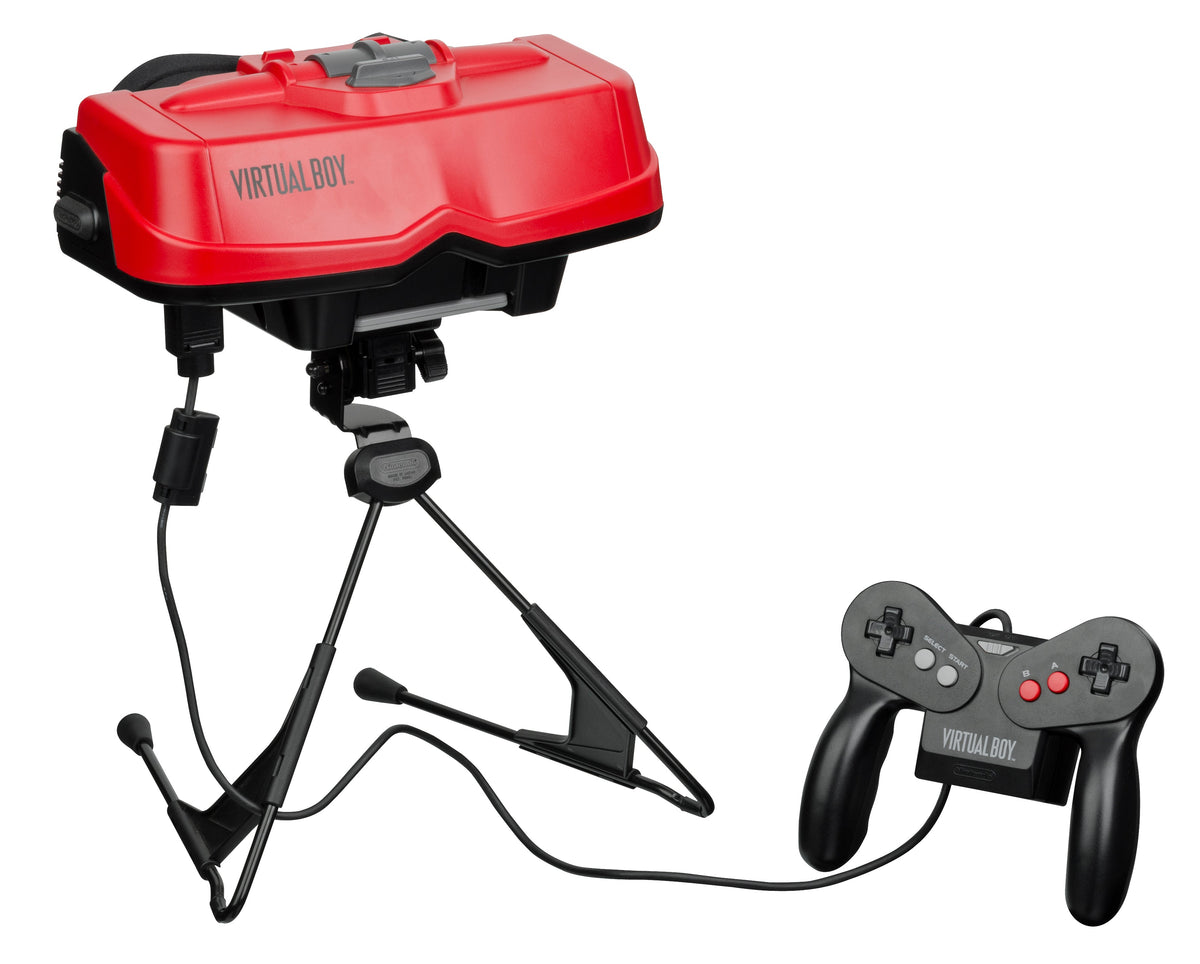
Nintendo's Virtual Boy is easy to flatten into a punch line: red-and-black 3D, an awkward tabletop visor, and a short life. That leaves out the more interesting question. Was it supposed to be the next Game Boy, a full console platform, or an unusual toy with a handful of games? Nintendo's own account suggests that the answer changed depending on who was selling it.
The original hardware arrived in 1995. Players looked into a visor to see separate images for each eye, and the system sat on a stand rather than being held like a Game Boy. It offered a striking effect, but its shape and display also made it a hard fit beside the portable and living-room machines shoppers already understood.
What Virtual Boy promised
Virtual Boy did not simply add a flat 3D gimmick to a familiar handheld. Its two-eye display was the point of the machine. Nintendo's historical account calls it a 32-bit “Virtual Immersion” system, while a later Iwata Asks discussion identifies Gunpei Yokoi, the Game Boy's central creator, as central to its development. The name suggested one family connection; the object on the table offered a very different way to play.
That difference mattered to the games. Red Alarm used a wire-frame look to send a craft through apparent space. Teleroboxer put attacks at different depths. Virtual Boy Wario Land made foreground and background layers part of its platforming identity. Nintendo's current descriptions of these games show that the library was not one repeated tech demo. The hardware asked every game to make its unusual viewing setup worth the effort.

Why the idea struggled as a platform
Shigeru Miyamoto's retrospective is more useful than a single invented cause. He said he thought of Virtual Boy as an intriguing, relatively niche toy, while people inside and outside Nintendo treated it like a successor to Game Boy or a conventional Nintendo platform. His point was about expectations: a curious accessory-like experiment and a machine expected to support an enduring game business are judged very differently. That is his recollection, not a documented statement that one marketing choice alone ended the product.
The software challenge was just as concrete. Miyamoto said the team had aimed at wire-frame spaces, yet many games instead placed two-dimensional images at different depths. He also described the red-and-black picture as disadvantaged while games elsewhere grew visually richer. Nintendo was building Nintendo 64 during the same period, giving shoppers another, very different promise of 3D games. These observations explain the mismatch better than treating every Virtual Boy title as worthless.
The machine's physical posture was part of the problem too. Miyamoto recalled that a player peering into the visor was difficult to present as everyday entertainment. A tabletop stand is not a pocket console; it also does not share a TV with friends watching from the sofa. His retrospective calls Virtual Boy a failure when viewed as a gaming platform, while defending its appeal as a toy. Neither assessment requires a made-up sales figure or a claim about every owner's experience.

What an original owner still has
For a collector, the surviving attraction is the original way the display, visor, stand, controller and game cartridges work together. A listing that shows only a red visor is not the same as a complete playable setup. Ask for clear photographs of the stand and its mounting point, the controller and its power arrangement, the eye shade, and a compatible cartridge. Ask to see the picture functioning through both viewing sides. These are practical inspection requests, not a guarantee that an untested old unit will work.
The underside deserves a look as well: it exposes the bracket and connections, and wear can be visible there even when a seller's front-facing photo looks tidy. Treat the picture below as an example of an original, visibly worn unit, not a claim that every Virtual Boy has this condition. If a sale is for display only, say so in your own buying decision and avoid paying a playable-system premium based on a single glamor shot.

The games returned, but the old hardware did not
As of October 2026, select Virtual Boy games are available through Virtual Boy – Nintendo Classics on Switch and Switch 2 in supported regions. Nintendo says the collection requires Nintendo Switch Online + Expansion Pack and either its replica-style viewing accessory or the cardboard version. Nintendo's accessory FAQ explicitly says the new device replicates the look and experience but is not a reproduction of the old console. It is a viewing accessory for Switch software, not a way to use your original cartridges; neither accessory works with Switch Lite.
That return changes access, not ownership. An original cartridge and machine remain a separate physical collection; the modern catalog is subscription access with different hardware requirements. Nintendo also advises short sessions and breaks if the 3D visuals cause discomfort, without claiming that everyone will react the same way. If the history of later Nintendo hardware interests you, our Nintendo 3DS retrospective and Wii U retrospective follow two very different paths after Virtual Boy.
Virtual Boy's lasting lesson is not that strange ideas must be avoided. It is that a distinctive toy can be fascinating and still struggle when it is presented, bought and supported as a broad gaming platform. The original is worth understanding on its own terms; the 2026 revival finally gives more people a way to examine the games without pretending that the machines are interchangeable.


