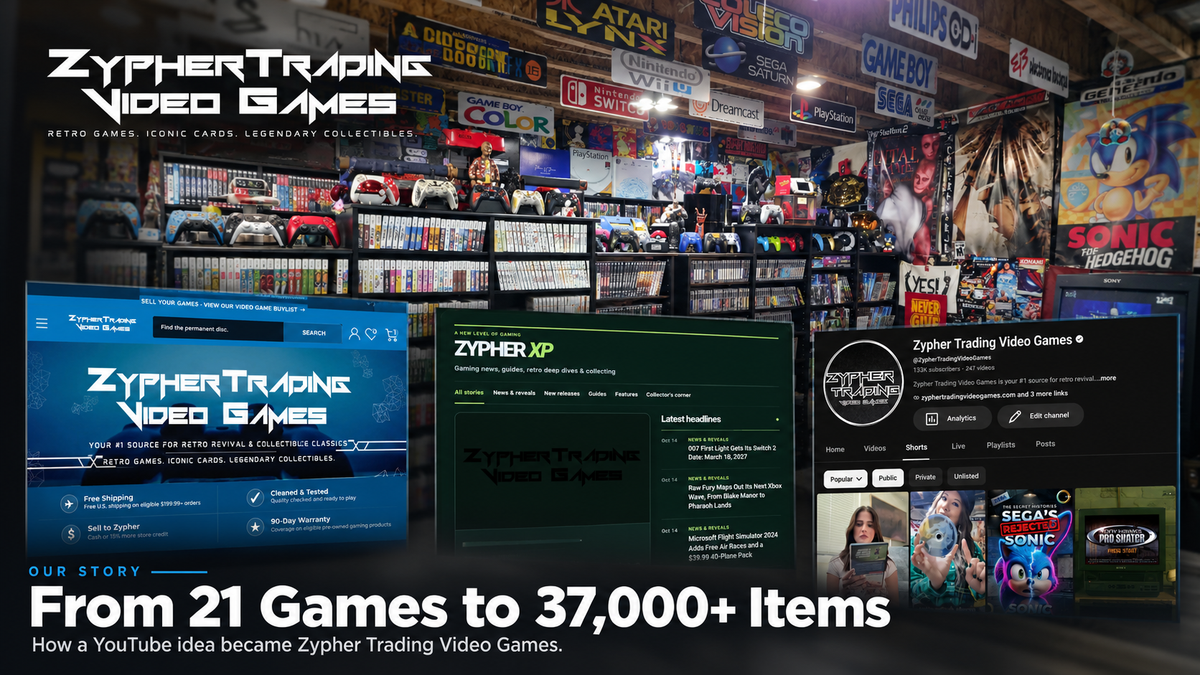
If you looked at Zypher Trading Video Games today, you probably would not guess how it started. There was no warehouse, no investors, no giant inventory purchase, and no five year plan created by people pretending they knew exactly where all of this was going.
On August 20, 2021, Zypher was supposed to be a YouTube channel. I bought an Xbox One with 21 games so I could record gameplay and start making content. After that purchase, I had about $25 left to my name.
I thought I had bought the equipment for a gaming channel. I had no idea I had just bought the first chapter of what would become my life's work.

Gaming has been part of me for as long as I can remember
I did not get into video games because they looked like a good business opportunity. I was playing Sonic the Hedgehog on a Sega when I was about two years old. Some people remember their first bike or the first glove they took to a baseball field. Some of my earliest memories are a blue hedgehog moving across a television screen while I sat there completely fascinated.

That fascination never really left. I remember how proud I was when I bought my first PlayStation 2. Buying your own console feels different when you are young. It is not just another box under the TV. You saved for it, you earned it, and for a little while it feels like the most advanced thing humanity has ever managed to create.
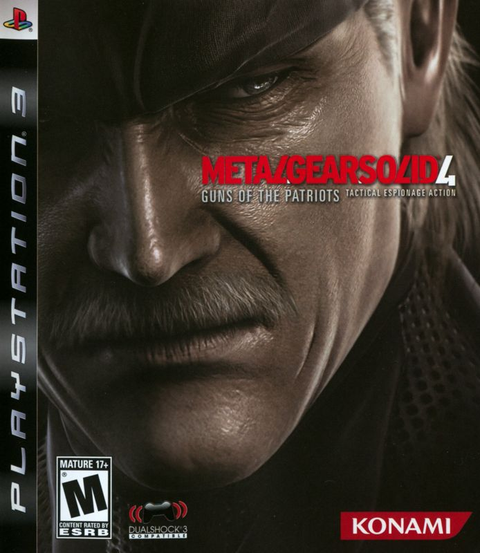
Then came the PlayStation 3. I remember putting Metal Gear Solid 4 into it and being completely blown away. The graphics, presentation, scale, and cinematic feel made me wonder how gaming could possibly get more impressive. Apparently the industry took that as a challenge, because a few years later I spent around twenty hours waiting for the PlayStation 4 launch. A reasonable adult probably would have gone home and slept. I was not interested in being reasonable.

That is what games do. They attach themselves to periods of your life. You remember opening one on Christmas morning, the console you saved for, the friend you always played with, or the boss that almost caused a controller to develop the ability to fly. Sometimes a startup sound or five seconds of music can put you back in a room you have not seen in years.
That history matters because Zypher was never created by somebody standing outside gaming and looking in. I was already the customer. I already understood why somebody might spend thirty minutes browsing old games they have no intention of buying just because seeing them again feels good. I loved gaming long before it ever became a business, and I think that is still visible in almost every decision we make.
The plan changed fast
The original plan was straightforward: play games, record them, make videos, and hopefully build an audience. Then I started selling games, and something clicked. I loved researching them, figuring out what they were worth, learning different versions and releases, cleaning them up, testing them, and wondering what might be hiding in the next collection.
More than anything, I loved the hunt. Anyone who has gone through enough collections knows the feeling. One box might contain something valuable, something you forgot existed, or a game you have not seen since childhood. Sometimes it contains a title with cover art so strange that you have to stop and appreciate the fact that several adults almost certainly approved it before it reached store shelves.

The early sales were small, but they created motion. One sale helped pay for the next purchase. The next purchase created more inventory. More inventory created more orders. I kept putting the money back into the next step because every time the operation grew a little, I could see another version of what it might become.


There was no dramatic moment where Zypher suddenly became a “real company.” Nobody showed up with giant scissors for a ribbon cutting. There was no morning where I woke up and thousands of games had magically appeared. It was messier than that and, in a way, more meaningful. The business grew through shelves that filled up, boxes that needed somewhere to go, customers who returned, collections that showed up at the door, and constant decisions about what to improve next.
At first, every improvement felt huge. A better workspace felt huge. Better equipment felt huge. Being able to buy a larger collection felt huge. Reaching a point where the business needed more organization than one person could keep in his head felt huge. The operation was still small, but it was starting to behave like something that wanted to become much larger.


The YouTube channel had not failed. The idea had simply taken a turn I never planned for. The games themselves had become the opportunity, and I realized I loved being part of the cycle of finding them, restoring them, selling them, and sending them somewhere they could matter again.
Buying used games taught me what not to build
The more used games I handled, the more I noticed everything that can make buying them frustrating. You find the title you want, but the listing barely tells you anything. Was it tested? What does “good condition” actually mean? How scratched is the disc? Is the case intact? Did anybody clean it? Does the artwork look like it survived a flood, a basement, and several poor life choices?
At a certain point, buying a used game can feel less like shopping and more like gambling. You place the order, wait a few days, and hope whoever handled it cared enough to do the basics.
I never wanted Zypher to feel that way. If somebody spends money with us, I want the experience to feel considered from the first click through the moment they open the package. The website should be useful and enjoyable to browse. Product pages should answer questions instead of creating new ones. Condition standards should mean something. The game itself should arrive looking like somebody actually cared.

Our goal is to make each used game as close to like new condition as reasonably possible. That does not mean pretending a twenty year old game can somehow become new again. Some of these things have survived childhood bedrooms, basements, moves, questionable storage bins, and more than one owner. There is only so much time travel we can perform.
What we can control is the work. We clean games, test them, resurface discs when appropriate, prepare them carefully, wrap them in plastic, and include little freebies with every order. None of those things individually reinvent commerce. Together, they tell the customer that somebody on the other side gave a damn.


The packaging matters for the same reason. Maybe somebody finally found a game they have been chasing for years. Maybe they are rebuilding a collection they had to sell when they were younger. Maybe they are about to play something for the first time. Or maybe they watched a video about an obscure PlayStation 2 game at 1:17 in the morning and immediately decided owning it was essential to their continued happiness. We understand that particular disease.

There is anticipation when something you genuinely want arrives at your door. I want opening a Zypher package to add to that feeling, not flatten it. That is why I obsess over things that can look small from the outside. Customers notice when a website is frustrating. They notice lazy product information, dirty games, careless packaging, and customer service that feels like somebody is trying to get rid of them. They also notice the opposite.
That philosophy has become one of the clearest differences between what Zypher is and what it could have been if we had simply focused on moving units. I do not want the company to become efficient at the expense of caring. Efficiency should give us more room to care, not less.
We love the weird stuff too
Of course we love the obvious games. Mario, Zelda, Pokémon, Sonic, Halo, Metal Gear, Final Fantasy, Grand Theft Auto. The classics became classics for a reason. But gaming history would be incredibly boring if the only things that survived were the games everybody already agrees were great.
Give us the weird stuff. Give us the forgotten PlayStation 2 game somebody rented once and has been trying to identify ever since. Give us the random Wii game a family somehow played every weekend for a year. Give us licensed games, failed experiments, annual sports releases, shovelware, and the title reviewers destroyed that somehow became one person's favorite game in the world.
Running Zypher has made something very clear to me: a game's financial value and its emotional value are often completely unrelated. A $300 collectible can be exciting. Of course it can. But sometimes an $8 game matters more because it is the exact game somebody has been trying to remember for fifteen years.
You have seen the descriptions online: “I think you were a robot. Or maybe a knight. There was lava. The cover might have been red.” Fantastic. Extremely helpful. Then somebody figures it out, and suddenly a cheap game nobody was thinking about means everything to one person.

That is why I never wanted Zypher to stock only what collectors currently consider valuable. I want the masterpieces, hidden gems, strange experiments, sports games, movie tie-ins, failures, and titles remembered by approximately twelve people on Earth. They all belong to gaming history.
Every used copy also had a life before it reached us. Somebody bought it new. Maybe they saved for weeks, opened it on a birthday, played it every day after school, or spent an entire summer trying to beat it. Maybe they rage quit on level three and spent the next decade insisting the game was unfair. Eventually life changes, collections move, and sometimes those games reach us.
For a little while, Zypher becomes part of that story. We prepare the game, list it, and send it somewhere new. The next person might be playing it for the first time, buying back something they lost years ago, or introducing their kid to a game they loved themselves. A game can survive long enough to become part of two completely different childhoods. That is freaking cool.
Physical games deserve another life
The video game industry moves fast. Digital storefronts close. Licenses expire. Games get delisted. Servers shut down. Online services disappear. Hardware gets older. Sometimes access to a piece of gaming history can change in a very short amount of time.
Physical games do not magically solve every preservation problem. Modern gaming is complicated. Some releases need updates, some need servers, and some discs or cartridges do not contain everything. But physical media still gives a game something important: a tangible path from one person to another.


A cartridge can sit forgotten in a box for fifteen years and suddenly matter again because the right person found it. A disc can leave one collection and become the missing piece in another. A parent can put the exact game they loved into the hands of their kid. That ability to move across time and ownership is one of the reasons I care so much about the physical side of gaming.
Even terrible games deserve another chance. Honestly, the terrible ones might be some of the most important. Future generations deserve proof that we really did pay full retail price for some of this stuff.
More than 80,000 orders later
When Zypher was tiny, there was no such thing as an insignificant order. You noticed every sale. A repeat customer meant something. A review meant something. Somebody trusting us with a collection meant something. As the company grew, everything naturally started becoming larger numbers: order volume, inventory, revenue, shipping times, conversion rates, support tickets.
Businesses need those numbers. We do too. The danger is letting the numbers replace the people behind them.

Zypher has now fulfilled more than 80,000 orders, earned a 4.96 out of 5 star rating, and received more than 15,000 five star reviews. I am proud of those numbers, but not because they look good in bold type. I am proud because more than 80,000 times, somebody chose to trust us with an order, and more than 15,000 times somebody cared enough about the experience to leave five stars.

I never want that trust to become background noise. An order number is still a person on the other side of the screen. They had options. They chose us. Sometimes it is a cheap game. Sometimes it is a rare collectible. Sometimes it is a gift for somebody else. Whatever the dollar amount is, the expectation is the same: deliver what we promised and care about what happens afterward.
I also refuse to pretend every order has gone perfectly. Games can fail. Older hardware can behave unpredictably. Shipping carriers occasionally decide a package deserves a scenic tour of America. People make mistakes, and we make mistakes too. Any company claiming nothing ever goes wrong is either lying or has shipped approximately three orders.
What matters is what happens next. Customer service is easy when everything goes perfectly. You find out what a company actually believes when something does not. I want customers to know there are real people behind Zypher who will care about fixing the problem instead of hiding behind a ticket number.
What Zypher is today
Sometimes I have to stop and look around because my brain is usually focused on whatever needs improving next. Today, Zypher has a team of six people and more than 37,000 items available to purchase. The scale is almost unrecognizable compared with the early rooms in this story.


The coolest part is that the original idea never completely disappeared. The YouTube dream eventually came back around. Zypher now creates content on YouTube, Instagram, and TikTok. What began as an idea to play games and make videos ended up taking the longest possible route back to becoming exactly that too, only attached to an entire company now.

We have also built what we believe is an industry leading video game Buy List. Selling a collection should not require fifteen emails, mystery math, and a prayer. We want people to be able to see what we are paying, build their list, choose cash or store credit, and understand the process.

Then there is Zypher XP, our gaming news, guides, retro, collecting, and editorial expansion. It gives us a place to talk about the hobby beyond whatever happens to be for sale. New releases matter. Old games matter. Preservation matters. Weird gaming history matters. If Zypher is supposed to feel like a place built by gamers, then there should be something worth reading there even when you are not buying anything.
We are expanding beyond games into sports and trading cards too. It is another corner of collecting built around the same thrill: the hunt, nostalgia, finding the thing you were looking for, and occasionally convincing yourself that opening one more pack is a financially sophisticated decision.

We have even started building out official Zypher merch. That is a smaller part of the company, but seeing the logo on something somebody actually wants to wear is still surreal to me. There was a time when Zypher was just a name on a screen. Now people wear it.

The technology behind the experience
Behind the scenes, Zypher today is a completely different animal. We use industry grade refurbishment equipment and supplies, specialized tools, catalog systems, automation, data, and technology that I could not have imagined having access to when this started.
There is far more going on behind a used video game order than most people would ever need to know, and that is fine. The customer should not have to care about our systems. The systems should care about the customer.


I am not mentioning the technology because I expect anybody to be impressed by a machine, database, or piece of software. Nobody opens a package, discovers the wrong game, and thinks, “Well, at least their backend architecture is probably incredible.” Technology is only useful if it creates a better experience.
For us, that means keeping a huge catalog organized, improving product data, making refurbishment more consistent, catching problems sooner, tracking inventory more accurately, finding games faster, responding to customers more efficiently, and giving our team better tools to do the work. Every little system is supposed to remove friction somewhere else.
And we keep reinvesting. Money goes back into inventory, equipment, technology, people, systems, content, and new categories. There is always something else we can improve. Some improvements are obvious, like better equipment. Others are invisible, like a process that saves thirty seconds on something we do thousands of times. Those seconds eventually become hours that can be spent doing something better.
I do not want Zypher to reach a comfortable point and start coasting. Comfort is dangerous when you are trying to build something exceptional. I want us to keep raising the standard until the experience customers get from Zypher becomes what they expect from the rest of the industry.
This is my life's work
There is one number that probably explains my relationship with Zypher better than any sales metric ever could. The company has existed for about 62 months, and in that time I have taken three days off.
I do not say that because anybody owes me something for it. They do not. I chose this. I say it because “I work hard” does not really explain what Zypher has been in my life. There have been mornings when it was the first thing I thought about and nights when it was the last. There have been problems I went to sleep thinking about and solutions I woke up wanting to try.


There have been orders to pack, collections to buy, systems to rebuild, mistakes to fix, products to improve, equipment to learn, people to train, ideas to test, and plenty of moments where the easiest answer would have been, “That is good enough.” I hate good enough. There is always another level.
That kind of obsession has a cost. Building anything meaningful does. But it has also given my life a kind of direction I did not have when this started. I get to wake up and work on something that connects directly to something I have loved for almost as long as I can remember.


And that is where the emotional part of this really lands for me. Games become attached to people's lives. They end up connected to childhoods, friendships, siblings, parents, late nights, houses, holidays, and moments somebody may not realize are important until years later.
Every game we send out has a chance to become part of somebody else's story. Maybe it is simply entertainment for a weekend. Maybe it becomes a favorite. Maybe somebody is replacing a copy they lost years ago. Maybe a parent is buying a game for their kid, and that kid is about to make a memory they will still talk about thirty years from now.
Gaming has given me memories for essentially my entire life. Now my life's work gives me the chance to help other people create theirs. I do not take that lightly. I consider it an honor.
The video game store I always wanted to exist
If I had to explain the goal in one sentence, it would be this: I want to build the video game store I would want to shop at.
I want the massive selection. I want expensive collectibles sitting beside the $8 game somebody simply loves. I want famous games and weird games, the title somebody has been hunting for years and the one they completely forgot existed until they saw the cover again.

I want the games tested and clean. I want condition standards to actually mean something. I want product pages that help instead of creating confusion. I want the website to be fun to explore. I want opening the package to be part of the experience. I want the plastic wrapping and the little extras. I want somebody placing order number twenty to feel appreciated just like the person placing their first one.
I also want somebody who has a problem to know we are going to care. That part is easy to say in marketing and much harder to live when something breaks, a carrier loses a package, or a human makes a mistake. That is precisely why it matters.

Zypher is not built around one giant gimmick. It is thousands of little decisions. Thousands of details. Thousands of times asking the same question: how can we make this better?
This is normally where a company starts talking about “customer centric solutions,” “industry leading service,” and its “commitment to excellence.” I would rather walk barefoot across a room full of loose Lego pieces.
The real answer is simpler. Choose Zypher because we actually love this stuff. We know an $8 childhood favorite can mean more than a $300 collectible. We understand why somebody can browse old games for thirty minutes without buying anything and still have a great time. We understand why receiving a used game can still be exciting. The experience matters because the games matter to the people buying them.
We are only getting started
One of my favorite pieces of full-circle proof is sitting inside Zypher today: our YouTube Silver Creator Award. The channel that once existed only as an idea eventually passed 100,000 subscribers. The route there made absolutely no sense compared with the plan I had in my head in 2021, which is probably the most accurate summary of this company possible.

I am proud of what Zypher has become, but I do not feel finished. I do not even feel close to finished. There are more games to find, more collections we have never seen, more customers we have not met, more categories to build, more stories to tell, and more parts of the experience that can become better than they are today.
There are ideas sitting in my head right now that probably sound excessive. That has happened before. Some of the things we take for granted inside Zypher today started as ideas that would have sounded ridiculous when the company was smaller.
I want the Buy List to keep getting better. I want Zypher XP to keep growing into a real destination for people who love gaming. I want our social channels to keep reaching people who may never have heard of us otherwise. I want the catalog deeper, the technology smarter, the refurbishment better, the packaging better, and the experience more polished without ever losing the personality that made the company worth caring about in the first place.
Most of all, I want growth to make us better instead of making us generic. Bigger should not mean colder. More orders should not make individual orders matter less. More technology should not make us feel less human. More inventory should not turn games into meaningless SKUs. The challenge is to grow without losing the reason we started caring so much in the first place.
I have put everything I have into Zypher. After all of the orders, shelves, equipment, mistakes, wins, long nights, and unexpected turns, I still get excited thinking about what comes next.
Somehow, after everything we have built, I still feel like we are only getting started.

Keep exploring: shop Zypher, read Zypher XP, sell games with the Zypher Buy List, shop Zypher merch, or watch us on YouTube.
Thank you,
DJ
Owner of Zypher