

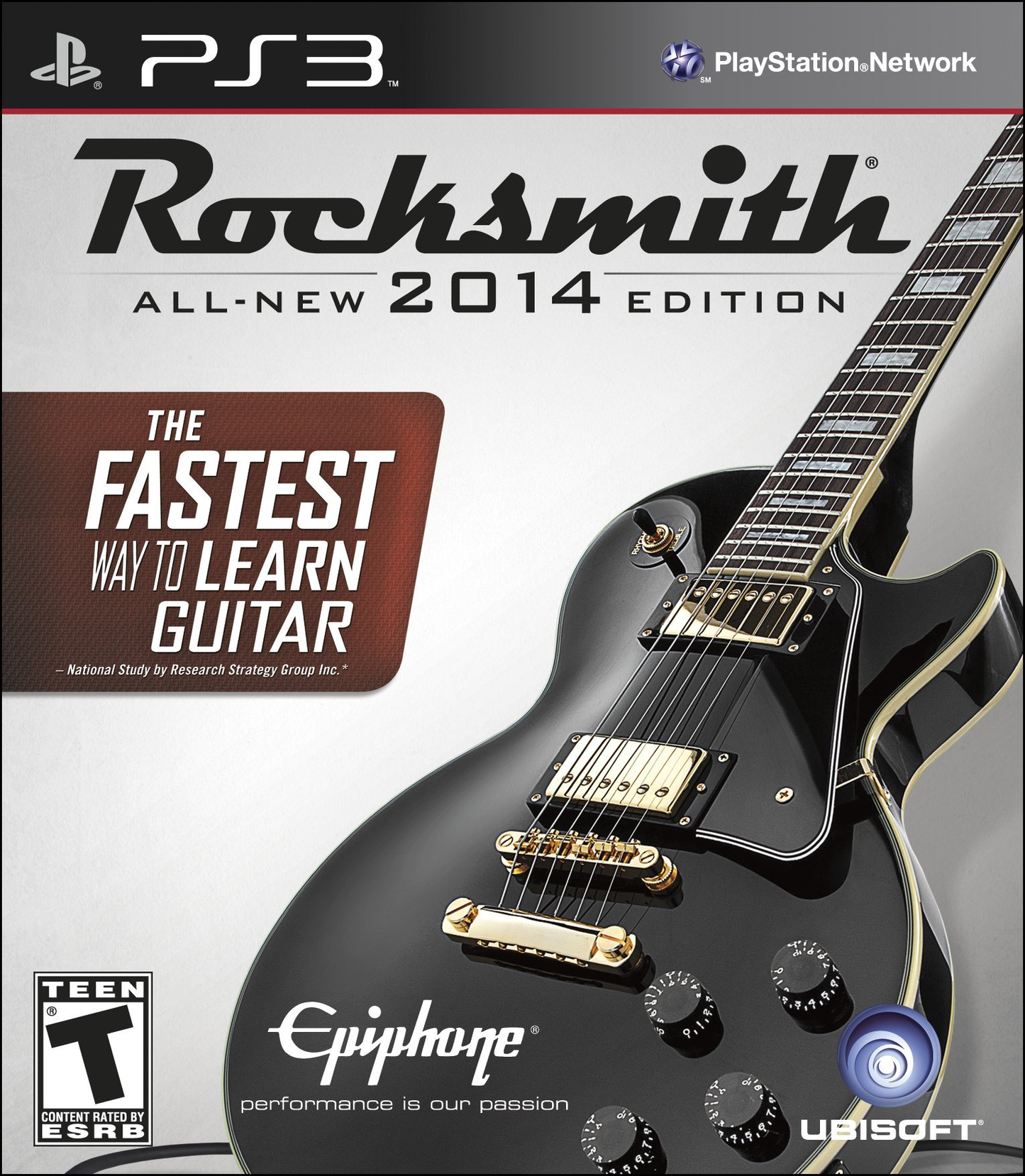
Rocksmith: All-New 2014 Edition
About the Game
Rocksmith 2014 is the sequel to Rocksmith . As its predecessor, it is a music game which uses an actual electric guitar as a controller, but now designed more as a learning tool than a game. The gameplay is essentially the same: notes are shown floating on a board towards an overlay of the guitar's fingerboard near the bottom of the screen and players must hit them as they reach it. The presentation, though, is different: there is no more a "journey" mode where players progresses through events with set lists organized by difficulty.
Gameplay & Core Systems
Songs can be chosen in no particular order, but the game will recommend songs in a specific progression to help beginners to learn how to play the instrument. The game will also recommend specific lessons or techniques to be learnt or practiced, judging by the players' previous performance. While playing a song, players can enter a mode called "Riff Repeater", where specific parts of the song can be chosen and repeated until mastery. There are several options in this mode, like setting a starting difficulty or speed; once players reaches mastery in this level of difficulty or speed, the game will level up, increasing the difficulty or speed. Number of repetitions, error tolerance and the ability of viewing previous mistakes are also available.
Standout Features
- Songs can be chosen in no particular order, but the game will recommend songs in a specific progression to help beginners to learn how to play the instrument.
- While playing a song, players can enter a mode called "Riff Repeater", where specific parts of the song can be chosen and repeated until mastery.
- The band has A.I. and is responsive to how the music is being played, so depending on the intensity or speed of the notes being played, it will follow players.
- Lessons: here players can access lessons from the simplest ones like holding the guitar or the pick to more advanced ones two-hands or harmonics techniques.
- Gone Wailin', a volume dynamics forced side-scroller; String Skip Saloon, a string skipping game with an old-west shooter theme; Ducks ReDux, a duck shooting fretting game; Ninja Slide N, a game where players controls a ninja slicing ghosts with slides; Scale Warriors, a beat'em up scales game; Return to Castle Chordead, a chords rail shooter resembling House of the Dead ; Hurtlin' Hurdles, a tremolo game with an Olympiad theme; Temple of Bends, a bends platformer; Scale Racer, an arcade racer game for practicing scales; Star Chords, another chords rail shooter, now with a sci-fi theme; Harmonic Heist, a game where players controls the movements of a thief in a museum with harmonics.* Multiplayer: two players can play co-op in this mode (two Real Tone cables are needed).
- Tone designer: an assortment of guitar amps and pedals is available so players can create their own tone.
- As its predecessor, it is a music game which uses an actual electric guitar as a controller, but now designed more as a learning tool than a game.
- The gameplay is essentially the same: notes are shown floating on a board towards an overlay of the guitar's fingerboard near the bottom of the screen and players must hit them as they reach it.
Modes & Ways to Play
While playing a song, players can enter a mode called "Riff Repeater", where specific parts of the song can be chosen and repeated until mastery. There are several options in this mode, like setting a starting difficulty or speed; once players reaches mastery in this level of difficulty or speed, the game will level up, increasing the difficulty or speed. Session mode: in this mode players jams with a virtual band. Nonstop play: in this mode players create a set list of one or more songs and plays them in sequence, with no intervals between them (except for tuning when needed).
Presentation & Atmosphere
There are several options in this mode, like setting a starting difficulty or speed; once players reaches mastery in this level of difficulty or speed, the game will level up, increasing the difficulty or speed. players selects number and kinds of instruments to play with, the music genre, key, scale (pentatonic minor, for instance), tempo and complexity. The band has A.I. and is responsive to how the music is being played, so depending on the intensity or speed of the notes being played, it will follow players.
