
A character sheet can look like homework until it changes the conversation you are about to have. In Baldur's Gate 3, deciding who you are is part of deciding how you get through trouble. A background, a class and a companion are not just boxes to finish before the adventure starts.
Larian's party RPG reached its full PC release on August 3, 2023, after entering Early Access in 2020. Its lasting appeal is easier to understand through the connections between its systems than through a list of things it contains. This is a researched design spotlight, without a claim of a new hands-on playtest or story spoilers.
Start with a person, not a perfect build
In Larian's explanation of character reactivity, class, ancestry and background affect responses and opportunities during the adventure. Background goals also reward actions that fit the identity you chose. The opening decisions have a job beyond determining which weapon looks appropriate.
That makes a useful starting question: what sort of person would you enjoy committing to when the answer is inconvenient? An interesting role does not need to be an ideal spreadsheet. A character with a clear point of view gives you a reason to choose between options even before you know which one produces the tidiest reward.

The same build follows you into a conversation
Lead systems designer Nick Pechenin's official build discussion connects character choices to more than damage. A Barbarian can bring class-specific forcefulness into dialogue. A Charisma-focused Warlock can act as the party's speaker, while a Rogue's strengths include deception and getting into places that were supposed to stay closed.
These are different ways of expressing a role, rather than a promise that one class solves every encounter. Our reading is that the interesting design move is continuity: the person you built for a fight is still present when somebody asks a difficult question. The character sheet is not packed away when the camera moves closer.

A battle asks you to read the space
The developer's game description identifies turn-based combat built on D&D's fifth-edition rules, with advantage, disadvantage and environmental interactions. Exploration includes jumping, climbing, shoving and sneaking. The map therefore matters as a physical space, not simply a backdrop behind the next attack animation.
For a newcomer, the useful habit is to inspect the position before chasing the largest damage number. Where can this character move? What changes if the party approaches from somewhere else? That is a way of thinking about the documented tools, not a guaranteed solution or an instruction to push every stranger off a ledge. Fantasy diplomacy has enough problems already.

Make the controls show you the possibilities
The PS5 adaptation provides another view of the same complexity. Larian's controller explanation describes customizable radial menus for actions, spells and items, alongside access to the journal, character sheet, rests and camp. It also explains a tactical camera view, Dialogue History and a cursor mode for more precise selection.
Those details suggest a better first-session goal than memorizing an entire ruleset: learn where to find your options. Arrange a useful radial, inspect an unfamiliar action and check a conversation you have lost track of. Complexity becomes less intimidating when retrieving information is part of the routine, rather than a separate emergency.
Your party is more than extra attacks
Larian's companion overview distinguishes playing an authored Origin character from recruiting one. Companions bring their own backgrounds and attitudes, and their relationships respond to your decisions. Camp connects that company to the journey between encounters.
This is why choosing company can feel different from filling vacant combat roles. The practical question is not only what an ally can do, but whether you want this particular person along while making the next decision. A party can be tactically convenient and socially complicated at the same time.

Return to the campaign that exists now
Old launch guides need context. Patch 8 arrived on April 15, 2025, adding cross-play, Photo Mode and twelve subclasses. Larian described it as the final major content patch, while leaving room for bug fixes. Those additions are not a newly announced expansion or a reason to treat every 2023 feature count as current.
If friends are joining across platforms, use Larian's cross-play instructions to check linked accounts, game settings and the campaign save before arranging the session. The appeal remains the same: a character becomes interesting through the decisions you keep making with them. You do not have to finish designing that person before you start playing.
For another approach to consequences, read our Fable reputation feature. Our Battle for Wesnoth spotlight examines a different relationship between a party's survival and its continuing campaign.
Watch Larian's original launch trailer
Watch Baldur's Gate 3: Launch Trailer on Larian Studios' official YouTube channel, published August 3, 2023. This is historical launch footage, not a new update trailer. YouTube may show advertising or require sign-in or age verification.
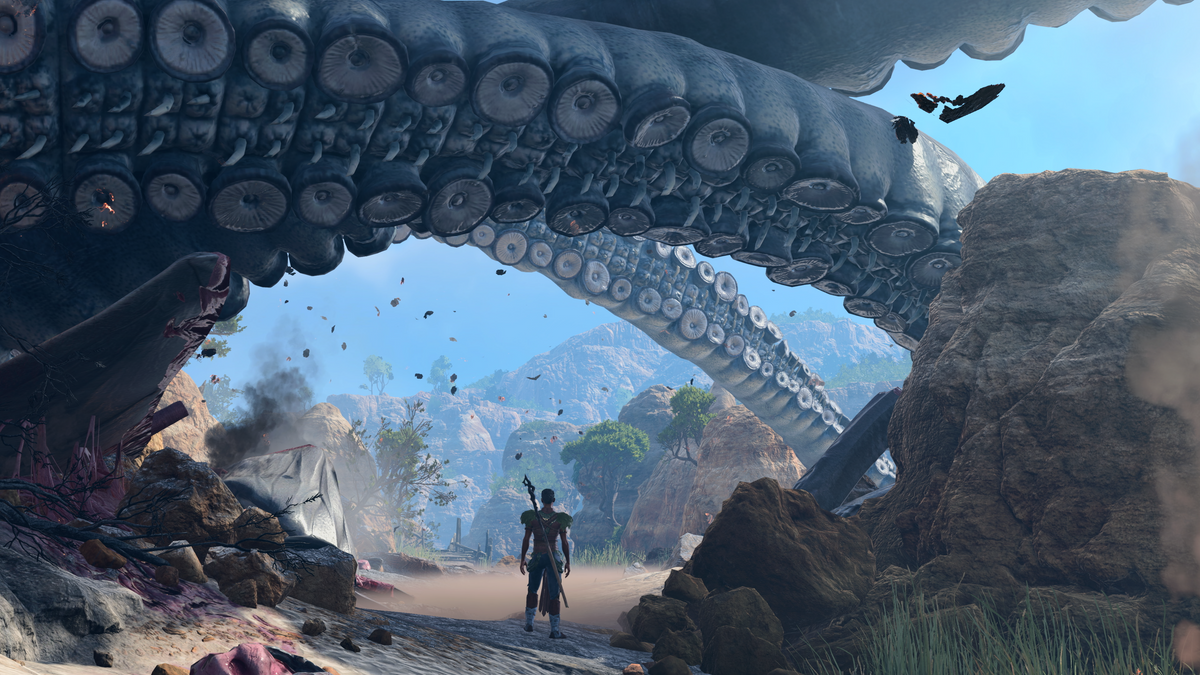
Research checked October 18, 2026. Featured image: a character beneath a vast tentacle at a wreck-strewn shore. All five images are unchanged PC-era screenshots supplied in Larian's Release Day Press Kit through its official press area, linked by the studio's September 2023 press release. © Larian Studios / Wizards of the Coast. Independent editorial coverage; not sponsored or endorsed by either company. Images do not document Zypher testing or the current patched interface.


