
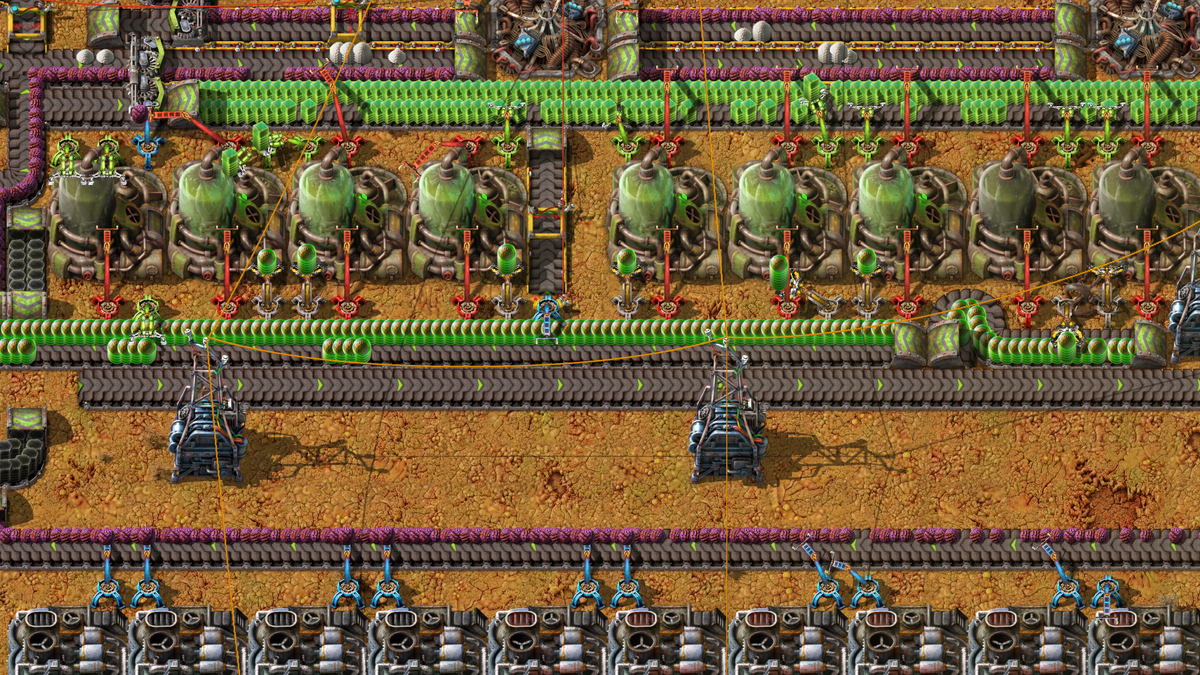
A chest full of ingredients usually looks reassuring in Factorio. On Gleba, it can also be a chest full of ingredients quietly running out of useful life. Space Age's spoilage system changes the question from how much you stored to whether the next machine will use it in time.
This guide covers the Space Age expansion on PC, which requires ownership of base-game Factorio. The current official wiki provides the spoilage rules below; Wube’s June 2024 development post supplies historical context. Screenshots come from the official Space Age press kit.
The clock travels with the item
The official spoilage documentation makes the important point that a belt or chest does not pause the process. Items can spoil in machine inventories and even while held by an inserter. Moving a vulnerable product into a more impressive container is not refrigeration.
Begin by finding where a product waits. Is it collecting before the next recipe, backing up after a machine, or sitting through an oversized delivery cycle? A longer belt and a larger buffer can both increase the time between creation and use.
Our recommendation is to diagnose that waiting before adding production. More output is useful when the next step can consume it. If the line is already holding goods until they expire, another machine can make the same waste problem arrive faster.

Different products have different deadlines
Spoil times belong to individual item types. At normal quality, the current table gives nutrients five minutes and bioflux two hours. Agricultural science packs have a one-hour spoil time. Those are not interchangeable planning windows.
That makes a single rule such as keeping everything nearby too crude. A short-lived intermediate deserves particular attention to the next consumer. A longer-lived product may tolerate a different route, though its age still matters when it becomes an ingredient or a science pack.
Check the quality of the actual item as well. The official documentation says quality extends spoil time. Do not compare a higher-quality stack with a normal-quality table entry and conclude the entire mechanic has stopped behaving consistently.

Crafting is not a universal freshness reset
Freshness can pass from spoilable ingredients into a spoilable output. The documentation describes direct transfer for a single spoilable input and averaging when multiple spoilable inputs contribute, while also identifying recipe-specific exceptions.
The practical consequence is to inspect ingredients before blaming the final transport leg. If an output is already old when it leaves the machine, the problem began earlier. Shipping that product faster can help, but it does not erase the time its ingredients already spent waiting.
Likewise, combining stacks averages their freshness. Adding a few fresh items to a large old stack does not make the entire pile new. Keep that in mind when deciding whether a buffer is preserving a useful flow or merely mixing different stages of decline.

Waste needs a working exit
Many organic products become the spoilage item. Machines handling spoilable ingredients or outputs have trash slots for the results, and a full waste path can stop useful work. The official mechanics page describes output inserters removing those items and the need to filter for trash where appropriate.
Build the removal route as part of the line, not as an apology added after the first jam. Follow the waste to its destination and check that the destination can keep accepting it. A belt that ends in another full container has relocated the problem.
Spoilage itself can be useful. The official item page describes converting it to nutrients in an assembling machine 2 or better, a route that does not require a nutrient-fueled biochamber. Treat that as a possible role for the material, not a claim that every waste stream should use the same layout.

Science can lose value before it disappears
Agricultural science packs have an additional consequence: declining freshness reduces the research value they provide. The official mechanics example says a half-fresh pack is consumed twice as fast without producing extra science, leaving half the value of a fully fresh pack.
That means counting delivered packs is an incomplete performance measure. Look at their condition when they reach the labs, and examine the delays between production, shipment and use. A delivery can arrive successfully and still be less useful than its item count suggests.
Labs also need a way to remove spoilage. The wiki specifically notes that the pass-through behavior used for science packs does not pass spoilage onward. A tidy row of labs therefore still needs a deliberate waste-removal plan.

Test the whole route, including a slowdown
After the line works, observe what happens when demand falls or the next stage backs up. Look at the oldest waiting goods, the waste exits and the condition of science arriving at its destination. Those observations show whether the layout can recover from an interruption.
Gleba asks you to find a different balance: enough material available to keep working, but not so much aging in the wrong place that storage becomes the main activity. A line that recovers cleanly from a slowdown is worth more than one impressive screenshot of full belts.
Give the next product somewhere useful to go, and give its spoiled replacement somewhere to leave. Then the buffer can earn its floor space.

Find your next game at Zypher
Browse games at Zypher Trading Video Games for your next shelf addition. Check the platform, edition, selected condition and included items on each listing before buying.
Making room on the shelf? Check Zypher’s Buy List and sell your old games.
Sources and image credits
- Official Factorio Wiki: spoilage mechanics
- Official Factorio Wiki: spoilage item and uses
- Official Factorio Wiki: agricultural science packs
- Wube: Friday Facts 414, historical design account
- Wube: Space Age press kit
- Wube: website asset permission
- Wube: Space Age ownership and supported platforms
Sources checked November 16, 2026.


