
Cloud showing up in another Final Fantasy game is hardly a shocking development. Cloud changing how you build a party member is the part worth paying attention to.
PlayStation's October 20 preview of Final Fantasy Resonance explains how its Visions system turns returning characters into equipped companions with abilities, stat benefits and their own progression. The preview lists 26 companions across the game and dates the PS5 launch for October 22. This is a closer look at an already announced game, with new detail about what those familiar faces actually do.
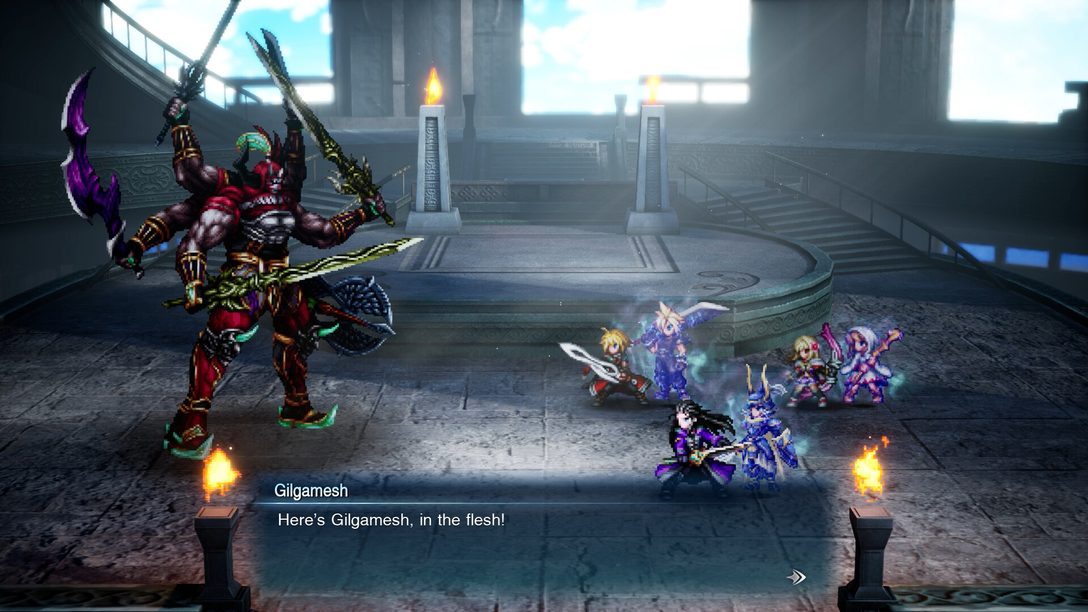
Featured image: Gilgamesh confronts the party in an official Final Fantasy Resonance screenshot. Game imagery: Square Enix, via the linked PlayStation Blog preview. Image unaltered.
The cameo has a job to do
Visions are found through crystal shrines in Lapis. PlayStation contributor Corey Brotherson describes short character introductions, clips and questions before a Vision becomes available to equip. The roster reaches from the original Warrior of Light to Lightning and Sephiroth, alongside characters originating in Final Fantasy Brave Exvius.
Equipping one grants access to a starting set of attacks, magic and passive benefits. Winning battles earns mastery points that open further bonuses and character-specific skills. Zidane's progression, for example, includes stealing and a later ability that can add damage to the attempt. Apparently, taking someone's belongings can also be a career development plan.

Your party role can stretch
The useful distinction is how a Vision interacts with the character wearing it. Brotherson's example pairs Lasswell, whose Breaker role focuses on staggering enemies, with Medic Leah. That combination gives him healing and the option to pass his turn to another ally. Pairing him with Cloud instead pushes his offensive capabilities further.
Our takeaway is that the interesting choice may be whether to reinforce a specialist or cover a weakness. A stronger attacker and an emergency support character solve different problems. Recognizing the guest character is the nostalgic part; deciding what your party needs gives that recognition a practical purpose.
The preview also describes affinity growing as a party member uses a Vision. Collecting magicite and visiting the Moogle of Light can raise a Vision's base rank to open more abilities. Those are separate reasons to pay attention to development over time, rather than judging a companion only by the first skill it offers.
The big finisher still gets its moment
When all opponents have been staggered, the system offers a cinematic Resonance attack from an equipped Vision. Cloud's Ascension is the example shown in the preview. The flashy payoff therefore sits alongside the ongoing build decisions, instead of being the companion's entire contribution.
Espers fill the more conventional summon role and can join battles for a limited number of turns. Keeping those two systems separate makes the announcement easier to read: an equipped Vision affects a party member's options and growth, while an Esper enters combat temporarily.

What this tells us before launch
Square Enix's original announcement describes this as an extensively rebuilt adaptation of Brave Exvius's first story arc, presented in HD-2D. Its October 22 release also includes Nintendo Switch, Switch 2, Xbox Series X|S and PC. The PlayStation preview focuses on the PS5 version; it is not an exclusivity announcement.
For players following the October 22 PS5 release, the new information gives a clearer question to bring into the game: which companions complement the party you want to build? The announcement establishes the systems and some examples. It does not establish how balanced every combination will be across a full playthrough.
We have not played the final game. This report draws on the official preview, with our interpretation labeled above. For the wider launch calendar, see our October 19-25 release roundup.


