
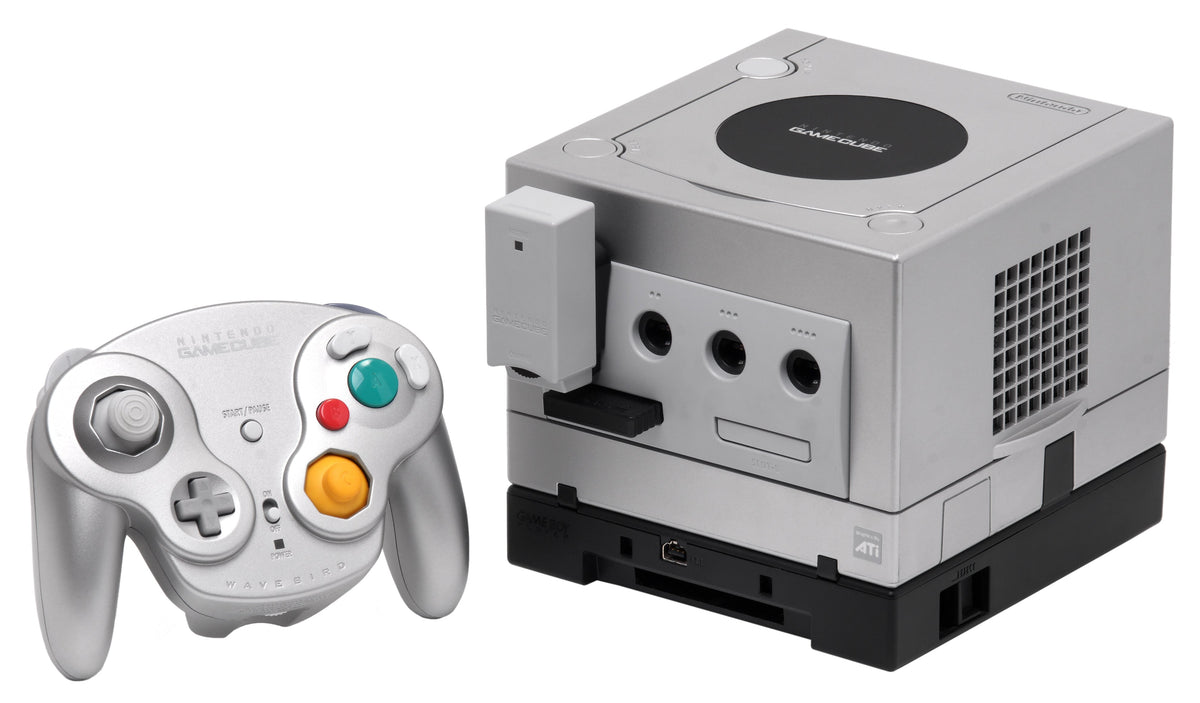
The Game Boy Player gave the GameCube a basement apartment for handheld cartridges. Attach the accessory underneath the console and a collection associated with small screens suddenly had a place beside the television. Nintendo had found another use for that famously square little machine. Apparently, being a lunchbox with a handle was not enough.
The interesting part is what that changed about owning the games. A handheld cartridge could become something you played from a sofa, using a different controller and a much larger display. The cartridge was still the object you needed. The room around it, and the equipment making it useful, had changed.
Featured photo: Evan-Amos, public domain; unaltered. The pictured accessories illustrate one assembled setup, not an original retail bundle or a Zypher stock listing.
A home-console accessory with a handheld library
Nintendo of America's June 23, 2003 launch release, preserved by Nintendo World Report, presented the Player as a way to bring Game Boy games onto a television through GameCube. It described regular GameCube and WaveBird controls, with a Game Boy Advance connected by a separate cable as another option.
That is a different idea from buying a new edition of an old game. The appeal was access to cartridges an owner might already have, in another setting. A handheld collection could stay relevant when the preferred place to play changed. For a collector, that makes the Player interesting as an accessory that expands the use of software, rather than as another shelf of software to acquire.

The disc that looks like an extra is not an extra
In Nintendo's original setup, the Start-up Disc is required. The accessory attaches through the High Speed Port underneath GameCube, while the disc goes in the console. A loose Player and a complete original setup are therefore different purchases. The disc is not optional paperwork with a shiny surface.
This is where collecting the object and collecting its intended function can part company. A clean-looking unit may be perfectly suitable for display while leaving a buyer short of what they need to use Nintendo's documented arrangement. A photograph of the black base cannot demonstrate that a disc is included, readable or appropriate for the console being sold with it.
Ask the seller to identify the actual included disc and demonstrate the setup, rather than treating a generic product photograph as evidence. Keep working original components together when possible. That is a useful preservation habit without turning this article into a price prediction or a guide to unofficial boot methods.
Moving to the television also moves the controls
A bigger screen does not automatically mean the same experience, only larger. The way you sit, hold the controller and reach familiar inputs becomes part of the choice. Someone attached to the feel of a handheld has a different reason to consider the Player from someone who wants a standard console controller in their hands.
Nintendo's manual allows a Game Boy Advance to act as the controller through the GameCube-GBA cable. For that arrangement, the handheld's cartridge slot must be empty. The cable goes into a GameCube controller socket; it is not the same connection as the Player's front EXT port.

Those two uses should not be mixed up just because both involve a handheld and a cable. Multiplayer arrangements depend on the particular game's instructions and appropriate link equipment. More GameCube controller sockets do not, by themselves, turn a single-player cartridge into a four-player party. An accessory can do several clever things without performing miracles on request.
Television play is a choice, not a universal upgrade
The Player's menu offers frame, screen-size, controller and filter choices. Nintendo also cautions that some original Game Boy games can have display or sound issues, and that tilt, rumble and infrared cartridge features are exceptions. Check the particular game rather than translating a broad compatibility claim into a promise about every function.
That matters most when a game's personality depends on something physical. A feature built around moving or feeling a cartridge is not merely a picture that needs another display. Preserving a library means noticing those differences, not insisting that one device must replace every other way to use it.

Likewise, a television is not a reason to stretch the image until every available inch is occupied. Start with the intended proportions and evaluate the display options for the game. This article offers no claim that a particular modern TV, converter or cable will eliminate softness or delay. The Player's role and the rest of the display setup are related questions, not identical ones.
Why it still earns a place in a collection
The Game Boy Player makes the most sense when television play is something you actually want. It is less persuasive as a compulsory purchase made because a collection feels incomplete without every accessory. Decide whether the change of setting appeals to you before deciding that an empty space underneath a GameCube is a personal emergency.
For owners who do want that setting, the result is a distinctive relationship between two Nintendo families. The GameCube supplies the home-console setting and controls, while the cartridge collection supplies the reason to use it. Preserve the original startup components, understand the particular game's limits, and judge the setup by what you intend to play.
Our Game Boy handheld compatibility guide covers the different portable alternatives. For the television side, the retro video connection guide explains how to plan the display path. The Player is a good reminder that an old game can gain another place in your life without needing to become a different game.
Research and exact photo permissions checked October 19, 2026. Setup details follow Nintendo's US Game Boy Player instruction booklet, linked from its official manuals index. Historical launch context comes from Nintendo's dated 2003 release. This is a research-based feature, not a claim of hands-on testing.


