
A paper clip can be a prize. A chair can be a wall. A room can feel enormous, right up until the game gives you a reason to look at that same room differently.
Katamari Damacy makes progress unusually tangible. You push a sticky ball, gather objects, and become large enough to gather something that stopped you moments earlier. The joke keeps getting bigger because your relationship with the world keeps changing.
Namco's 2004 PlayStation 2 game remains a remarkable example of how far one strong idea can travel. Its strange royal family, colorful clutter, and musical personality are immediately recognizable. Underneath the spectacle is an action game about observation, control, and choosing a productive path.
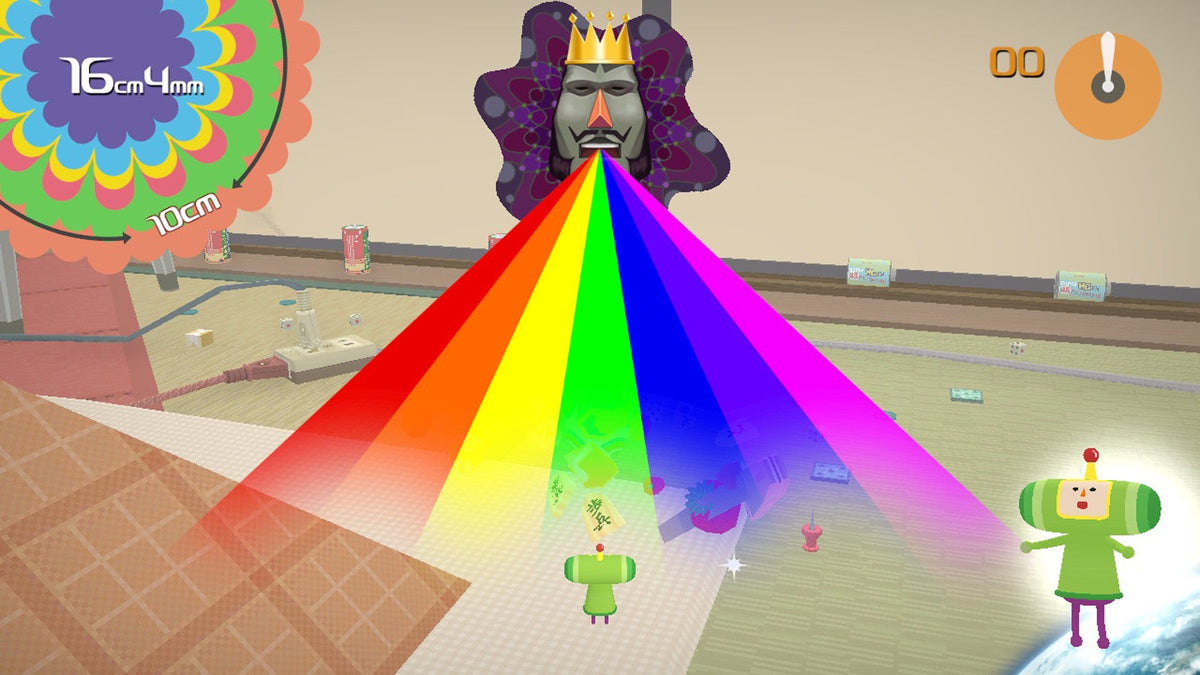
Images in this feature show Katamari Damacy REROLL, the remaster of the original game. They are not captures of the PS2 release.
The best upgrade is seeing an obstacle become a collectible
The basic loop is wonderfully physical: roll into something small enough to collect, add it to the katamari, then use that extra size to collect more. Bandai Namco's launch description follows the escalation from stationery to vehicles, buildings, and eventually much larger pieces of the landscape.
Our reading is that the crucial reward happens between those extremes. Something you could only steer around becomes something you can take with you. You understand the improvement through a change in behavior, before you need to read a measurement.
That gives an ordinary object two roles. It can obstruct your current route while advertising a future opportunity. A good piece of level scenery therefore does several jobs at once: it establishes scale, creates a navigation problem, and offers a reason to return.
The resulting pleasure has a mischievous edge. A household object that seemed immovable loses its authority. Familiar spaces become strange because the game keeps changing which parts of them deserve your attention.

Rolling is a route-planning problem
For all its absurdity, Katamari has a clear practical question: what can you collect efficiently from here? A promising line of small objects can be more useful than repeatedly colliding with one tempting object you cannot yet absorb.
That makes attention part of the skill. You are reading the floor, the available space, and the relationship between your current size and the objects ahead. The attractive target and the useful target do not always coincide.
It also gives repetition a purpose. Knowing where to go can matter as much as moving the sticks more quickly. A return visit lets you recognize an opportunity earlier, avoid an unproductive corner, or connect several small gains into a better route.
There is a satisfying change in perspective here: clutter becomes information. You begin to notice arrangements and possible sequences inside a scene that initially looks like a pile of unrelated household things.
The two sticks make the ball feel like something you push
Katamari's analog-stick control scheme is central to its identity. Steering the rolling mass asks for a different habit from directing a conventional third-person character with one stick and freely aiming a camera with the other.
That difference can feel awkward at first. The interesting payoff is a sense of handling an object. A turn becomes a maneuver you perform, and navigating a confined space becomes part of the challenge.
Keita Takahashi's original development postmortem describes a deliberate decision to avoid power-up items that would temporarily increase size or simplify collection. Growth was meant to come through rolling. It is a revealing choice: the game keeps your attention on learning the action itself.
In our view, that focus helps the premise survive its own novelty. Once the initial joke is familiar, getting better at moving through the world remains a worthwhile activity.

The King makes a cosmic disaster feel like a family problem
The premise gives the rolling a wonderfully unreasonable employer. The King of All Cosmos destroys the stars, then orders his tiny son to restore them. The Prince inherits an enormous job from someone with rather more confidence than accountability.
The visual imbalance does much of the comic work. The King fills the scene. The Prince looks small enough to misplace. Even a basic instruction can feel ridiculous when delivered across that difference in scale.
His presence also changes how achievement feels. You may be proud of a roll, but you still have to present the result to this overwhelming personality. The relationship gives an otherwise abstract size target a theatrical audience.
We read the humor as a useful companion to the mechanics. Both keep destabilizing proportion: a small object matters enormously to the player, while an enormous figure behaves with the casual entitlement of a troublesome parent.

The soundtrack gives the absurdity a personality
Katamari's music is part of how the world introduces itself. Bandai Namco describes REROLL's soundtrack through a mixture of jazz, rap, and funky rock. That variety suits a game whose scenery is already full of unlikely neighbors.
The effect is more specific than simple cheerfulness. Music can make collecting everyday objects feel playful, extravagant, or oddly affectionate. It gives the rolling a mood that a meter and a countdown could never establish alone.
Sound director Yuu Miyake later discussed the series' resistance to staying inside a single musical genre in an official PlayStation Blog post about Katamari Forever. That later soundtrack reworked songs from earlier entries, showing how important those musical identities had become to the series.
Our interpretation is that the songs help the game feel authored at every level. Its objects, voices, colors, and music all seem to belong to the same peculiar imagination.
The rough edges belong in the appreciation
A bright presentation does not guarantee a frictionless game. Most stages in the original have a time limit. A failed approach can therefore feel costly, especially while you are still learning how the controls and camera communicate a tight space.
Takahashi was candid about the camera in his postmortem, including the difficulty of conveying changing scale and the nausea some players experienced. He also explained that removing time limits had proved difficult to reconcile with making the game engaging.
Those admissions are useful because they leave room for different reactions. A player can admire the idea while finding particular maneuvers uncomfortable. The pressure that makes one roll exciting may make another player's attempt feel hurried.
That is why Katamari works best as a specific proposition. It asks you to enjoy learning an unusual way of moving, tolerate some awkwardness, and find comedy in a world whose proportions refuse to stay put.

Katamari Damacy, REROLL, and We Love Katamari are different purchases
The similar names deserve attention. REROLL revisits the first game. We Love Katamari REROLL+ Royal Reverie revisits its sequel, which originally released in 2005.
| Release | What it is | Why choose it |
|---|---|---|
| Katamari Damacy on PS2 | The 2004 original. | The original console release for a PS2 collection. |
| Katamari Damacy REROLL | A remaster of the first game with updated graphics and recreated cutscenes. | A way to explore the original premise on Switch, PC, PS4, or Xbox One. |
| We Love Katamari REROLL+ Royal Reverie | A remaster of the sequel, with additional Royal Reverie challenges and other features. | A different campaign, including an Eternal Mode for play without a time limit. |
Choose the first game's REROLL if your goal is to understand where the series began. The sequel remaster offers another set of ideas and additions; its extra features should not be assumed to exist in the first REROLL.
Physical collectors should also compare the exact platform and selected condition. Our used game condition guide explains what those condition labels mean.
A good first roll starts with a smaller ambition
Give yourself time to learn turning before worrying about an impressive result. Look for nearby objects you can collect comfortably, then notice what becomes possible after a little growth. Treat an awkward collision as information about your current size and approach.
Pay attention to what the game asks of the current stage. The appealing target in the distance can wait while you learn the route in front of you. There is plenty of satisfaction in making one familiar corner easier on the next attempt.
Katamari's lasting achievement is that it makes improvement visible in the world itself. You remember when a thing was too large. Later, you roll it away.
For another game built around an unusual physical language, read our Patapon retrospective. You can also explore Zypher's PlayStation 2 collection for more of the era's distinctive ideas.
Sources and further reading
- Bandai Namco: original PS2 history, REROLL platforms, and soundtrack overview.
- Bandai Namco: REROLL's rolling and scale mechanics.
- Bandai Namco: REROLL features and analog-stick controls.
- Keita Takahashi: original 2004 development postmortem, republished by Game Developer in 2024.
- Yuu Miyake and Kazuhito Udetsu: the series' musical approach, on PlayStation Blog.
- Bandai Namco: We Love Katamari REROLL+ Royal Reverie features.
- Official Steam listing and publisher screenshot gallery.
A Zypher XP retrospective combining documented features with editorial interpretation. Featured image and all inline screenshots show Katamari Damacy REROLL. Image rights remain with Bandai Namco Entertainment Inc.


