
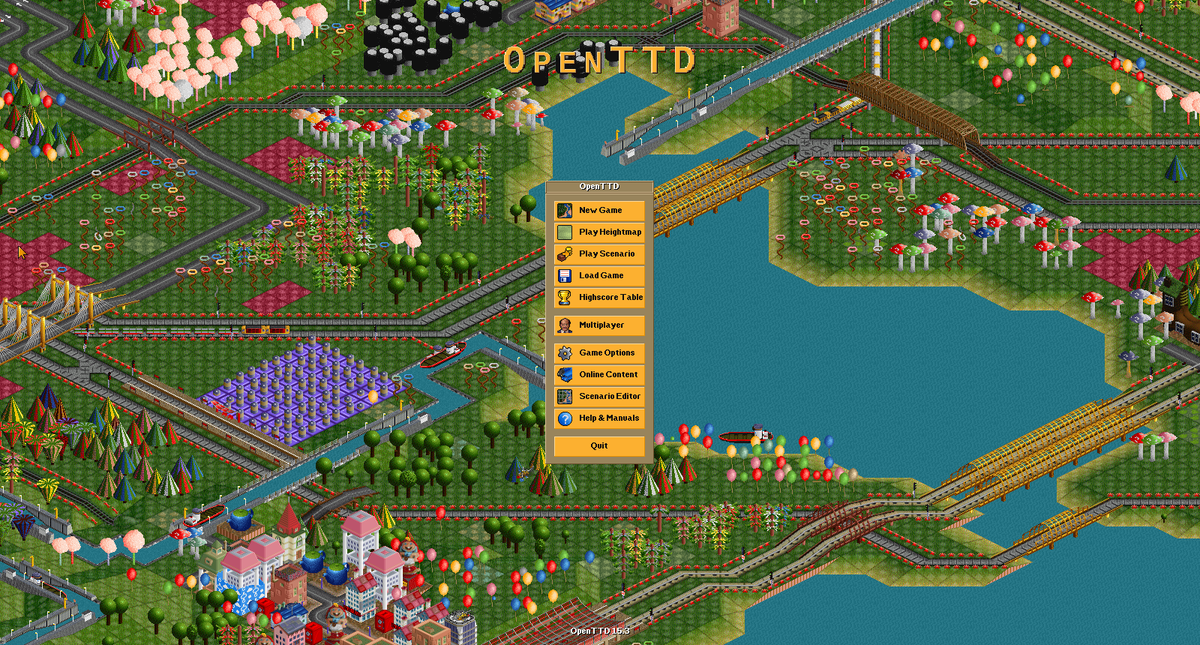
OpenTTD is at its best when the network is not working. A train waits outside a full platform. Trucks bunch up behind a depot. One profitable route becomes five routes sharing a junction that was never meant to carry them. The game does not hide those mistakes behind a vague efficiency score. It leaves the evidence on the map.
That makes this open-source transport simulation unusually easy to learn from. It is based on the design of Transport Tycoon Deluxe, but the current project has spent years expanding the practical tools around that foundation. Larger maps, improved pathfinding, flexible stations, advanced orders, modern signals, vehicle replacement and multiplayer all support the same central pleasure: noticing where a system breaks, then rebuilding it with intent.
The map is not scenery. It is the problem.
A new OpenTTD map looks permissive. Towns have room to grow, industries appear comfortably separated and the first rail line can usually take the direct route. Geography becomes important only after the network starts competing with itself. A shoreline limits station approaches. A hill makes a compact junction awkward. A growing town absorbs the empty tiles that looked disposable ten years earlier.

The overview map is therefore more than a navigation aid. It is a diagram of relationships: production sites, destinations, crowded towns and the narrow corridors connecting them. Zoomed in, a late train can look like an isolated annoyance. Zoomed out, it may be one symptom of a route that crosses too many others or sends every cargo type through the same hub.
A route only works until it meets another route
The first profitable line answers a simple question: can cargo move from here to there? The next line changes the question to whether both services can share track, stations and junctions without sabotaging each other. That shift is the heart of OpenTTD. Expansion is not merely adding more vehicles. It is managing interference.
Signals divide rail into usable sections, but they do not magically fix bad geometry. Extra platforms increase station capacity, but only if trains can enter and leave cleanly. More buses may raise theoretical capacity while making a crowded road slower for every vehicle. The tools are powerful because they expose tradeoffs instead of erasing them.

This is why a bottleneck feels useful rather than arbitrary. The game usually gives you something concrete to inspect: a queue, a blocked signal, a station rating, a vehicle waiting for cargo or a line of trains approaching the same platform. Fixing it can mean changing orders, separating fast and slow traffic, adding a passing route or accepting that the elegant small station has reached retirement age.
Failure stays visible
Many management games summarize trouble in dashboards. OpenTTD certainly provides windows and statistics, but the map remains the clearest report. Vehicles physically occupy space. Timetables collide with junction design. A town grows around infrastructure that once sat safely outside it. The network becomes a history of earlier decisions, including the cheap ones you hoped never to revisit.
That visibility makes iteration satisfying. You can watch a rebuilt junction begin to drain a queue, then discover that the improved flow has merely moved congestion two stations down the line. It is systems design with comic timing. The reward is not a permanently solved map. It is a network whose next problem is more interesting than the last one.
A living game, not a museum piece
OpenTTD is also important as a preservation story. The official project describes it as an open-source simulation based on Transport Tycoon Deluxe, yet it is not frozen in the shape of a 1990s release. As of October 10, 2026, the official site lists version 15.3 as stable and 16.0-beta4 as the current testing build. Its current feature set includes path-based signaling, conditional orders, larger stations, extra viewports and extensive automation for managing vehicles.

Those additions matter because they support bigger and clearer experiments without changing the basic appeal. The player still reads a landscape, commits money to infrastructure and learns what happens when demand meets limited space. Better tools let that loop scale. They do not turn it into a spreadsheet that plays itself.
The open project model also makes the game accessible without pretending every community add-on carries the same rights. The screenshots here use OpenTTD with the OpenGFX base set, whose licensing and content-creation terms explicitly allow review and similar coverage of the unmodified game. That clarity is part of why the project remains easier to document responsibly than many abandoned commercial games.
Where to start without turning it into homework
A first map does not need a giant network. Start with one obvious cargo chain and make it reliable. Keep the initial junctions simple enough to read at a glance. Watch the vehicles and station windows before buying a fleet twice as large. Expand only after the route behaves the way you think it does.
- Give busy services their own platforms before every train begins waiting for the same one.
- Use signals to create safe sections, then watch the traffic rather than assuming the signal layout is correct.
- Separate routes when shared infrastructure creates more delay than convenience.
- Leave room around stations and junctions. Town growth has a habit of collecting the tiles you planned to use later.
None of those habits guarantees a perfect network. That is the point. OpenTTD remains absorbing because success generates new pressure. A route becomes profitable, the fleet grows, the junction fills and the map asks whether you understand the system you built. When the answer is no, the evidence is already waiting in the queue.
Sources and further reading
- OpenTTD: About, checked October 10, 2026.
- OpenTTD official site, current release status checked October 10, 2026.
- OpenTTD content-creation and licensing guidance, checked October 10, 2026.
- Zypher XP: How Warzone 2100's Open-Source Afterlife Preserved Its Weirdest Ideas.


