
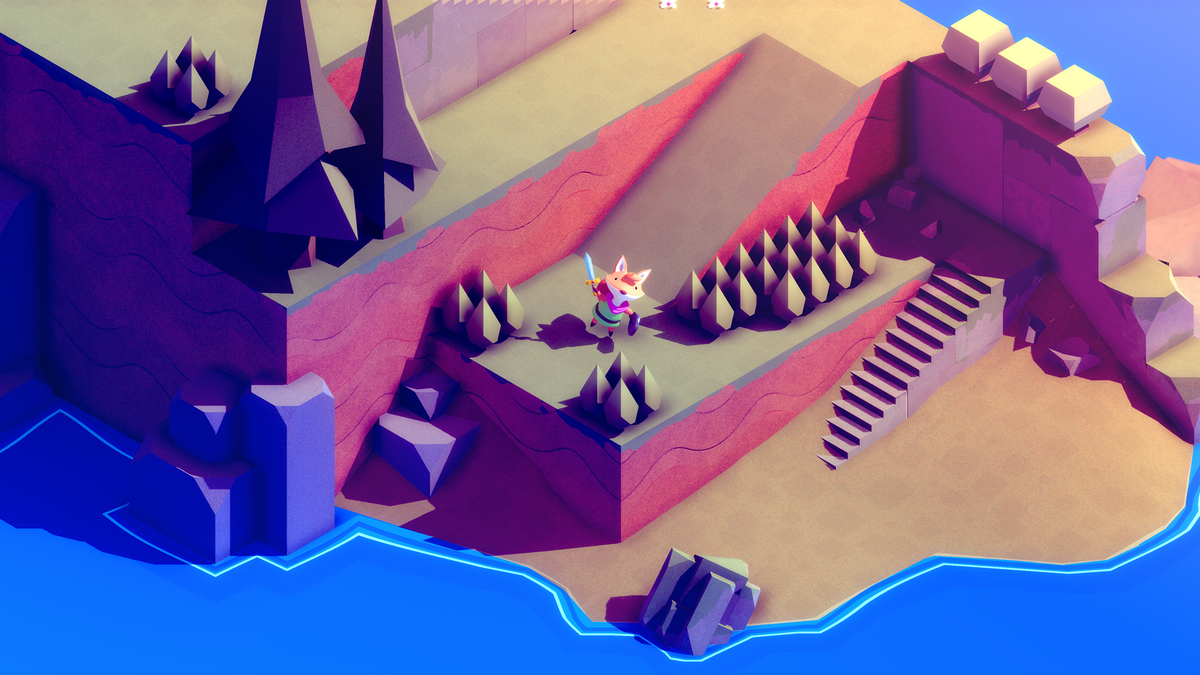
TUNIC gives a tiny fox a dangerous world and leaves the instruction manual scattered around it. Your onboarding department is missing several pages. The fox will have to manage.
That joke is also the reason this 2022 action-adventure deserves attention. Finding a page can be as exciting as finding equipment, because understanding what you already have is part of the adventure. This is a spoiler-light look at that design: how the booklet, the landscape and the fights encourage different kinds of observation, without handing over the discoveries that make them worthwhile.
Featured image: TUNIC © Isometricorp Games Ltd. Screenshot supplied by Finji; unaltered.
The manual belongs inside the mystery
Instruction booklets usually explain a game before you start. TUNIC makes collecting their pages part of playing. Illustrations, maps and hints arrive among unfamiliar symbols. A page asks you to look at its arrangement and pictures, rather than treating every useful answer as a sentence waiting to be read.
The map shown below makes the distinction tangible. Recognizable landmarks sit beside labels, paths and a reference to another page. It is information presented as an object worth examining. A picture can offer a lead before the surrounding language makes sense, while a small annotation can deserve more attention than its size suggests.
That gives the booklet an unusual role. Collecting it adds something to your inventory, but interpreting it asks something of you. There is satisfaction in noticing the connection yourself. TUNIC makes reading feel adventurous, which is a fairly impressive rehabilitation of an activity that games often assign to the pause menu.

A beautiful world still needs a second look
The isometric view turns the ruined landscape into a layered arrangement of stairs, edges and structures. In the wider scene below, several elevations share the frame. Your eye can follow a staircase, notice a building beyond it, then wonder how those spaces connect. The fox is small enough that the surroundings keep their sense of scale.
Finji describes an interconnected world of forests, ruins and catacombs. Our reading of that design is that a place can remain interesting after its first introduction. A map fragment or an illustration gives you a reason to reconsider something familiar, rather than demanding that every discovery come with a new biome and an explosion.
There is a useful habit to bring here: separate what you saw from what you assumed. A strange object is worth remembering even when its purpose is unclear. You do not have to solve the entire game at the first suspicious doorway. The doorway can survive being suspicious for a while.

The cute fox has serious combat homework
The gentle-looking scenery does not promise gentle opposition. TUNIC's combat includes dodging, blocking, parrying and attacking. The developer's Steam listing presents those actions alongside exploration and puzzles, so the sword is a substantial part of the game rather than a decorative accessory for the fox.
The dungeon screenshot below shows a different observation problem from the manual. Enemies, projectiles and stairways compete for the same space. Reading a page permits lingering over a detail; a fight asks you to recognize an opening and act. The two kinds of attention give the adventure a useful change of pace.
Finji's March 16, 2022 launch account also warns that dying returns you to a checkpoint without restoring items already consumed. Supplies therefore deserve thought. Getting angry and throwing everything in your pockets at a problem is a recognizable strategy. It is not automatically a sustainable one.

Confusion is part of the invitation, and a possible sticking point
In his September 2022 account of the manual's creation, lead developer Andrew Shouldice explains that he wanted unfamiliar writing to recall playing games before he could understand their text. The booklet brings that idea into the interface, with dense pages containing illustrations, advice, maps and secrets.
That history helps explain the appeal, but it also identifies a real preference question. A player who enjoys piecing together clues may welcome the uncertainty. Someone seeking clear directions after a long day may find the same uncertainty tiring. Mystery works best when you want to spend time with it; it does not become a moral achievement because you refused to look up a hint.
If you need help, a narrow hint preserves more room for discovery than a complete solution. Describe the obstacle and ask for the smallest useful nudge. The point is to get back to enjoying the game, not to turn a fox adventure into an unpaid certification course.
Old booklet, different job
TUNIC launched on March 16, 2022, with Isometricorp Games as developer and Finji as publisher. Its historical interest lies in what it does with the memory of a packaged-game booklet. Maps and illustrations become material to discover inside the adventure itself. The older format provides a new way to organize curiosity.
Our Wonder Boy: The Dragon's Trap feature considers another way games revisit their past, through presentation and preservation. For a different relationship between challenge and learning, the Celeste spotlight looks at the value of another attempt. TUNIC's particular pleasure is the moment a detail stops being decoration and starts being useful. Give the fox time to look around. The paperwork might actually help.
Watch the official-site trailer
Watch the TUNIC trailer linked by the official game site.
Hosted by YouTube and linked from the official TUNIC website. YouTube may show advertising or require sign-in. This link opens the provider's player.
Sources and screenshots checked October 19, 2026. Gameplay images are the unaltered TUNIC press screenshots offered through Finji's game page and creator resources.


