
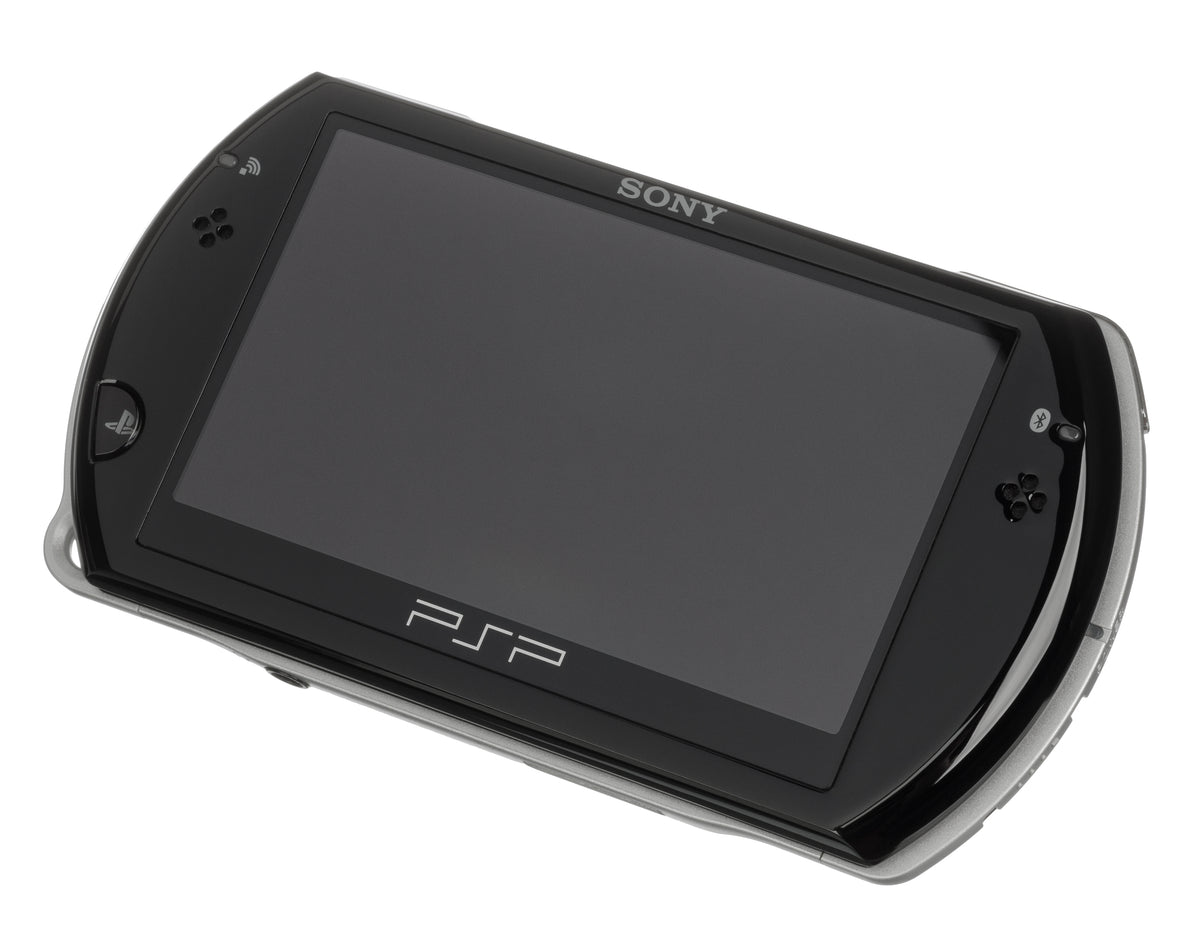
PSP Go looks almost normal now. A pocket-sized gaming device with built-in storage, a digital storefront, Bluetooth, and no optical drive barely sounds radical in 2026. In 2009, though, Sony was asking PSP owners to leave the UMD shelf behind while the rest of the PSP family kept using physical discs.
That contradiction is the key to understanding what happened. PSP Go was not simply a smaller PSP. It was a parallel version of the platform built around a different ownership model.
Sony removed the UMD drive on purpose
Sony Computer Entertainment unveiled the PSP Go on June 3, 2009 as model PSP-N1000. The company's launch announcement described it as a system for a growing digital lifestyle, replacing the UMD drive with 16GB of internal flash storage.
The North American, European, and selected Asian launch followed on October 1, 2009 at a recommended US price of $249. Japan followed on November 1. Sony did not present PSP Go as the replacement for every other PSP. The company explicitly said PSP-3000 would continue beside it.
That matters because the physical and digital versions of the PSP ecosystem were being sold at the same time. Sony's own E3 explanation called PSP Go a device for customers comfortable downloading and storing digital media, while saying it remained committed to UMD for people who preferred discs.

The hardware was genuinely different
PSP Go was more than a PSP with a missing drive. Sony said it was more than 50 percent smaller and more than 40 percent lighter than the original PSP. It added a sliding screen, Bluetooth, 16GB of internal storage, and a Memory Stick Micro slot.
The tradeoff was obvious the moment you looked at an existing PSP collection. A UMD could not be inserted because there was nowhere to put it. In a June 2009 PSP Go Q&A, Sony acknowledged that owners were worried about leaving their UMD collections behind and said it was planning a goodwill program. The machine itself, however, was designed around downloaded software.
That makes PSP Go an unusually clear example of how hardware design can change what ownership means. Two PSP systems could run software from the same broader library while asking their owners to acquire and store it in fundamentally different ways.
A digital-only PSP arrived before digital-only handhelds felt normal
The concept aged better than the specific product. Built-in storage, downloadable libraries, sleep-friendly portable hardware, and compact designs are ordinary expectations today. In 2009, Sony was introducing those ideas while retail game shelves and UMD ownership were still central to PSP.
The $249 launch price also placed the experiment in premium territory. Sony was not offering a stripped-down bargain PSP. It was charging for a smaller, more specialized model whose main limitation was most visible to people who already owned physical PSP games.
The ending was messier than “Sony killed it in 2011”
The PSP Go's exit was not one clean worldwide date. In April 2011, Japanese reporting said Sony had ended production and shipment of PSP Go in Japan as it shifted attention toward its next handheld. At almost the same time, Sony's North American representatives told GameSpot that the company was continuing PSP Go production for North America.
So the accurate version is regional: the system was already disappearing in some markets while still officially being produced in others. That is less tidy than a single discontinuation date, but it better matches the public record.
It also fits the product's role. PSP Go had always existed beside the standard PSP rather than replacing it, and Sony was already moving toward the Next Generation Portable that became PlayStation Vita.
What still matters to a PSP Go owner in 2026
The lack of a UMD drive makes account history and downloaded content unusually important. PlayStation's current service notice says PSP Store search and in-game purchases stopped on July 6, 2021, but previously purchased PSP content can still be downloaded on a PSP through the device's Download List.
That means a PSP Go owner should treat the machine, its storage, and access to previously purchased content as one preservation problem. A standard PSP owner can still put a compatible UMD into the drive. A PSP Go owner cannot fall back to that physical copy on the same hardware.
If you are buying one used, verify more than whether it powers on. Check the slider, controls, display, charging, storage, Wi-Fi behavior, and whether the system can reach the account and download history you expect to use. Do not assume that seeing a PSP game on a shelf means it can be played directly on PSP Go.
PSP Go was early, not imaginary
It is tempting to look back at PSP Go as a failed prediction of a digital future. The more interesting reading is that Sony predicted part of the future accurately but delivered it inside an ecosystem that still gave physical PSP owners a strong reason to keep the UMD drive.
The pocketable hardware, internal storage, downloads, and Bluetooth all point forward. The missing physical-media path points to the preservation problem that followed. PSP Go is still useful history because both parts of that story turned out to matter.
For another Sony experiment that complicated compatibility, read WTF Happened to PlayStation TV?
Sources checked October 14, 2026: Sony Computer Entertainment's 2009 PSP Go announcement, PlayStation Blog, current PlayStation service notices, and contemporaneous GameSpot reporting for the region-specific 2011 production status. Featured photo by Evan-Amos, public domain. Open-console photo by Evan-Amos, CC0.


