
The Sega Saturn has been sentenced to a surprisingly short biography: bad American launch, beaten by PlayStation, next console please. Convenient. Also incomplete. Sega's own hardware archive calls Saturn its biggest domestic console hit, meaning Japan. A machine can disappoint in one market without becoming a historical rounding error everywhere else.
So what happened? Saturn did not turn into Dreamcast, and a library did not become worthless because its platform lost momentum. Its story is about the distance between a persuasive machine for committed players and a business capable of bringing in the next customer.
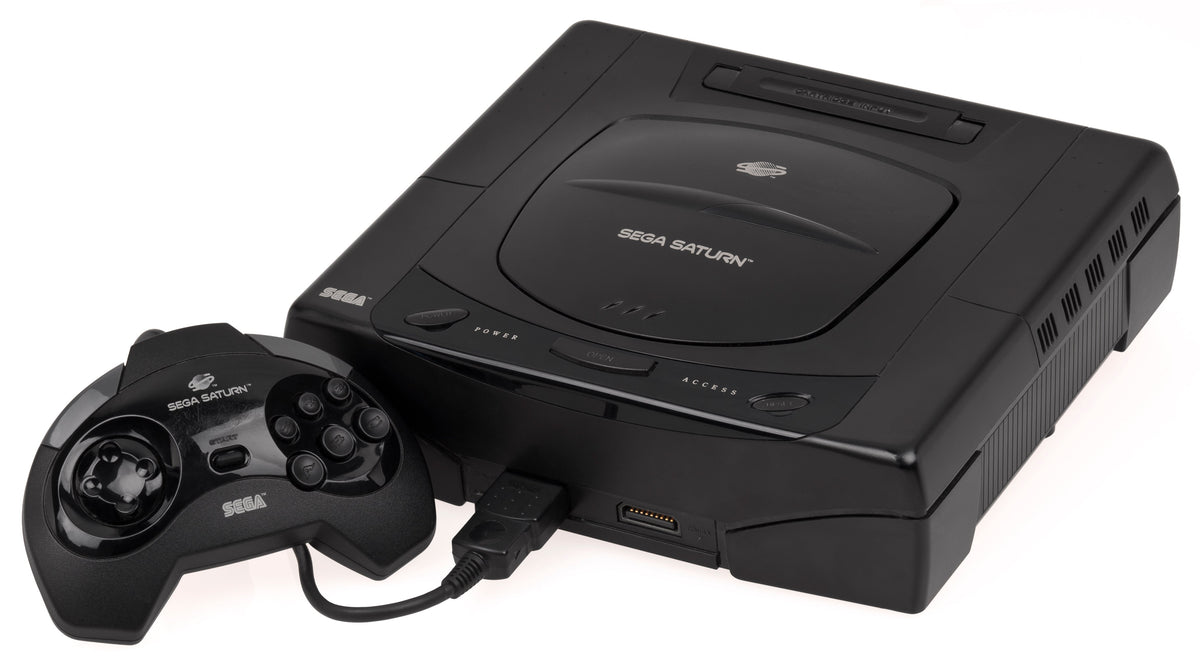
Featured photograph: first-model US Saturn and controller by Evan-Amos, public domain; uncropped; hosted JPEG compressed. Hardware photographs illustrate the history, not current stock or hands-on testing.
The promise was bigger than one dimension
Saturn launched in Japan on November 22, 1994. Sega's hardware overview describes two SH-2 processors and a platform supporting both polygonal 3D and enhanced 2D graphics. The interesting point is the breadth of the ambition, not an invitation to decide an entire generation by counting chips.
From a player's perspective, that ambition leaves a useful question: what did the machine offer that you actually wanted to play? A technical feature becomes meaningful through software. Conversely, a memorable game does not prove that the platform around it had a sustainable route to the next buyer.
That distinction keeps this history from becoming a fan-club loyalty test. You can admire an idea without defending every commercial decision around it. You can also recognize a commercial problem without pretending the games were sitting there apologizing for themselves.
The American launch became the headline
In a May 11, 2015 interview with SEGA Nerds, former Sega of America president Tom Kalinske revisited Saturn's surprise May 11, 1995 US availability, ahead of the previously announced September window. He argued that waiting for more games, a broader retailer launch and fuller marketing would have produced a better result.
That is valuable participant testimony, not a controlled experiment. It documents what Kalinske believed went wrong; it cannot prove that a later date would have defeated Sony. Alternate-history victories are wonderfully affordable because nobody has to manufacture the winning console.
Our reading is narrower: an earlier date is not automatically a stronger launch. Availability, software and retail coverage have to work together. Surprising people with a release is a different achievement from giving them a convincing reason to buy it.
Sega's own postmortem names several pressures
Sega's March 1, 2018 retrospective identifies competition for third-party support and difficulty attracting new customers. For North America and Europe, it also points to confusion around Sega's overlapping platforms, the late arrival of Sonic software and high hardware cost. It says Saturn could not sustain its early momentum as 3D games spread faster than anticipated, prompting a faster move toward a successor.
No single item in that account deserves to be promoted into the secret explanation for everything. Nor does the account give us a reliable percentage of blame to assign each decision. A tidy villain makes a punchy anecdote. It is less useful for understanding a platform that needed several parts of the business to succeed at once.
We covered the separate upgrade problem in our 32X retrospective. Saturn's question is different: why an established console with its own identity did not convert that identity into lasting momentum across its markets.
The controller is a good reason to look beyond the launch

Sega's peripheral archive records the Japanese analog controller's July 5, 1996 arrival alongside NiGHTS into dreams..., including a controller-bundled edition. A mode switch selected analog or directional-pad operation.
That gives a collector a more interesting starting point than a console-war scoreboard. Investigate a specific game and the way its original equipment let you interact with it. The controller is not proof that every game supports every input; it is a physical prompt to ask better questions about the library.
What remains worth owning?

Start with an actual reason to use a Saturn, then evaluate the specific console and software offered. Ask for the model label, included leads and a demonstration of the intended game. Treat the different revisions pictured here as identified examples, not a promise that every regional unit has identical electrical requirements or contents.
A photograph is not a condition report. Neither is a reputation. Buy for the experience you want to preserve, not because someone insists that a machine everyone supposedly misunderstood must now be an investment. This article offers no current price forecast or claim of universal compatibility.
Sega's corporate history dates Dreamcast's arrival to 1998, so Saturn was not the company's final console. Our Dreamcast retrospective covers that later chapter. Saturn deserves its own verdict: an uneven commercial legacy, not an empty one. The launch matters. It does not get to confiscate the rest of the machine's history.
Historical sources and exact photo grants checked October 19, 2026. Sega's retrospective and Kalinske's later account are attributed as such; editorial interpretation is identified. No invented sales, budgets or firsthand play claims.


