
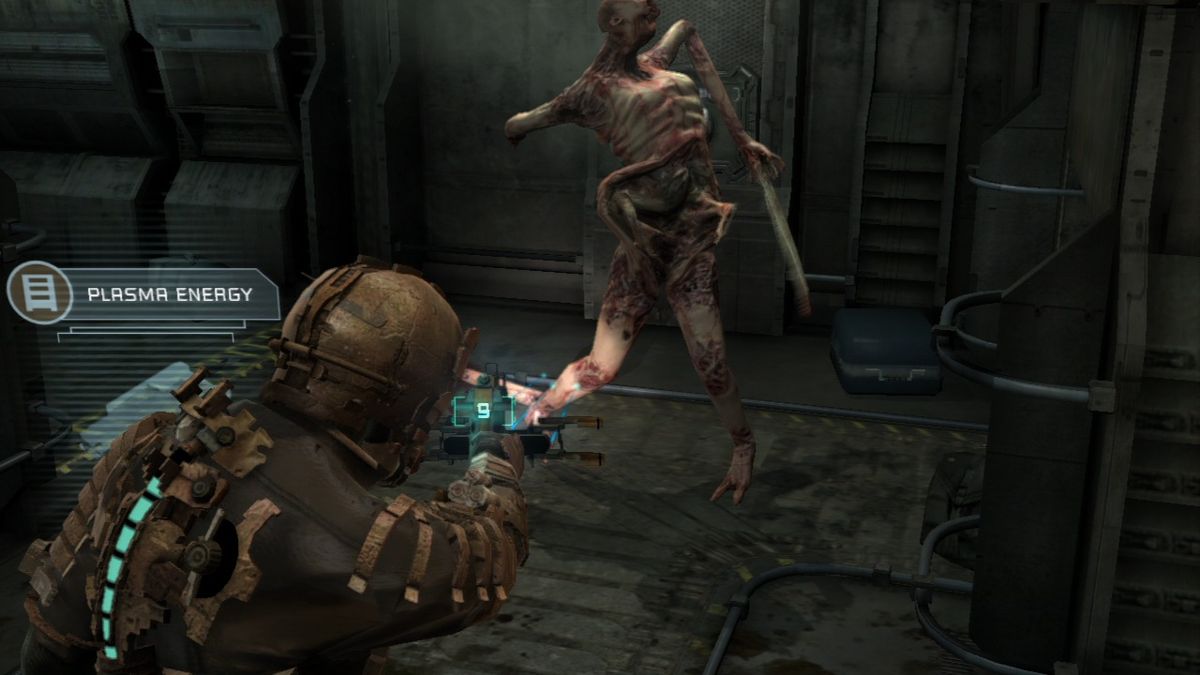
Dead Space takes a familiar shooter habit and makes it suspicious: aim at the head, pull the trigger, assume the problem has been professionally handled. The 2008 original wants you looking at the rest of the body. Suddenly your target is not just something to hit. It is something to understand before it gets close enough to rearrange you.
That is a stronger design idea than “space is dark and monsters are unpleasant.” Both statements are true, but neither explains why this particular nightmare sticks. Dead Space gives violence a shape, puts useful information on an engineer's equipment and makes even finding the next job feel like part of working aboard a very broken ship.
Content note: horror violence and creature imagery. Featured image: original PlayStation 3 gameplay, contributed by MAT, via MobyGames. © Electronic Arts. This article concerns the 2008 game, not the 2023 remake.
Isaac has arrived for the wrong kind of repair
EA's October 14, 2008 launch announcement identifies Isaac Clarke as a systems engineer sent with a repair team to restore communications on the mining ship USG Ishimura. Developed by EA Redwood Shores, the game turns that maintenance assignment into a survival crisis. This is not a soldier being dropped into a battlefield he has trained to command.

The engineer identity matters as a way to read the design. Isaac's tools do not make the situation ordinary; they give the extraordinary danger a practical vocabulary. Space horror becomes a job involving angles, equipment and things that no longer function as expected. The onboarding paperwork has clearly left out a few relevant hazards.
Aiming becomes a question of anatomy
In an August 2008 interview, creative director Bret Robbins explained that dismemberment shaped enemy design from the beginning. The team had to consider how a creature looked and behaved after losing particular limbs. He described the goal as fewer creatures with more interesting behaviors, rather than difficulty created only by throwing a larger crowd at the player.
That is the key to reading the combat. Aim is not simply an accuracy test against a moving outline. The meaningful question is which part of that outline you intend to change. You are watching the enemy as a structure, not merely waiting for a health bar to empty.
The original PC instruction manual makes the Plasma Cutter's role concrete: its secondary action rotates the firing orientation by 90 degrees. A small change of geometry becomes a deliberate part of aiming. The tool asks you to consider alignment, rather than treating every shot as an identical answer.

Time is another tool, not a permanent solution
The manual describes Stasis as a temporary slowing effect that needs replenishment. Kinesis instead manipulates objects and can propel them away. These are distinct abilities, not two names for the same power. We are discussing their original-game functions, not importing later remake mechanics.
Read alongside precision aiming, temporary slowing offers an interesting bargain: it can create room for a decision without removing the need to make it. A threat slowed down is still a threat you must handle. The satisfying connection is between creating an opening and choosing what to do with it.
The interface belongs beside the danger
Senior producer Chuck Beaver discussed another important choice in a September 2008 Game Developer interview: the inventory would not pause the action, even though the game itself could be paused. That keeps inventory management from automatically becoming a protected break in the situation.

That distinction gives the interface a personality beyond its appearance. Getting information is still an action performed by somebody standing in a place. The original screenshots show Isaac's segmented suit meter and projected displays sharing the view with the room around him. Useful information does not require pretending the room has stopped existing.
It also explains why calling the game “HUD-free” can obscure what is interesting. Information remains present. The design question is where that information lives and how looking at it changes your attention.
The ship does not need to be a navigation exam

The manual's deck navigation system projects a route toward the current objective; its map identifies useful locations such as stores and benches. Those aids make sense for equipment intended to help an employee work aboard the ship.
Our reading is that guidance does not automatically cancel horror. Knowing which way to go answers a spatial question. It does not guarantee that the trip will be comfortable. The corridor can remain threatening even when the game is not asking you to prove that you memorized the floor plan.
Why revisit the original?
The current original-game listing still identifies the 2008 release as single-player. That is a useful boundary for this retrospective, not a claim that every old disc, operating system or modern console will run it without separate checks. Choose the exact edition and platform deliberately.
For a different kind of horror pressure, our Amnesia spotlight examines what happens when fighting is not the answer. Dead Space's particular trick is making the answer more specific than “shoot it.” The engineer, the cutter and the body's shape turn a familiar action into a decision with teeth. Unfortunately, the teeth are coming toward you.
For another game-specific retrospective, continue with our Dead Rising design feature.
Primary sources, platform identity and image-use terms checked October 19, 2026. Screenshots via MobyGames, used under its credited screenshot-use permission; this is not an unrestricted rightsholder-license claim. Independent research and design commentary, not a new hands-on test. This website is not endorsed by or affiliated with EA or its licensors.


