

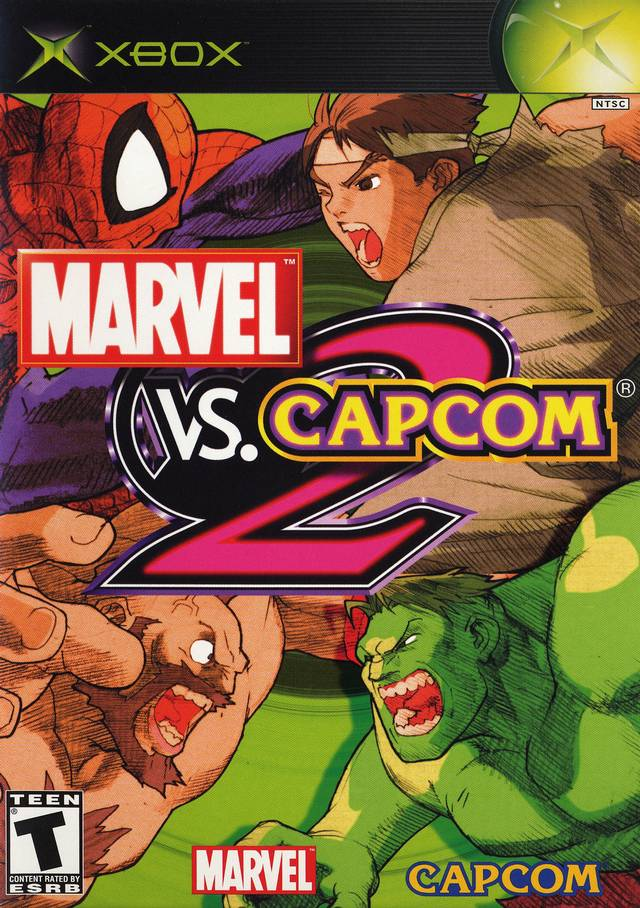
Marvel vs. Capcom 2: New Age Of Heroes
About the Game
Capcom 2: New Age of Heroes is a single-player and multiplayer 2D tag-team fighting game. It brings together characters from Marvel comics and Capcom franchises and frames them in a loose crossover where teams of three heroes or villains battle across a series of stages. players’ objective is to select a trio, manage active and reserve fighters, and defeat opposing teams across arcade ladders or versus play. Core combat centers on three-on-three team mechanics.
Gameplay & Core Systems
Players choose a point character and two reserves, then switch mid-match using tags and assists. Each teammate has three selectable assist types, commonly labeled Alpha, Beta, and Gamma, which determine the move performed when called from off-screen. Super meters are shared across the team and power Hyper Combos, Team Hyper Combos that bring in partners, and delayed sequences that chain one character’s super into the next. Movement and offense emphasize verticality and aerial pressure. Launchers send opponents into the air for extended “Aerial Rave” combos, super jumps help chase follow-ups, and advancing guard, often called pushblock, creates breathing room during pressure.
Standout Features
- Capcom 2: New Age of Heroes is a single-player and multiplayer 2D tag-team fighting game.
- Assists can extend combos, cover approaches, or defend space, and they can be struck by the opponent if used recklessly.
- Super meters are shared across the team and power Hyper Combos, Team Hyper Combos that bring in partners, and delayed sequences that chain one character’s super into the next.
- Several fighters are original to this entry, including Ruby Heart and Amingo, and many returning characters feature updated moves or assists that fit the three-on-three system.
- Later digital releases have also been issued with the full roster available from the start, depending on platform.
- Marvel: It brings together characters from Marvel comics and Capcom franchises and frames them in a loose crossover where teams of three heroes or villains battle across a series of stages.
- Core combat centers on three-on-three team mechanics.
- Players choose a point character and two reserves, then switch mid-match using tags and assists.
Modes & Ways to Play
Modes typically include an arcade ladder, local versus, training, and survival-style challenges. Progress in most single-player modes grants points, and many home versions use an in-game shop to unlock additional characters, color palettes, stages, and gallery items over time.
More game data: releases, identifiers & technical details
Regional release records and identifiers for Marvel vs. Capcom 2: New Age Of Heroes | Xbox.
Release and technical facts
| Fact | Value | Release / platform | Source |
|---|---|---|---|
| Published by | Capcom Co., Ltd. | Japan | MobyGames |
| Developed by | Capcom Co., Ltd. | Japan | MobyGames |
| Middleware by | CRI Middleware Co., Ltd. | Japan | MobyGames |
| Licensed by | Marvel Characters, Inc. | Japan | MobyGames |
| Published by | Capcom Co., Ltd. | France | MobyGames |
| Developed by | Capcom Co., Ltd. | France | MobyGames |
| Distributed by | Capcom Eurosoft Ltd. | France | MobyGames |
| Middleware by | CRI Middleware Co., Ltd. | France | MobyGames |
| Licensed by | Marvel Characters, Inc. | France | MobyGames |
| Published by | Capcom Co., Ltd. | United States | MobyGames |
| Developed by | Capcom Co., Ltd. | United States | MobyGames |
| Distributed by | Capcom Entertainment, Inc. | United States | MobyGames |
| Middleware by | CRI Middleware Co., Ltd. | United States | MobyGames |
| Licensed by | Marvel Characters, Inc. | United States | MobyGames |
| Media Type | DVD-ROM | Xbox | MobyGames |
| Input Devices Supported/Optional | Arcade Stick | Xbox | MobyGames |
| Number of Offline Players | 1-2 Players | Xbox | MobyGames |
| Miscellaneous Attributes | Memory Unit | Xbox | MobyGames |
| Miscellaneous Attributes | Xbox 360 Compatible | Xbox | MobyGames |
Regional releases
| Release date | Region / edition | Source |
|---|---|---|
| 2002-09-19 | Japan | MobyGames |
| 2002-11-28 | France | MobyGames |
| 2003-03-27 | United States | MobyGames |
Catalog identifiers by release
| Identifier | Code | Region / edition | Source |
|---|---|---|---|
| EAN-13 | 4976219724791 | Japan | MobyGames |
| eBay Product ID | 1946777158 | Japan | MobyGames |
| EAN-13 | 5055060960097 | France | MobyGames |
| eBay Product ID | 214721569 | France | MobyGames |
| UPC-A | 013388290031 | United States | MobyGames |
| ASIN | B00006LEM0 | United States | MobyGames |
| eBay Product ID | 10939 | United States | MobyGames |
Data by MobyGames.com


