


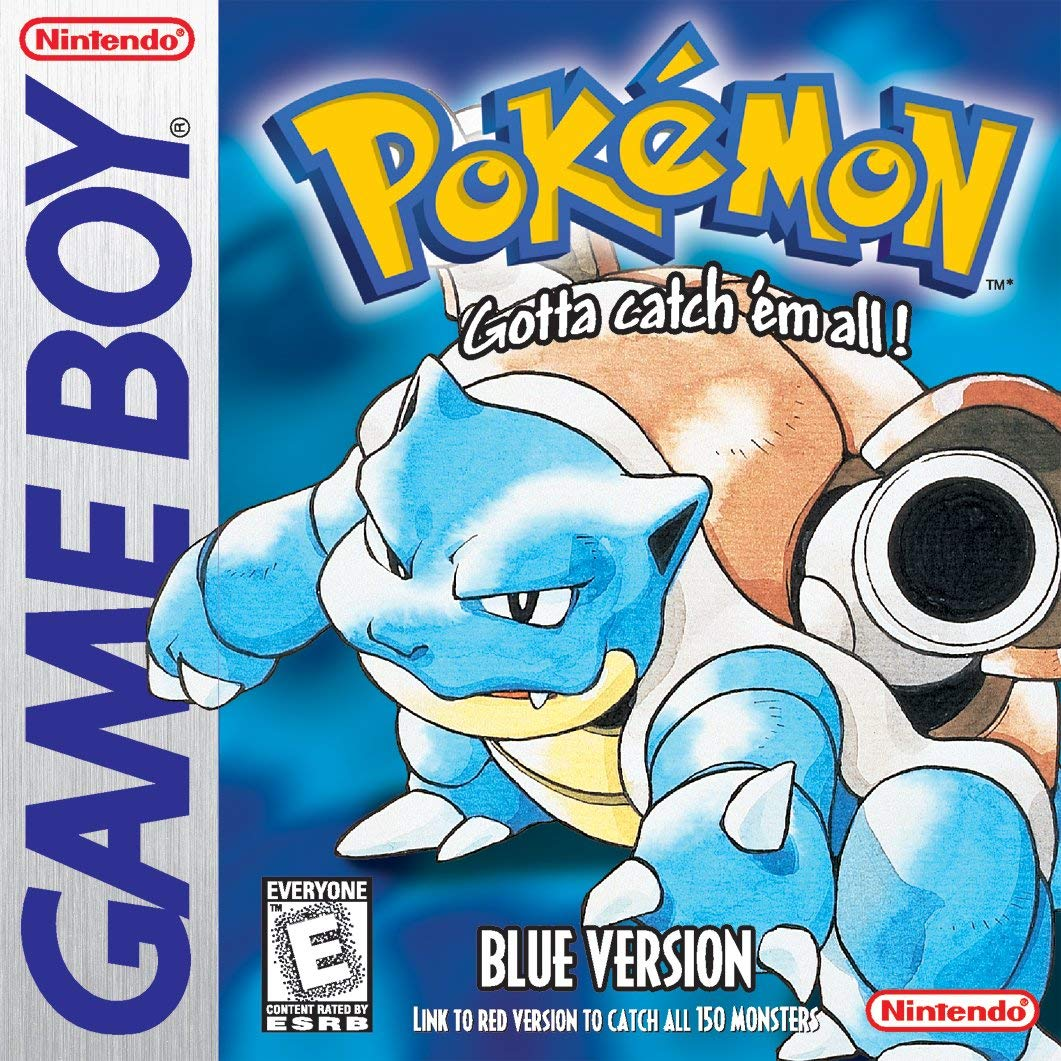


Pokémon Blue Version
About the Game
Pokémon Blue Version is a single-player role-playing game with turn-based battles and monster-collecting mechanics. It is one of the paired titles that introduced the Pokémon series outside Japan, released alongside Pokémon Red Version . The story centers on a young Pokémon Trainer who sets out from Pallet Town with the goal of completing the Pokédex, an encyclopedia of all known Pokémon species.
Story & Setting
Along the way, players confront Team Rocket, a criminal group that exploits Pokémon for profit, and works to thwart their schemes.
Gameplay & Core Systems
Guided by Professor Oak and rivaled by Oak’s grandson, players travel across the Kanto region, capturing and training Pokémon, battling other Trainers, and defeating the eight Gym Leaders in order to challenge the Pokémon League. At its core, the gameplay is presented from a top-down perspective and alternates between exploration and combat. Players capture Pokémon in the wild using Poké Balls and can carry a party of up to six creatures at a time. Battles are turn-based, with each Pokémon having a set of elemental types, hit points, and up to four moves that include damaging attacks and status effects. Victory in battle grants experience points, allowing Pokémon to level up, learn new moves, and in many cases evolve into more powerful forms.
Standout Features
- Gym Badges: Players must earn Gym Badges in sequence, which allow the use of special hidden techniques outside of battle and open access to later areas.
- Blue Version: Pokémon Blue Version includes 151 species, but not all are obtainable in a single game.
- Compared to the earlier Japanese release Pocket Monsters Midori (Green), Blue Version features revised graphics, audio, and code based on the Japanese Pocket Monsters Ao (Blue).
- Rock Tunnel: Progression involves exploring towns, caves, and routes while solving simple environmental puzzles, such as navigating the Rock Tunnel or using abilities like Cut to remove obstacles.
- Certain Pokémon are exclusive to Blue , requiring players to trade with Red owners through a link cable to complete the Pokédex.
- Battles and trades between players are central to the design, making multiplayer interaction a key component despite the primarily single-player structure.
Modes & Ways to Play
Player support includes Turn-Based Multiplayer (Game Link Cable), Free-for-all / One-on-one (VS), and 1-2 Players.
Presentation & Atmosphere
Display support includes 160×144.
More game data: releases, identifiers & technical details
Regional release records and identifiers for Pokémon Blue Version | Nintendo Game Boy.
Release and technical facts
| Fact | Value | Release / platform | Source |
|---|---|---|---|
| Published by | Nintendo of America Inc. | United States | MobyGames |
| Developed by | Nintendo Co., Ltd. | United States | MobyGames |
| Developed by | Game Freak, Inc. | United States | MobyGames |
| Developed by | Creatures, Inc. | United States | MobyGames |
| Published by | Nintendo Co., Ltd. | Australia | MobyGames |
| Developed by | Nintendo Co., Ltd. | Australia | MobyGames |
| Developed by | Game Freak, Inc. | Australia | MobyGames |
| Developed by | Creatures, Inc. | Australia | MobyGames |
| Distributed by | Nintendo Australia Pty., Ltd. | Australia | MobyGames |
| Published by | Nintendo of Europe GmbH | Ireland, United Kingdom | MobyGames |
| Developed by | Creatures, Inc. | Ireland, United Kingdom | MobyGames |
| Developed by | Game Freak, Inc. | Ireland, United Kingdom | MobyGames |
| Developed by | Nintendo Co., Ltd. | Ireland, United Kingdom | MobyGames |
| Distributed by | THE Games Ltd. | Ireland, United Kingdom | MobyGames |
| Published by | Nintendo of Europe GmbH | Belgium, Luxembourg, The Netherlands | MobyGames |
| Developed by | Game Freak, Inc. | Belgium, Luxembourg, The Netherlands | MobyGames |
| Developed by | Creatures, Inc. | Belgium, Luxembourg, The Netherlands | MobyGames |
| Developed by | Nintendo Co., Ltd. | Belgium, Luxembourg, The Netherlands | MobyGames |
| Distributed by | Nintendo Benelux B.V. | Belgium, Luxembourg, The Netherlands | MobyGames |
| Video Resolutions Supported | 160×144 | Game Boy | MobyGames |
| Color Depth | 2-bit (4 greyscales) | Game Boy | MobyGames |
| Multiplayer Options | Turn-Based Multiplayer (Game Link Cable) | Game Boy | MobyGames |
| Multiplayer Game Modes | Free-for-all / One-on-one (VS) | Game Boy | MobyGames |
| Number of Players Supported | 1-2 Players | Game Boy | MobyGames |
| Save Game Methods | Manual Save | Game Boy | MobyGames |
| Save Game Methods | Game Media | Game Boy | MobyGames |
| Miscellaneous Attributes | Battery Backed RAM | Game Boy | MobyGames |
| Miscellaneous Attributes | Game Link Cable | Game Boy | MobyGames |
| Miscellaneous Attributes | Super Game Boy Compatible | Game Boy | MobyGames |
| Miscellaneous Attributes | Transfer Pak | Game Boy | MobyGames |
| Original game disc count | 1 | North America | MobyGames |
Regional releases
| Release date | Region / edition | Source |
|---|---|---|
| 1998-09-28 | United States | MobyGames |
| 1998-10-23 | Australia | MobyGames |
| 1999-10-05 | Ireland, United Kingdom | MobyGames |
| 1999-10-05 | Belgium, Luxembourg, The Netherlands | MobyGames |
Catalog identifiers by release
| Identifier | Code | Region / edition | Source |
|---|---|---|---|
| UPC-A | 045496730826 | United States | MobyGames |
| Nintendo Media PN | DMG-APEE-USA | United States | MobyGames |
| ASIN | B00000IYER | United States | MobyGames |
| eBay Product ID | 108927148 | United States | MobyGames |
| UPC-A | 045496730826 | Australia | MobyGames |
| Nintendo Media PN | DMG-APEU-AUS | Australia | MobyGames |
| ASIN | B00000IYER | Australia | MobyGames |
| eBay Product ID | 108927148 | Australia | MobyGames |
| UPC-A | 045496730826 | Ireland, United Kingdom | MobyGames |
| Nintendo Media PN | DMG-APEU-EUR | Ireland, United Kingdom | MobyGames |
| ASIN | B00000IYER | Ireland, United Kingdom | MobyGames |
| eBay Product ID | 108927148 | Ireland, United Kingdom | MobyGames |
| UPC-A | 045496730826 | Belgium, Luxembourg, The Netherlands | MobyGames |
| Nintendo Media PN | DMG-APEU-EUR | Belgium, Luxembourg, The Netherlands | MobyGames |
| ASIN | B00000IYER | Belgium, Luxembourg, The Netherlands | MobyGames |
| eBay Product ID | 108927148 | Belgium, Luxembourg, The Netherlands | MobyGames |
Data by MobyGames.com


