
One belt of iron plates, two places that need them, and a splitter between them. That tiny junction contains a decision: should the destinations share the supply, should one get first refusal, or are you trying to separate different items? In Factorio, those are different jobs.
This guide explains ordinary splitter distribution, input priority, output priority and item filtering for the unmodded base game's PC belt system. It does not cover circuit-controlled splitters or advanced balancing networks. The examples are suggested experiments based on the documented mechanics, not a claim of hands-on testing.
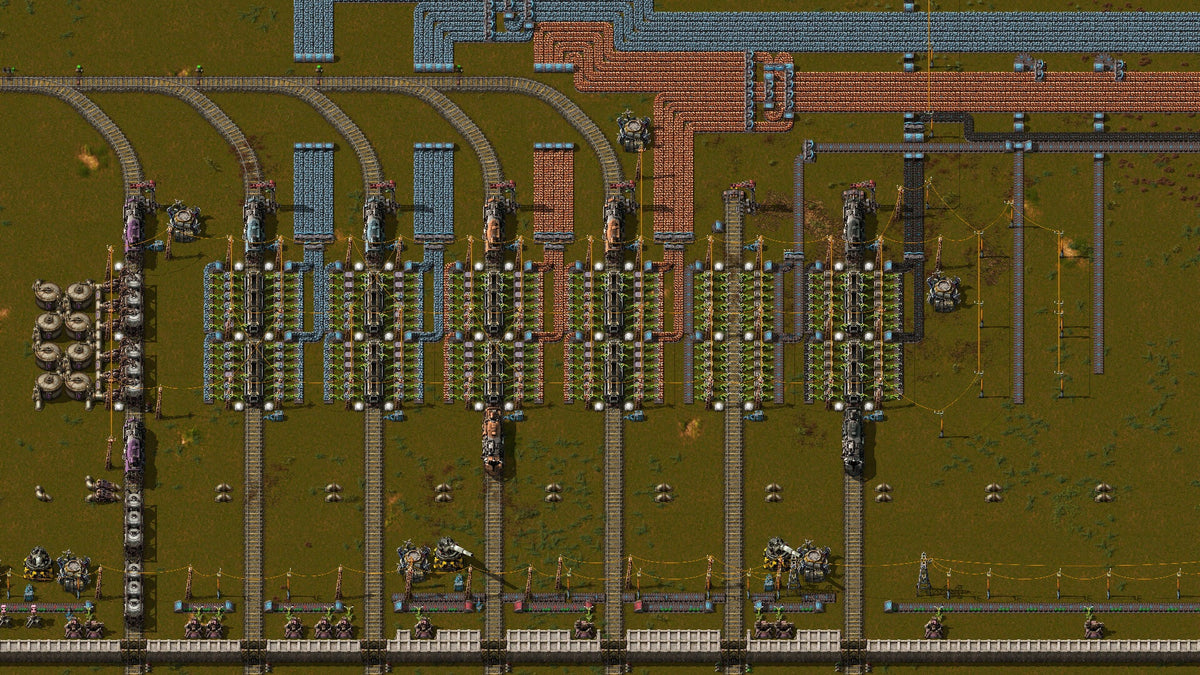
Featured image: Wube's PC press screenshot of train unloading stations feeding banks of splitters and parallel belts. Capture version unspecified. It illustrates physical belt routing, not the current settings interface. © Wube Software.
Give the junction a job
The officially hosted splitter reference describes the machine as a way to divide, combine or balance belts. The belt-system reference explains that an ordinary splitter shares one incoming belt between its outputs, using the other output when one is backed up.
Start by writing down what you want the junction to accomplish. “Share iron between two branches” is a different instruction from “feed this branch before sending the remainder elsewhere.” If the second sentence describes your factory, an even split is the wrong goal before you have placed another piece of belt.
For a small experiment, use a single material and two visible destinations. Watch the ordinary split first. Keep that arrangement understandable before introducing a second input, mixed items or a priority setting. You want to see the effect of one change, rather than guess which of four changes mattered.

Input priority chooses which supply gets used first
With input priority selected, the splitter tries the chosen incoming side first and draws from the other when gaps appear. This is a preference between supplies, not a command choosing which outgoing destination deserves the material.
Imagine a left-hand belt draining stored iron plates and a right-hand belt bringing fresh plates from smelters. You want to empty the stored supply first. Give that input priority, then watch whether the fresh supply supplements the gaps. The destination does not change merely because you chose a preferred source.
The important planning detail is what “first” means to you. Perhaps one source is the one you want to empty before relying on the other. State that purpose plainly. A priority that made sense while clearing one supply can remain in place long after you have forgotten why it was set.
Output priority gives one destination first refusal
Output priority directs items toward the selected outgoing side first, using the other when the preferred output is full. Wube's March 29, 2018 release overview documents input/output priorities and item filters as separate splitter options. The current belt-system reference supplies their detailed behavior.
For example, give a branch supplying gear assembly first access and send overflow toward a storage branch. If the gear branch keeps accepting every plate you deliver, storage may get very little. That can be the exact policy you wanted. Changing it to an even split would change the production decision, rather than repair a broken splitter.
Try the reverse setting on the same small arrangement and compare which branch receives material. If the observed behavior now matches your written goal, you have answered the routing question. Whether the overall factory produces enough iron is another calculation.

A filter sorts an item, rather than granting it overflow
A splitter filter assigns the chosen item to one output and other items to the other. In that configuration, the output-side selector chooses the filtered side; input priority remains independently selectable. Filtering therefore changes the meaning of that output choice.
Use a small mixed stream to make the distinction visible: select one item, identify its assigned output and follow where it goes. Don't assume the ordinary output-priority overflow behavior is a promise that a filtered item can use either exit. The filter is a sorting instruction.
For your own notes, name both the item and its destination. “Iron left” tells the next person inspecting the junction more than “priority splitter.” It also gives you a precise thing to compare with the settings after a layout change.
Keep lane questions separate
Splitters preserve the side of the belt that an item occupies. A right-lane item does not become a left-lane item simply by passing through the splitter. Redistributing between two whole belts is therefore different from balancing the two lanes of one belt.
Inspect those separately. First identify the incoming and outgoing belts; then look at their individual lanes. If your complaint is an uneven lane, changing which complete output has priority may be answering a different question. Describe the visible problem before copying a larger balancing layout.

Three checks before rebuilding the junction
- Wrong supply is being consumed first? Inspect input priority.
- Right item, wrong destination preference? Inspect output priority, and check whether a filter has changed the selector's role.
- One lane stays busy while the other is empty? Inspect lane behavior separately from whole-belt distribution.
Keep the symptom specific. A splitter can only route the items arriving at it; choosing a favorite output cannot fill a gap in your upstream supply. Start with what actually reaches the junction before redesigning every belt downstream.
For a separate transport problem, our Factorio rail-signal guide covers trains entering shared track. This guide concerns a built belt junction and the routing choice inside it.
Make room for the next game
Building your physical collection too? Shop games at Zypher, checking the platform, selected condition and included items on each listing. Those physical console games are separate from Factorio, which you can find through Wube's linked official site. Sell your old games to Zypher through the general Buy List when it is time to clear some shelf space.
Mechanics and store destinations checked November 9, 2026. Gameplay imagery comes unchanged from Wube's official press archive and is used under its website-asset permission. The screenshots are reference views, not guaranteed layouts, current-interface demonstrations or Zypher captures.


