
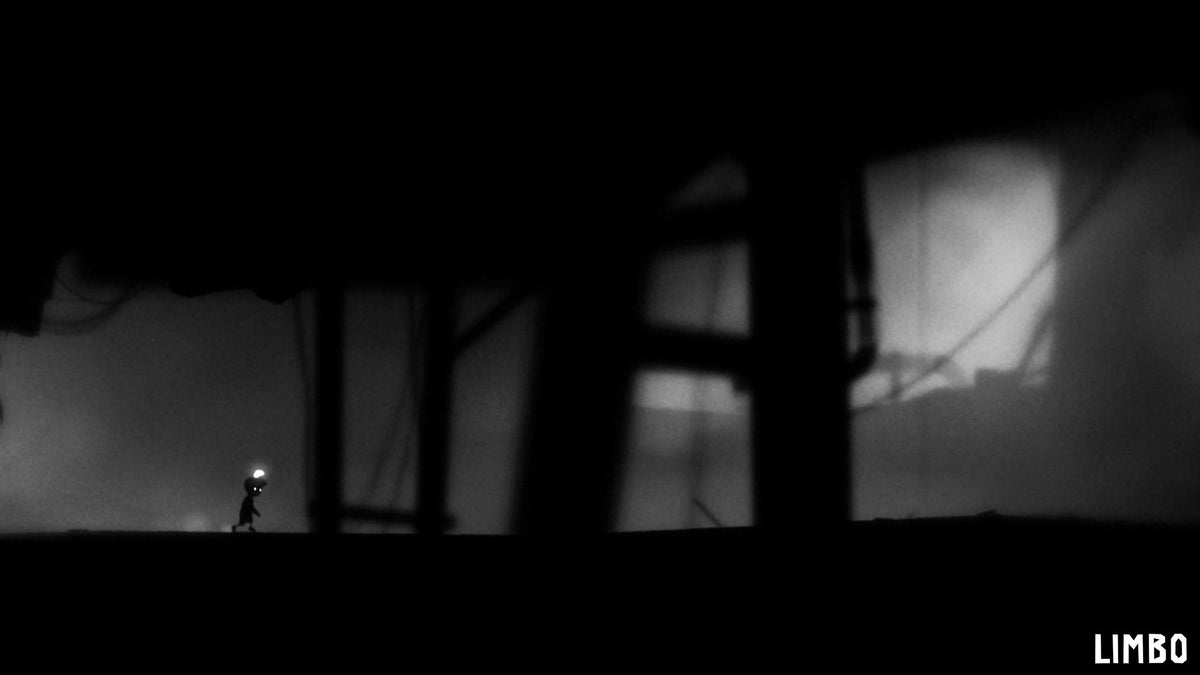
LIMBO can make a patch of empty ground look suspicious. A boy crosses the screen, pale eyes pick him out of the darkness, and something about the next stretch of scenery asks you to hesitate. It is an unusually effective introduction to a game that expects looking to be part of playing.
Playdead’s 2010 puzzle-platformer remains worth a proper deep dive because its presentation and its challenges keep asking the same question: how much information is enough? Its pictures withhold detail. Its controls stay compact. Its puzzles need you to understand what a small collection of things can do. The resulting confidence is admirable. The resulting deaths are less flattering to the person holding the controller.
The picture gives you a route without giving you reassurance
Look at the featured screenshot. The boy sits low in the composition, underneath enormous dark beams. His eyes are much easier to distinguish than the surfaces around him. The foreground is almost solid black, while the background fades into a pale haze.
Our reading is that this arrangement makes recognition selective. You can locate the character immediately without understanding everything around him. A bright, fully described environment might give every object equal authority. Here, a few outlines carry much of the information. The empty-looking space between them becomes something you have to consider.
This is why the monochrome style matters beyond being an attractive thumbnail. A silhouette communicates an edge very well while concealing what is behind it. That is useful territory for a puzzle game interested in uncertainty. The same picture can be visually clear about where the boy stands and deeply unhelpful about how safe he ought to feel.

A small control vocabulary leaves the problem in the room
In Brandon Sheffield’s original report from GDC Europe 2010, lead level designer Jeppe Carlsen described a design built around direction, jumping and grabbing, without tutorial text. The report recounts a problem during development: players did not realize they should pull a boat after riding in it. Playdead revised the introduction to grabbing.
That is a revealing distinction. A short move list does not automatically make an interaction obvious. Players still need a reason to notice an object and understand that they can affect it. Simplicity in the controller has to be supported by communication in the scene.
For a newcomer, our recommendation is to establish that physical vocabulary early. Pay attention to what the boy can stand on, reach and move. An object may have a role beyond filling the background. Learning those possibilities is more useful than searching for a complicated combination of inputs that the game never asked you to memorize.
The ladder image below captures that emphasis neatly. A ladder, a wheeled base and a damaged structure create a specific arrangement of edges and reachable space. The screenshot cannot tell you the solution or the timing. It can show you where your attention should start. Nobody has helpfully painted the answer yellow.

Failure is information, with an unpleasant delivery method
Playdead’s official presentation archive places learning through death alongside accessibility, difficulty and fun in its account of LIMBO’s puzzle design. That matters when deciding what kind of game you are approaching. A failed attempt belongs to the design’s learning process; it is not necessarily evidence that you missed a long explanation.
Our advice is to distinguish two frustrations. One is not knowing what an obstacle requires. The other is knowing what you want to do and struggling to perform it. They feel similar when the boy has just come to another unfortunate end, but they call for different responses. The first asks for a new reading of the situation. The second asks you to examine the execution.
That approach will not suit every player. Being surprised by a danger can create tension and can also irritate. If you prefer to understand every hazard before committing, LIMBO’s bargain may feel less generous than its compact controls suggest. That is a useful preference to recognize before buying, rather than a failure to appreciate the art.
Few parts can still create a substantial puzzle
Guy Cocker’s original GDC 2011 report describes Carlsen’s emphasis on reducing puzzles to a small set of elements. It also records the later use of gravity-based challenges. The variety therefore comes from relationships and changed rules, rather than simply piling more visible machinery into every scene.
That is the design achievement worth separating from the reputation. “Minimalist” can sound like a polite way to say there is not much there. Our interpretation is that LIMBO makes the things that are there carry more responsibility. A platform’s position, the timing of an action or the direction a system works can change the meaning of an otherwise simple arrangement.
Consider the industrial screenshot below as a composition, without treating it as a walkthrough. The overhead lamp isolates part of the scene, a claw hangs ahead, and the boy occupies a narrow strip near the bottom. The image gives you several distinct points of attention while preserving a large amount of darkness. It is economical without looking empty.

The sound belongs to the environment
Playdead’s archive identifies Martin Stig Andersen’s GDC 2011 presentation as The Environment is the Orchestra: Soundscape Composition in LIMBO. The studio describes the presentation in terms of soundscape composition. That framing gives a useful starting point for thinking about the sound as part of the place you are moving through.
Our recommendation is to give the sound room in a first session. Keep the volume comfortable and reduce competing noise if you can. The attraction of this kind of environmental audio is being able to attend to the space, instead of treating it as a backing track for another conversation. You do not need an elaborate speaker setup to decide whether the approach works for you.
The PS4 product page also says the game contains no spoken dialogue. Its opening premise is spare: a boy enters LIMBO because he does not know his sister’s fate. We suggest leaving the ending alone until you reach it. The uncertainty is part of the invitation, and a shopping guide does not need to explain the last scene to sell the first one.
The platform dates are different chapters of the same game
LIMBO began on Xbox 360 in 2010. Later dates on storefronts refer to later platform releases. These verified records help keep a collection or purchase discussion precise:
| Platform record | Date | What the record establishes |
|---|---|---|
| Xbox 360 / Xbox Live Arcade | July 21, 2010 | Xbox’s original launch post. |
| PS3 / US PlayStation Network | July 19, 2011 | Playdead’s announcement gives Europe July 20 separately. |
| PC / Steam | August 2, 2011 | The PC product listing, not the original Xbox release. |
| PS4 / US listing | February 24, 2015 | The PS4 product record. |
| Nintendo Switch / US digital listing | June 28, 2018 | Nintendo’s Switch record, which lists one player. |
Choose a copy around how you want to keep it
For a physical Xbox 360 shelf, Zypher’s Triple Pack: Trials HD, LIMBO and ’Splosion Man is a relevant compilation to examine. It is a three-game Xbox 360 release. Multiplayer information for a compilation should not be applied indiscriminately to every game inside it: LIMBO’s current Steam, Switch and PS4 listings identify a single-player experience.
Read the actual listing’s platform, condition and included contents. Do not assume an old used copy contains unused promotional codes. Likewise, a physical Xbox 360 purchase is not a PC license or a promise about another console’s compatibility. Match the purchase to the hardware you intend to use.
For PC, check the current storefront requirements rather than assuming a 2010 game will run on every old machine. Steam currently lists a demo, and Playdead’s support page points Mac users toward that demo as a way to check operation. Its older troubleshooting notes should not be read as a blanket guarantee for modern computers and controllers.
Put the classic on your shelf with Zypher
Buy your physical games from Zypher Trading Video Games. Check the Xbox 360 Triple Pack containing LIMBO, then choose from the listed condition options and read the included contents before ordering. The appeal here is a specific way of owning this classic, with two other named games in the compilation.
Shop Zypher’s games, or sell your old games to Zypher.
Sources and native product listing checked November 2, 2026, America/Denver. Design readings and buying recommendations are Zypher editorial judgment. Featured and inline images: unaltered official screenshots from Playdead’s public LIMBO gallery; promotional screenshot distribution is provided through its press area. © Playdead. Capture builds unspecified; these are not fresh Zypher playtests or platform-performance comparisons. Original image logos retained.


