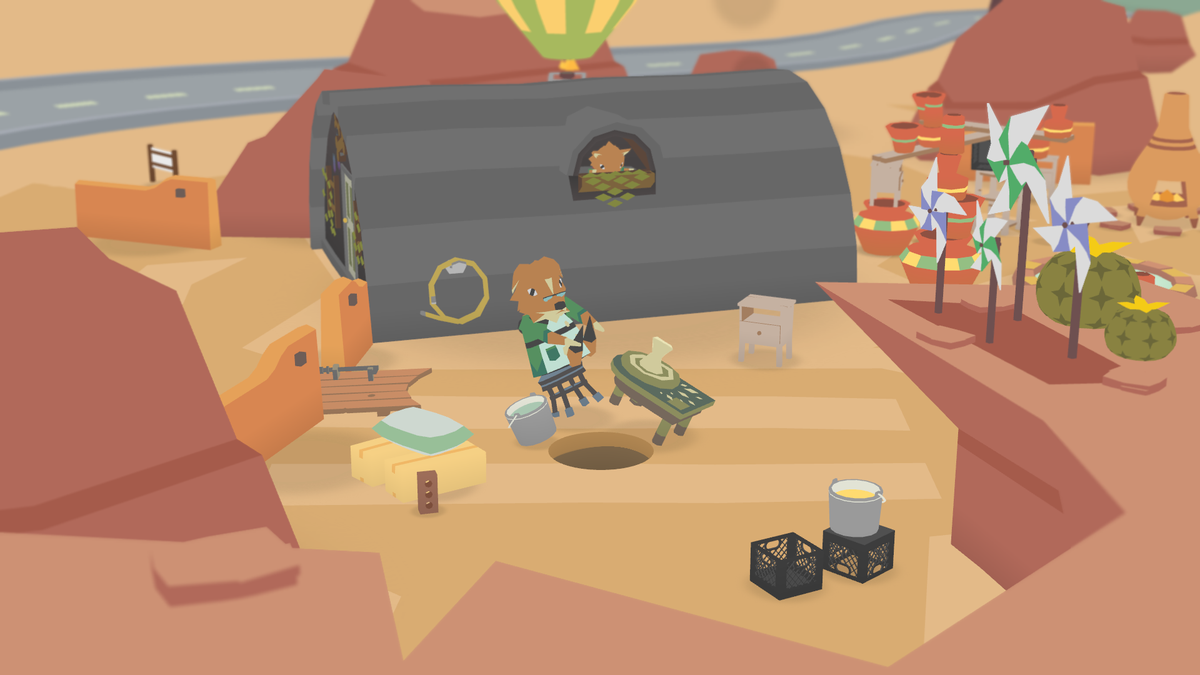
Donut County gives you a hole and an entire neighborhood of things that probably should not go in it. The important question is what each object can do before the scenery disappears. Size gets you started; interactions are where the puzzle becomes interesting.
This is our spoiler-light approach to Ben Esposito’s physics puzzler: separate a size problem from an interaction problem, then remember that a hole can send things back out. Repeatedly parking under the largest object in view is a plan, technically. It is just not a particularly productive one.
Decide what kind of problem you have
The basic rule is straightforward: swallowing objects makes the hole grow. That does not make every obstacle a request for more size. The developer also built puzzles around combining objects inside the hole and catapulting things out of it. Keep all three possibilities in mind instead of treating the opening as a bottomless rubbish bin with steering.
Our suggested order of questions is simple. Is there something smaller you can collect? Does an object have a useful role in an interaction? Has the game given you a way to use something above ground again? Those questions organize your next experiment without handing you a room-by-room solution.
If you are unsure, change one thing at a time. Choose an object or an action, watch what happens, then decide what that result tells you. Sweeping across everything at once may be satisfying, but it makes it harder to identify which part of an interaction mattered.

Use growth to open options
When a target will not fit, look for a smaller candidate rather than repeating the same approach to the same oversized object. The hole grows through what it takes in. That makes nearby small objects useful steps, even when the most tempting thing on screen is considerably larger.
The practical habit is to reassess after growth. Ask what new options you have gained, rather than continuing to chase the object you picked first. Your initial target was a guess about what would be useful. There is no prize for remaining emotionally committed to a piece of outdoor furniture.
Keep the distinction between access and solution clear. Becoming large enough to swallow something answers a question about size. It does not, by itself, explain why that object was placed in the scene. Once you can interact with more of the environment, consider whether a new possibility has appeared.
Read an object as more than a mouthful
The publisher’s description on Nintendo’s Switch listing names soup, breeding bunnies and fireworks among the effects possible through combinations. Those examples are a useful warning against one narrow assumption: an object entering the hole is not necessarily the end of its involvement.
Our advice is to look for relationships. Instead of asking only whether two things fit, ask why those particular things might belong in the same puzzle. A combination can be a better lead than another lap around the scene. Pick an interaction you can describe, then judge it by the change you can actually see.
Keep experiments specific. If one interaction changes the situation, pause long enough to notice that change before starting the next. Do not assume every pair of props has a secret recipe. If an experiment gives you no useful lead, try a different relationship instead of repeating it. Some objects are simply objects. They are allowed.
Remember the outward direction
The developer’s Steam description explicitly identifies catapulting objects out of the hole as a puzzle-solving tool. When that ability is available, your search for an answer needs to include what happens above the opening. “Put more in” is only half of the available idea.
Before reaching for a full walkthrough, identify which part you actually need help understanding: collecting something, combining it or using the result. A precise question is more useful than spoiling an entire sequence because one interaction was unclear. It also lets you preserve the pleasure of working out the next step yourself.

BK has a customer-service problem
Annapurna’s premise makes BK a raccoon operating remote-controlled holes, taking his friends and their homes along with the supposed trash. Mira and the other residents confront him underground. The people whose belongings you swallowed have opinions about that business model.
Our reading is that the story gives the physical comedy its bite. Clearing a scene can feel pleasantly tidy from the player’s side. Hearing from the residents complicates that satisfaction. BK’s job would be easier if the customers stayed abstract, which is a fairly reliable sign that the customers should be allowed to speak.

Choose the actual platform release
The PC Steam listing dates its release to August 28, 2018. Nintendo’s US listing dates the Switch version to December 18, 2018 and lists one player, with TV, tabletop and handheld modes. Those are separate platform records, not interchangeable release dates. Use the listing for the system you intend to play on.
The illustrations here come from the creator’s official 2017 press kit. They show the game’s settings and characters before release; they are not newly captured footage or proof of a particular current platform build.
Build a gloriously odd physical shelf at Zypher
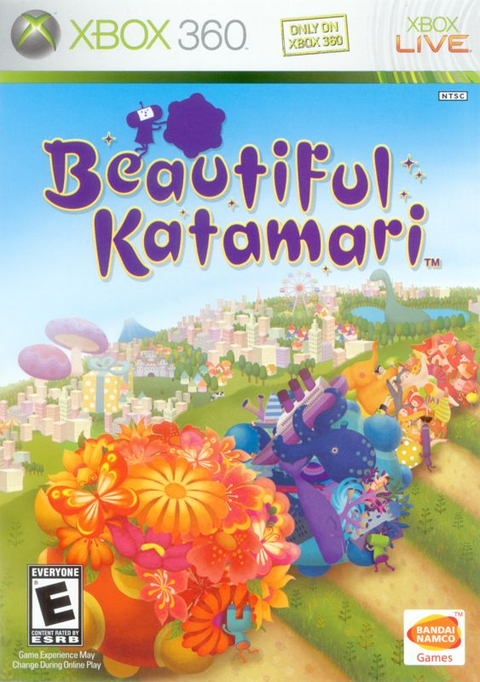
Buy your next physical game from Zypher Trading Video Games. If unusual object-based play is your kind of thing, check Katamari Damacy for PlayStation 2 and Beautiful Katamari for Xbox 360. These are separate Katamari games, not versions of Donut County. Read each listing’s selected condition and included contents before ordering.
Shop Zypher’s games, or sell your old games to Zypher when your shelf needs breathing room.
Primary sources and native product listings checked November 2, 2026, America/Denver. Playing advice and interpretation are Zypher editorial judgment. Featured image and inline images: unaltered screenshots supplied in Ben Esposito’s official Donut County press kit, 2017, published by Annapurna Interactive. Game rights remain with their respective owners.