
Patrick's Parabox makes moving house a little too literal. A box can contain a room. That room can contain another box. Eventually, the reassuring distinction between the thing you are pushing and the place you are standing starts looking negotiable.
Patrick Traynor's puzzle game builds its identity around that relationship. The official description explains that boxes move into and out of one another, including situations where a box contains itself. The useful question for a newcomer is how to think about those spaces without trying to understand every possible consequence at once.
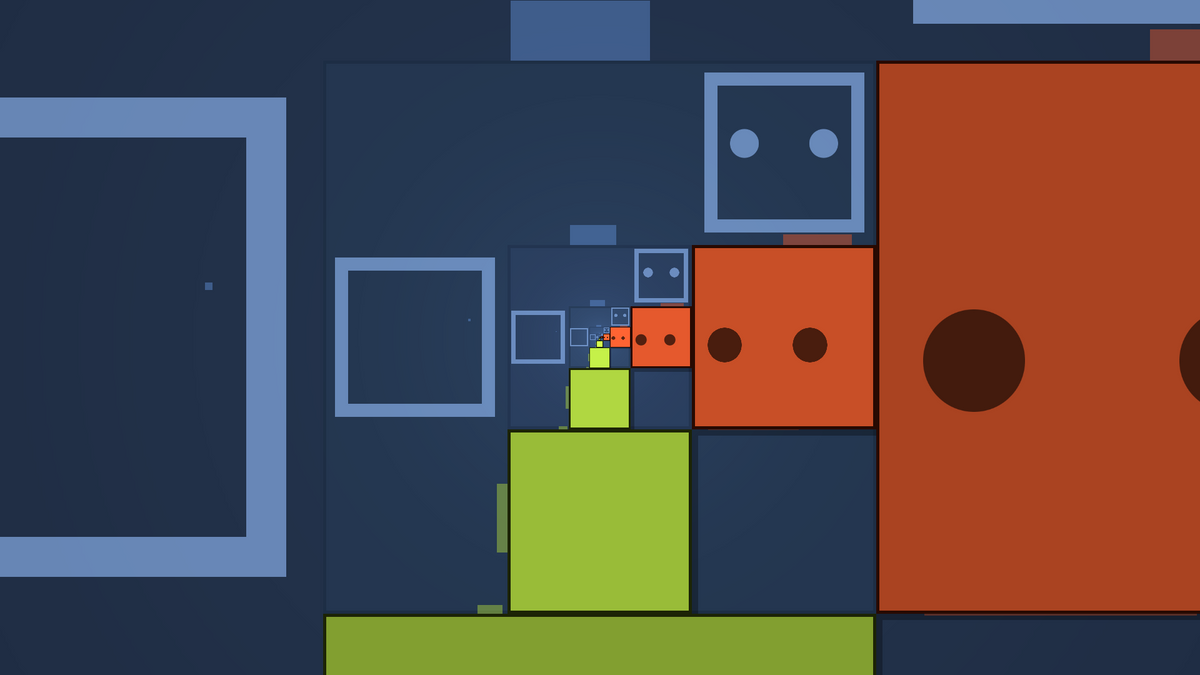
Featured image: repeated rooms and characters recede through nested spaces. Unmodified official gameplay screenshot, © Patrick Traynor. Capture platform and build unspecified.
Give the box two names
Start with the distinction visible in the images: an object can occupy space in a larger room while presenting an interior of its own. Calling it only a box makes it sound like ordinary cargo. Calling it only a room forgets that it is something you can move.
Our suggestion is to give it two jobs in your explanation. Describe the container's position separately from the space it contains. Moving an object across the larger room and moving through its interior are different ideas, even when both involve the same cheerful square. Keep those ideas separate long enough to see how they interact.
The first image below makes the distinction easier to hold in your head. A compact room contains a character and several differently colored objects. Some objects show interior shapes. Before proposing a sequence of pushes, take a moment to identify which visible spaces belong to which objects. You are building a description of the problem before trying to solve it.

Work on one relationship at a time
The developer describes a recursive system, including using infinity as part of the puzzle. That is the premise. You do not need a lecture on computer science before looking at a doorway.
A practical approach is to narrow your next question. Are you trying to change an object's position in the current room, or to make use of the space inside it? Hold that question steady while considering a move. If your explanation keeps jumping between scales, pause and name the relationship again.
This is advice for organizing your reasoning, not a solution formula. A room may ask for a surprising interaction. The point is to recognize what you are testing so that a surprise teaches you something. Random pushing can produce activity. It does not automatically produce an explanation you can reuse.
The blue-room capture below is useful because a small version of the surrounding arrangement appears inside a box on the right. You can compare the larger arrangement with the smaller one rather than treating every little shape as unrelated decoration. The image illustrates the nesting idea without supplying a step-by-step answer to its puzzle.

Keep an experiment small enough to explain
When a puzzle becomes confusing, an enormous sequence of guesses can make it harder to understand what changed. Our suggested habit is to state a modest prediction first. Which space do you expect to enter? Which object do you expect to move? What should look different afterward?
Then compare the result with that prediction. If the result differs, you have a specific misunderstanding to investigate. If it matches, you have learned something about the system even when the whole level remains unsolved. Progress can be a better explanation, rather than immediate access to the next screen.
A useful note can be one sentence describing a relationship. It does not need to be an elaborate diagram of every nested room. Writing a paragraph so complicated that you need a second puzzle game to interpret it is probably a sign to reduce the scope.
Use the puzzle selection to pace the session
The official press kit lists more than 350 handcrafted puzzles and optional challenge puzzles. That distinguishes the amount of content from a requirement to solve every difficult-looking branch immediately.
Our take: treat a session as an opportunity to understand an idea, rather than a race through a predetermined number of puzzles. If one arrangement has become a wall of unproductive guesses, take a break. Returning with a clear description of what confused you gives the next attempt a purpose.
The selection-screen image presents multiple small arrangements connected across a larger space. It is a useful visual reminder that the game explores a system through many individual problems. You can appreciate the broader collection without needing to digest the entire thing in one sitting.

Try the idea, then choose your next puzzle
The creator's itch.io page confirms Windows, Mac and Linux versions and points to a demo on Steam. The official press kit also lists Nintendo Switch and PlayStation 5 releases. Check the listing for the platform you intend to use; a PC demo is not a promise of a demo on every console.
Patrick's Parabox is an interesting choice when you want to spend time untangling spatial relationships. Its central trick gives familiar box-pushing a different question: what if rearranging the object also rearranges your access to another space?
Keep your next puzzle on the Zypher shelf. For separate games to consider, check Zypher's listings for Portal 2 on Xbox 360 and Scribblenauts Unlimited on Wii U. These are different games, not editions of Patrick's Parabox. Read each listing's platform, condition and included contents. Shop Zypher's games or sell your old games to Zypher when it is time to reorganize the real boxes.
Sources, product listings and official press imagery checked October 27, 2026. Learning suggestions and design readings are Zypher editorial interpretation. All images are unmodified captures supplied through the developer's press kit.


