
Slay the Spire gives you cards to play and a reason to stop staring at them. The enemy has information above its head. Before spending the turn on a beautiful attack, look at what is coming back.
This is a guide to reading the original Slay the Spire's combat screen, using Mega Crit's official press screenshots as examples. They are older promotional captures, visibly dated September 2017, not a claim about today's exact card balance. Read the effects in your installed version before acting. The useful habit is to consider the whole position before committing to the first promising card.
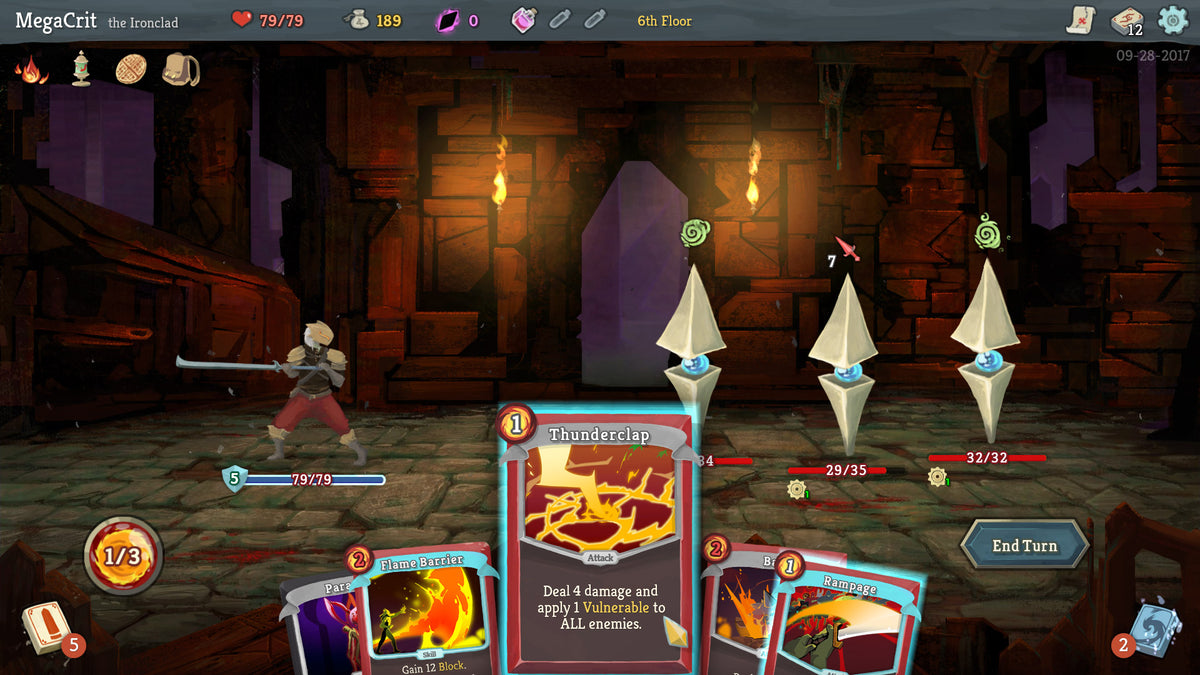
Featured image: the Ironclad facing three enemies with Thunderclap selected. Official in-game promotional screenshot from Mega Crit's Slay the Spire press kit, © Mega Crit. Unmodified; historical capture.
Start across the room
In the featured example, one enemy has a sword symbol with a number above it, while the neighboring enemies show different symbols. That is your reminder to inspect each opponent rather than treating a group as one shared threat.
Our recommended reading order starts with the enemies, then moves to your current protection, health and available cards. Ask what each opponent is indicating and what you can change before ending the turn. If you do not understand an icon, use the game's explanation instead of deciding that it probably means something harmless.
That last assumption has an impressive ability to become expensive. The advantage of a turn-based fight is having room to examine the position. Use that room. A card glowing invitingly at the bottom of the screen does not know which part of the fight you forgot to inspect.
Count what the shield actually covers
The Silent screenshot below gives a simple visual comparison: the enemy displays an attack value of 18, and the player's shield displays 16. Those two visible numbers differ by two. That comparison alone does not resolve every effect in the pictured battle, but it does show why seeing a shield is not the same as checking its amount.

Try describing the immediate problem before selecting the answer. Is there incoming damage you intend to cover? Is there an opponent you think you can finish first? Does your proposed sequence depend on a condition that is actually present? These are questions for the current hand and current enemies, not rules demanding the same response every turn.
Write down the order of a complicated sequence if that helps. Reconsider it before the first commitment, rather than halfway through discovering that the plan needed a resource you already spent. A good-looking individual play can still belong to a badly ordered turn.
Read the whole effect, including its limits
The press kit's card-library image includes effects with different time limits and conditions. Some refer to the current turn, some to combat, and others change how another mechanic behaves. The card's name and illustration are not enough to establish what happens.

For a card you have not used before, identify the action, the condition and the duration separately. Then connect those words to the position on screen. If a benefit needs a condition you cannot meet, admiring the benefit does not activate it.
Keep that habit when changing characters. Mega Crit's current Steam description identifies four characters with their own card sets. Familiarity with one collection of effects is useful experience, but it is not permission to stop reading another.
Judge the decision before blaming the climb
Mega Crit describes a changing layout, different enemies and relic interactions between attempts. A loss therefore needs a narrower question than whether the entire run was unlucky. Look for one decision you can explain and one piece of information you missed.

Our suggestion is to review the last understandable decision, not invent a complete theory from the final screen. Did you overlook a displayed value? Misread a condition? Spend resources in an order you would change? Pick something observable. That produces a better next experiment than declaring every card involved terrible.
This guide concerns the first game. Mega Crit's FAQ treats the sequel separately, including its multiplayer features. Check the title and edition when comparing advice, purchases or a video demonstration.
Choose your next game at Zypher
Buy your next physical game from Zypher Trading Video Games. Browse our game collection and check the exact console, condition and included contents on the listing before ordering. This article does not represent a stocked Slay the Spire offer.
Have games you are ready to move on from? Sell your old games to Zypher and make room for the next shelf decision.


