
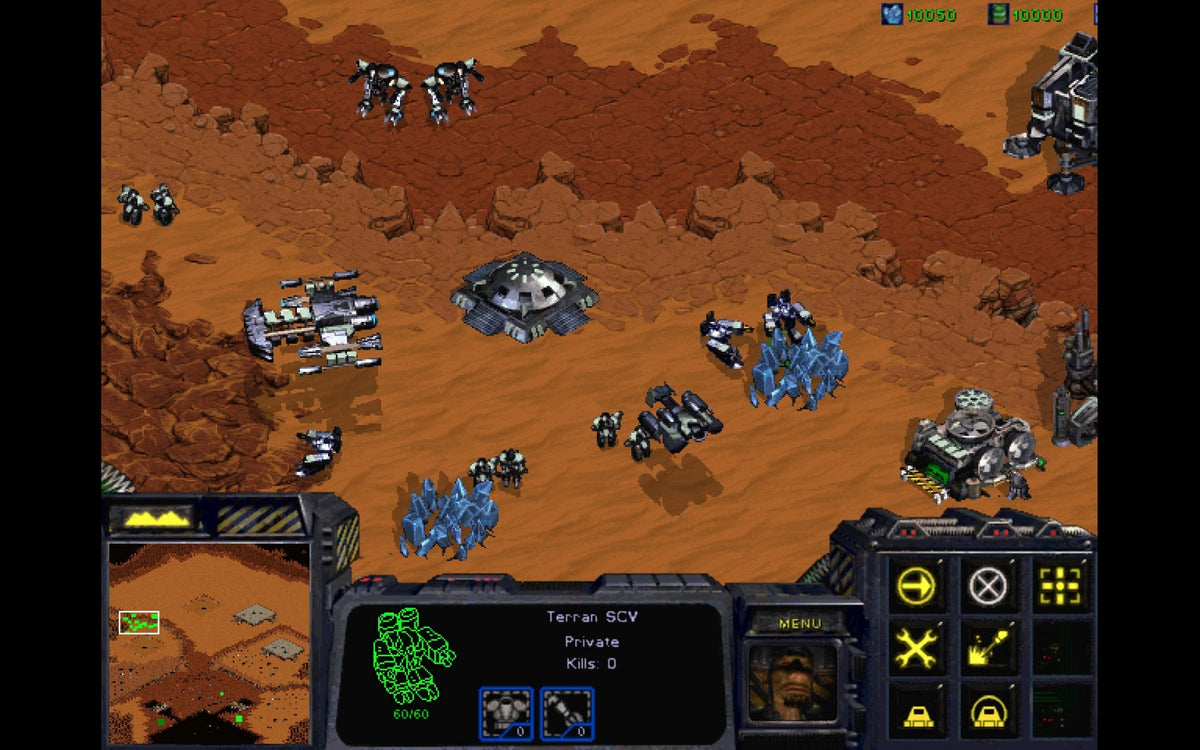
StarCraft makes a construction worker an interesting strategic decision. A Terran SCV stays busy while a building goes up. A Protoss Probe starts the warp-in and can leave. A Zerg Drone becomes the structure. Three armies, three different answers to a job that could easily have been identical behind different artwork.
That is a useful way into Blizzard’s 1998 real-time strategy classic. Before worrying about tournament legends or clicking faster, look at what happens inside the base. Workers, construction and production give each faction a personality before its army reaches the enemy.
This deep dive focuses on those original-game systems and how to approach them on a return visit. Brood War and Remastered belong in the ownership discussion, but they are not interchangeable names for the original release.
Featured image: a Terran base in Blizzard’s 2017 SD comparison capture, showing the classic rendering. Publisher-supplied image, not a new Zypher playtest capture. © Blizzard Entertainment.
The first difference is standing beside the building
Blizzard’s Probe reference sets out the construction contrast: the Probe initiates a warp-in and can take another assignment; the SCV remains occupied during construction; a Zerg Drone is lost in its transformation into a structure.
Our reading is that StarCraft makes the worker’s next job part of the building decision. The purchase is more than the object appearing on the ground. You also need to consider the unit that started it and what that unit will be doing afterward.
That is a stronger expression of faction identity than changing a factory’s paint. Even before comparing weapons, the three sides ask you to maintain different habits. Learn one construction routine, then carry it into another faction without thinking, and you have brought the wrong instructions to the building site.
Protoss: start the job, then give the Probe another one
The Probe guide confirms that one worker can initiate several warp-ins when resources permit. It can return to gathering after starting a structure rather than waiting for completion. That is a particular construction advantage, not evidence that Protoss is automatically the best beginner faction.
For a returning player, our advice is to watch the worker after placing a building. If you leave it standing there, the freedom to move on has bought you very little. Decide where it belongs next, then check that it actually received the assignment.
This is also a good reason to resist judging a base by its impressive-looking buildings alone. A tidy arrangement says little about how much attention its workers are receiving. The expensive part of the screen will happily absorb your admiration while a small unit waits for instructions.

Terran: remember the job after construction
The SCV’s construction commitment gives the same decision a different shape. You have assigned a worker to a job that occupies it while the building goes up. Remembering the next assignment matters even when the construction itself is proceeding correctly.
Blizzard’s classic controls guide documents a useful sequence: hold Shift while issuing the building order, then right-click a mineral patch or Refinery. Once construction finishes, the SCV starts gathering. This is a queued follow-up order, not a way to make construction instantaneous.
Try that with one building before turning it into a habit. Watch the SCV begin the work, finish it and take the follow-up assignment. The useful result is a complete sequence you understand. Frantically adding commands because the game is in real time is an excellent way to become very busy and poorly informed.
Zerg: the worker becomes part of the colony
Blizzard’s Drone reference explains that a Drone becomes the structure and is permanently lost when the transformation finishes. Canceling before completion can recover it. The guide explicitly connects construction to replacing Drones so that resource gathering and development stay balanced.
For a newcomer, the useful habit is to look back at the workforce after growing the base. A completed structure is visible progress, but it does not tell the whole economic story. What did that addition do to the units still gathering?
The biological presentation consequently does real work. Zerg structures grow out of units that were previously employed elsewhere. The colony is consuming part of its workforce to expand. Your building contractor has become the building, which is certainly one way to eliminate the commute.

Larvae connect the economy to the army
The official Larva entry describes Hatcheries, Lairs and Hives producing Larvae. Those Larvae develop into available breeds, with additional structures expanding the colony’s options. Workers and fighting units therefore draw on a shared production source.
Our interpretation is that this makes the next production decision unusually revealing. Another Drone supports the economy; a combat unit answers a different need. The correct choice depends on what you are trying to accomplish now, not on which creature looks more impressive in the command panel.
On a first revisit, notice that choice before trying to memorize a complicated opening. Look at the workers, the army and the immediate objective. Explain the next decision to yourself in plain language. That gives you something useful to reconsider when the plan meets an opponent.
Twelve-unit groups make organization matter
The controls reference documents assigning a building or up to twelve units to a number with Ctrl and a key from 0 through 9. Press the number to select the assignment, or press it twice to center the view. Shift plus F2, F3 or F4 saves a map location; the corresponding function key returns the camera there.
These are different tools. A control group recalls an assigned selection. A saved location recalls a place. Knowing which you need is more useful than trying to demonstrate every shortcut at once.
Our recommendation is to start with assignments you can remember and actual jobs you want to revisit. Give yourself a reliable route back to production and a way to find the force you are directing. The twelve-unit limit also means one group should not be mistaken for a magic handle on every soldier you own.
The campaign gives those systems a setting
In its retrospective on story presentation, Blizzard describes the original game’s spacecraft briefings, between-mission text crawls and battlefield storytelling through unit close-ups, voiceover and character portraits.
That gives a returning player something to follow beyond the pressure to improve. Read the briefing and the objective, then connect the mission’s demands to the faction’s tools. Finishing a scenario and becoming comfortable with the whole game need not happen at the same pace.
Our view is that the campaign is worth approaching as a sequence of particular situations. Ask what this mission wants from you before treating every problem as an invitation to build the same army again. A recognizable setting helps give those otherwise abstract production choices a purpose.
Original collecting and Remastered are separate purchases
Blizzard’s Remastered release notice describes a modernization of StarCraft and Brood War with upgraded graphics and sound. Its art retrospective explains the effort to retain recognizable unit identities while increasing detail.

For a collector, separate the physical object from the route to playing. An original boxed release, an expansion package and a modern digital product are different purchases. Check the exact contents and current requirements of the version you intend to use. An old box is not a promise of a current account entitlement or installation on every computer.
Decide what you want to own before comparing listings. Original packaging calls for an examination of the included material and its condition. Convenient play calls for checking the current product and requirements. Neither decision improves when somebody invents a rarity figure or predicts what your copy will be worth.
Put another strategy game on your Zypher shelf
Buy your next physical game from Zypher Trading Video Games. For a separate console strategy title, check Halo Wars for Xbox 360. Read the selected copy’s condition and included contents before ordering.
Shop Zypher’s games, or sell your old games to Zypher when it is time to make room. Sources and listing checked November 6, 2026. Gameplay observations and revisit suggestions are Zypher editorial analysis based on the linked Blizzard references.


