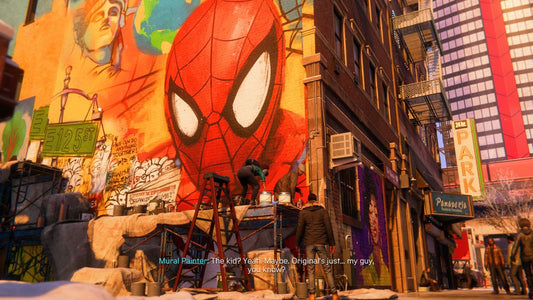
Marvel Spider-Man
Important: Game may not include original DLC, bonus-content, online-pass, season-pass, or other digital redemption codes. Any included codes may have already been redeemed or expired.
Preorder and launch bonuses, promotional or bonus inserts, and bundled bonus-game downloads are not guaranteed. Content supplied on the game disc or cartridge is unaffected.
Peter Parker's double life in Marvel's New York
Marvel's Spider-Man for PlayStation 4 begins with an experienced Peter Parker who has already spent eight years protecting New York. Insomniac Games builds an original story around that established hero, placing his work, friendships, and responsibilities alongside the larger danger facing the city. Wilson Fisk and the Inner Demons are part of a conflict that reaches beyond isolated street crimes, while Martin Li's connection to the F.E.A.S.T. shelters brings the problem close to Peter's personal life. The result is an action adventure in which the person beneath the mask matters as much as the hero crossing the skyline.
Swinging, wall running, and finding a route
Movement makes Manhattan more than a backdrop between missions. Webs attach to buildings, and Spider-Man can combine swinging with wall running and parkour to keep a route flowing through the city. A street, rooftop, or building face becomes part of the same journey instead of a separate obstacle course. Looking ahead helps you choose where to gain height, where to turn, and how to reach a useful perch. Learning to connect those actions gives ordinary travel its own satisfaction, whether you are following a story objective or simply crossing a neighborhood.
Web zips provide a more direct burst of movement through the air, while perching lets Spider-Man settle onto an object and consider his next move. Those tools complement the arc of a swing rather than replacing it. They make it possible to alternate broad movement across open streets with precise changes near a destination. The game's movement controls also carry into encounters, where closing a gap or gaining a better position can quickly change which enemies threaten you.
Acrobatic fighting with choices inside every encounter
Combat combines close strikes, dodges, webs, and attacks in the air. Spider-Man can zip toward an enemy or pull one closer, then launch a target upward and continue the combination above the crowd. Fighting builds Focus for powerful finishing moves. Nearby objects can also become weapons, letting a street fixture or loose piece of the environment interrupt an opponent. These actions make a fight about positioning and choosing a response as well as landing hits: an enemy with armor or a dangerous weapon may deserve attention before the closest unarmed opponent.
Gadgets broaden those choices. Impact Web can pin a target to a nearby surface, while other devices help control a group or set up an attack. Stealth opportunities let Spider-Man use his mobility to reach a better angle before committing to open combat. A perch can provide a useful view of a guarded area, and isolating an enemy can prevent a larger fight from beginning on unfavorable terms. The laboratory side of Peter's character therefore has a direct role in the action, supplying practical tools alongside his strength and agility.
Different opponents require different priorities. A crowd containing a heavy bruiser and someone attacking from a distance puts more demands on your attention than a group of similar enemies. Webbing one target, moving away from another, and using a gadget at the right moment can create room to recover control. Skill upgrades expand that vocabulary over the course of the game. The appeal is in developing a set of moves that works together, then adapting it when a mission changes the mix of enemies or the available space.
Progression and the city beyond the main story
Completing missions and activities develops Spider-Man's abilities and opens more customization. Experience contributes to skill progression, while activity rewards support suits, gadgets, and upgrades. The skill trees cover different aspects of fighting and movement, giving you choices about which techniques to learn next. Suit powers add another layer to a combat setup. Changing equipment can therefore affect how you approach a challenge as well as how Peter looks, and returning to an activity offers a chance to use abilities that were unavailable earlier.
Outside the main missions, the city contains crimes to interrupt, hidden backpacks to recover, and challenges that test particular skills. Taskmaster's trials give specific goals to work toward, while Black Cat's calling cards encourage closer attention to the surroundings. Backpacks connect collectible hunting to pieces of Peter's earlier life. These activities make a longer trip across Manhattan useful for several reasons: you may improve a skill, collect a needed reward, or uncover another small part of the character's history along the way.
Investigations, quieter moments, and Photo Mode
The pace changes when Peter steps away from direct crime fighting. His work in the laboratory includes technology puzzles, and visits involving Aunt May and the shelters keep his everyday obligations present. Some missions put you in control of Mary Jane Watson as an investigative journalist. Her sections rely on observation, movement, and problem solving without Spider-Man's superpowers. These shifts give the story room to show information from another perspective and make the return to Peter's more physical abilities feel distinct.
Photo Mode, available after installing update 1.04 or later, offers another way to spend time in the city. It freezes the action so you can adjust the camera, field of view, focus, filters, and other presentation options around a chosen moment. A wall run, a leap, or a gadget in use can become the subject of a carefully framed image. Selfie options, frames, and stickers support a more playful approach. It is an optional creative activity that makes use of the same detailed suits and environments you encounter during ordinary play.
This listing is for the original PS4 game. The City That Never Sleeps is a separate three-chapter story expansion, and its inclusion in the later Game of the Year package does not make it part of every standard copy. Any included codes or physical extras depend on the specific item and condition. The core attraction here is Peter's original adventure, with its connected mix of city traversal, combat, investigations, and personal storytelling.