
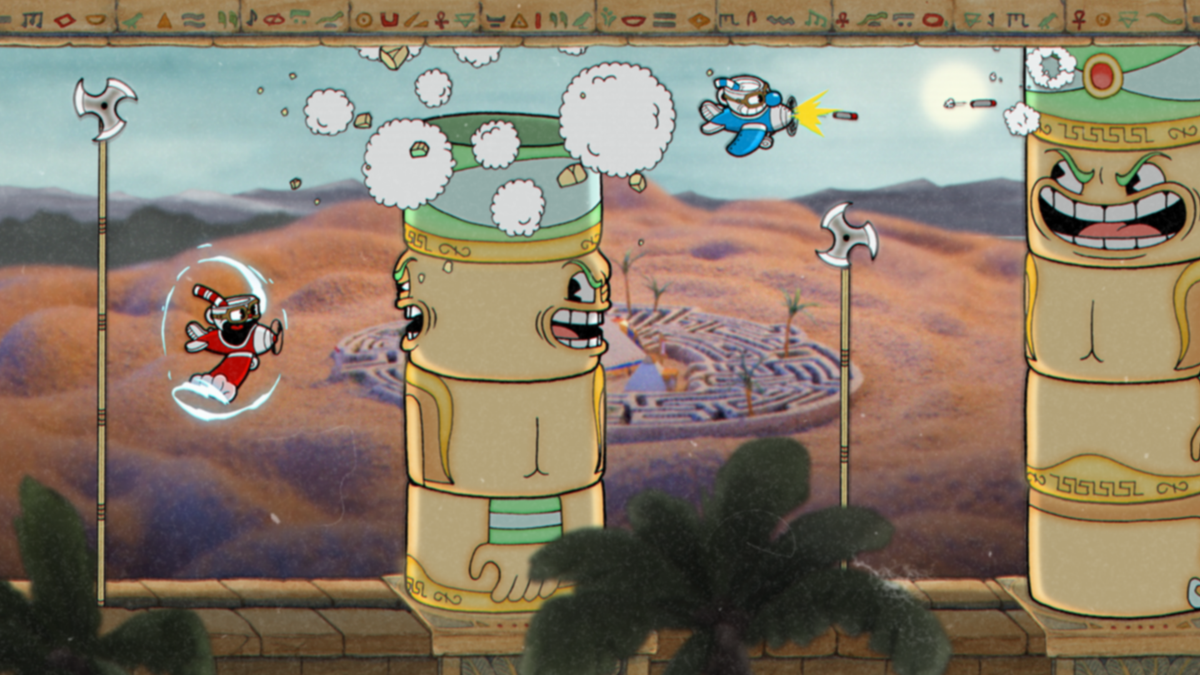
Featured image: an aircraft encounter with Djimmi the Great. Official Studio MDHR press screenshot. © Studio MDHR.
Cuphead can make a failed attempt feel like a verdict on your reflexes. A more useful response is to ask where the fight stopped making sense. Did you lose track of your character, move before you understood the threat, or keep attacking after your escape route had disappeared?
Studio MDHR describes the original Cuphead as a run-and-gun game focused on boss battles, with solo and local cooperative play. That focus makes a repeatable practice routine valuable. The next attempt should test a decision, rather than simply repeat the previous disaster with a more determined expression.
Here is our suggested routine for learning an unfamiliar encounter. It is editorial advice, not a claim that the game has a hidden practice score or one correct strategy for every boss.
Name the problem before changing your loadout
After a loss, give the trouble a short description: “I watched the boss instead of my landing,” “I moved into the next obstacle,” or “I had nowhere left to go.” Those are different problems. Buying into a new weapon plan before identifying which one occurred can turn an equipment change into a distraction from the actual mistake.
Keep the description about something you can observe. “This boss is impossible” does not tell you what to do next. “I cannot tell when that crowded section becomes unsafe” gives the next attempt a job. Cuphead's cast is already dramatic enough without your notes auditioning for a part.
For the next run, choose a single question. Try to recognize the troublesome moment earlier, or notice where you were standing just before it. You do not need to solve the whole encounter to learn something useful about one section.

Read the space around your character
The official Pirouletta screenshot above has several obvious attractions: the character on the left, the giant background figures and the bright chips across the middle. For planning movement, though, the important relationship is between Cuphead and the nearby objects. A striking boss portrait and a safe place to move are different pieces of information.
Our recommendation is to notice what is close enough to demand a response before committing to another movement. Look for the space you intend to occupy, not just the object you want to avoid. An escape plan needs a destination. Moving away from one threat without looking at the landing can simply arrange an introduction to the next one.
A screenshot cannot establish the timing or collision behavior of a moving encounter. Use it to think about spacing, then check your idea during play. Treat a failed movement as evidence about that situation, rather than assuming the same direction must always be wrong.

Separate a new scene from a familiar problem
Cuphead's presentation can make an encounter feel like a succession of elaborate performances. The Sally Stageplay press image puts Cuphead and Mugman on a wedding set, complete with curtains and an audience. It is a useful reminder to look again when the scene changes instead of carrying your attention forward on autopilot.
When something unfamiliar appears, first identify what you can actually see: your position, the usable space and the nearest obstacle. Avoid demanding a perfect response to a section you have barely observed. Make the immediate objective understanding that section well enough to describe it afterward.
This is also a reason to separate learning from finishing. A run that reaches unfamiliar material and gives you a clear observation can be useful even when it ends there. That does not make losing magically enjoyable. It gives the next attempt something more specific to accomplish than “be better.”
Change one part of the plan at a time
The developer identifies weapons and super moves as part of Cuphead's toolkit. Read the descriptions for the equipment you have, then decide what problem you want a change to address. Avoid changing several things and your movement plan simultaneously. If the result improves, you want to understand which adjustment helped.
For example, keep your equipment while testing a different position in the section that causes trouble. On another attempt, keep the position plan while trying equipment you believe suits the encounter better. This is a comparison method, not a promise that a particular weapon defeats a particular boss.
Give a promising change enough attention to judge it. One chaotic attempt may tell you very little. Equally, do not keep repeating an approach when you can already describe why it leaves you trapped. Persistence is more useful when it carries a revision along.

Make the next co-op attempt a shared experiment
In local cooperative play, agree on the troublesome section before restarting. Each player can describe what they noticed and the movement they intend to try. Two people silently revising different plans can make it hard to tell whether the new attempt actually tested anything.
Keep the conversation concrete. “Watch where we land in that section” is more useful than narrating every mistake your partner makes. You are trying to learn a cartoon fight together, not conduct a disciplinary hearing for Mugman.
When attention starts slipping, stop the session with a note about the next experiment. Remembering the problem is more valuable than squeezing out another attempt whose only plan is irritation. Return with one question, test it, and build from the answer.
Find your next challenge at Zypher
For Cuphead expansion and package questions, read our Delicious Last Course ownership guide. For other physical run-and-gun games, check Contra for NES and Contra: Shattered Soldier for PlayStation 2. These are separate games, not Cuphead editions; read each listing's condition and contents.
Buy your next physical game from Zypher Trading Video Games. Browse our games, or sell your old games to Zypher and make room for the next challenge.
Sources and Zypher listings checked October 30, 2026. Game features and image identifications: Studio MDHR's official press kit. Practice recommendations are Zypher editorial advice. All images are unmodified official gameplay press captures. © Studio MDHR; capture platform and build unspecified.


