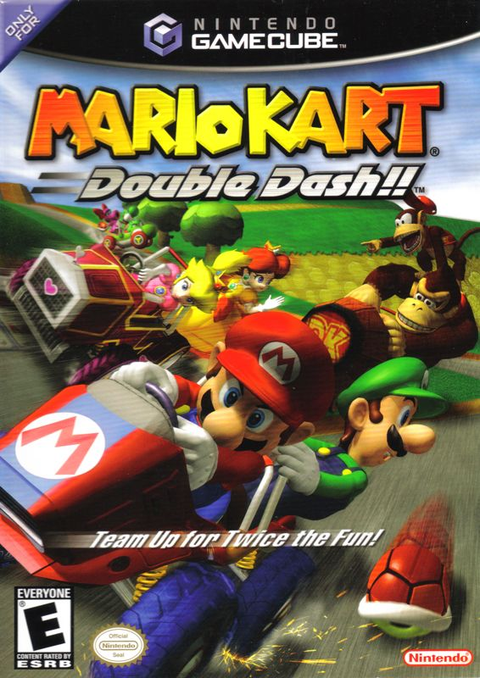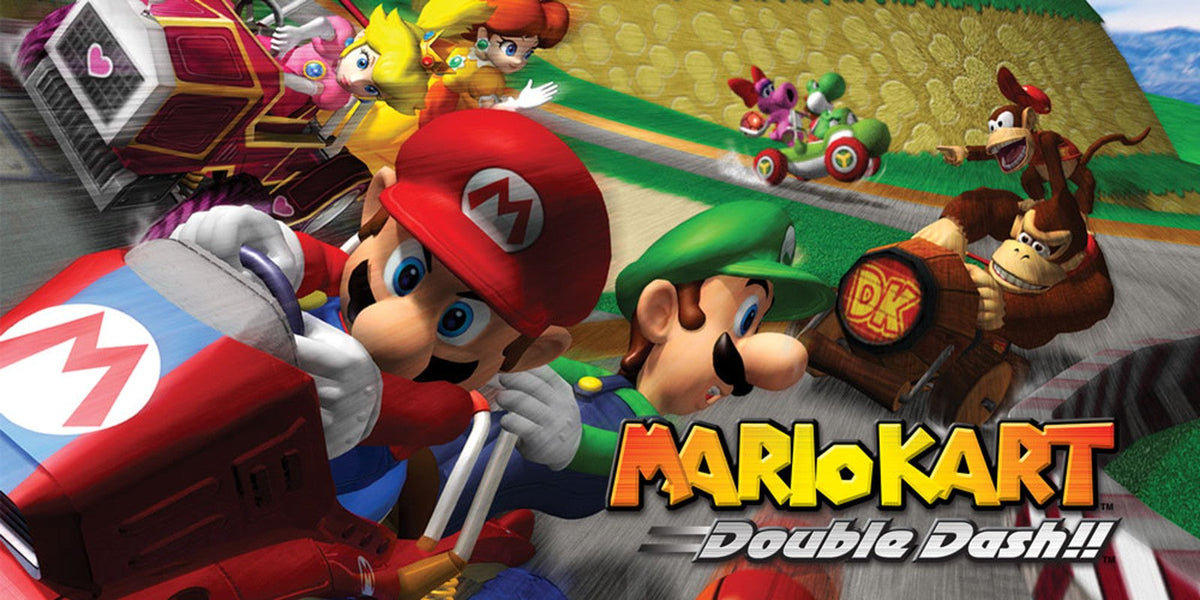
Mario Kart: Double Dash!! did more than put two characters in one kart. It split one racing machine into two jobs, then asked players to decide who should drive, who should hold the item and when both roles needed to change. Mario Kart has always turned friendships into very polite accusations. Double Dash simply gave the passenger evidence.
Nintendo released the game for GameCube in 2003, and the two-rider setup remains its defining idea. It changed character selection, item strategy and local multiplayer without replacing the readable racing underneath. You still steer, drift, dodge and chase the finish. Now there is somebody in the back seat carrying a giant shell and judging your line through the corner.
Two characters created a real decision
Nintendo's official game page explains the basic rule clearly: two characters ride in each kart, and the Z Button swaps their seats. The driver handles the road. The passenger collects and uses items. In a solo race, one player controls both roles, so switching is less about spectacle and more about putting the right character in the right position before the next item box.
That matters because characters have special items. Nintendo highlights examples such as Bowser's giant shell and Donkey Kong's oversized banana. Pairing characters therefore builds an item plan before the race begins. A team can combine two different special-item possibilities, but only the passenger is in position to use what the kart collects.
The clever part is how quickly that choice stays readable. Double Dash does not turn the race into a strategy menu with wheels. The character models are physically sitting in front and back, the passenger visibly holds an item, and one button changes the arrangement. The tactic is always on screen. Even during the usual shell-powered chaos, you can tell what your kart is prepared to do.

Co-op turned one kart into a conversation
The original instruction booklet separates single-player control from co-op control. In co-op, two people can share one kart, with one handling the front role and the other working from the back. That makes the same seat-swap idea feel completely different. A solo player decides when to switch. A co-op pair has to communicate.
That division gives the passenger something useful to do instead of reducing the second controller to moral support. The rear player watches items and nearby threats while the driver protects the racing line. Both players are following the same track, but they are reading different problems. A clean lap becomes a small teamwork exercise with banana peels.
It also creates wonderfully specific blame. The driver can miss a shortcut. The passenger can mistime an item. Both can disagree about when to swap. Traditional split-screen gives each player a separate kart and a separate disaster. Double Dash lets two people build one disaster together, which is much more efficient.
The mechanic changed the cast, not just the controls
Two riders meant Nintendo needed a larger character roster and more combinations. The official game page lists familiar drivers alongside additions such as Baby Mario, Baby Luigi, Diddy Kong and Waluigi. Pairings are not restricted to tidy franchise friendships, so the selection screen becomes part racing decision and part Mushroom Kingdom buddy comedy.
That freedom gives repeated races a different texture. Changing one member of the pair changes the special-item possibilities without forcing the entire kart concept to disappear. The game can stay immediately recognizable while the team plan changes. It is a simple way to add variety without burying players under upgrade trees, stat spreadsheets or a dealership loan application.

The LAN option made the hardware part of the event
Nintendo lists the game for one to eight players and documents linking GameCube systems and televisions through Broadband Adapters. This is local network play, not a promise that Nintendo's old online services are waiting behind a menu. The distinction matters for anyone rebuilding the setup today.
The normal disc is only one part of that larger arrangement. A linked event needs the supported hardware, cables, displays and game copies described by Nintendo's LAN instructions. A product listing for the game should never be read as including that equipment unless the listing says so. Retro multiplayer is fantastic, but it remains stubbornly unwilling to assemble its own cables.
As a preservation feature, LAN support shows how far Double Dash pushed its central idea. Two riders could share a kart, several players could share a screen, and linked systems could expand the room. The game kept scaling the same question: how many people can participate without losing the readable rules of a Mario Kart race?
Why the experiment still stands apart
Later Mario Kart games expanded online play, vehicle options and track presentation, but Double Dash's two-seat system still gives the GameCube entry its own identity. The mechanic is visible, easy to explain and deep enough to change decisions every lap. That is a strong design trick. The game adds teamwork without asking the race to stop and admire the feature.
If you are buying a copy now, check the live condition carefully. Zypher's Mario Kart: Double Dash!! GameCube listing currently has an active in-stock disc-only option. That means the listing does not promise an original case, manual, bonus disc, Broadband Adapter or other hardware. Read the selected condition before ordering, then bring your own co-driver and your own explanation for that last-place finish.
Want more GameCube picks after the race? Browse Zypher's GameCube classics guide, shop the live game listing above, or sell your old games to Zypher.
Sources
- Nintendo: Mario Kart: Double Dash!! game page, checked October 24, 2026.
- Nintendo of Canada: Mario Kart: Double Dash!! instruction booklet, preserved by Internet Archive and checked October 24, 2026.
- Nintendo: Mario Kart: Double Dash!! LAN setup instructions, checked October 24, 2026.