
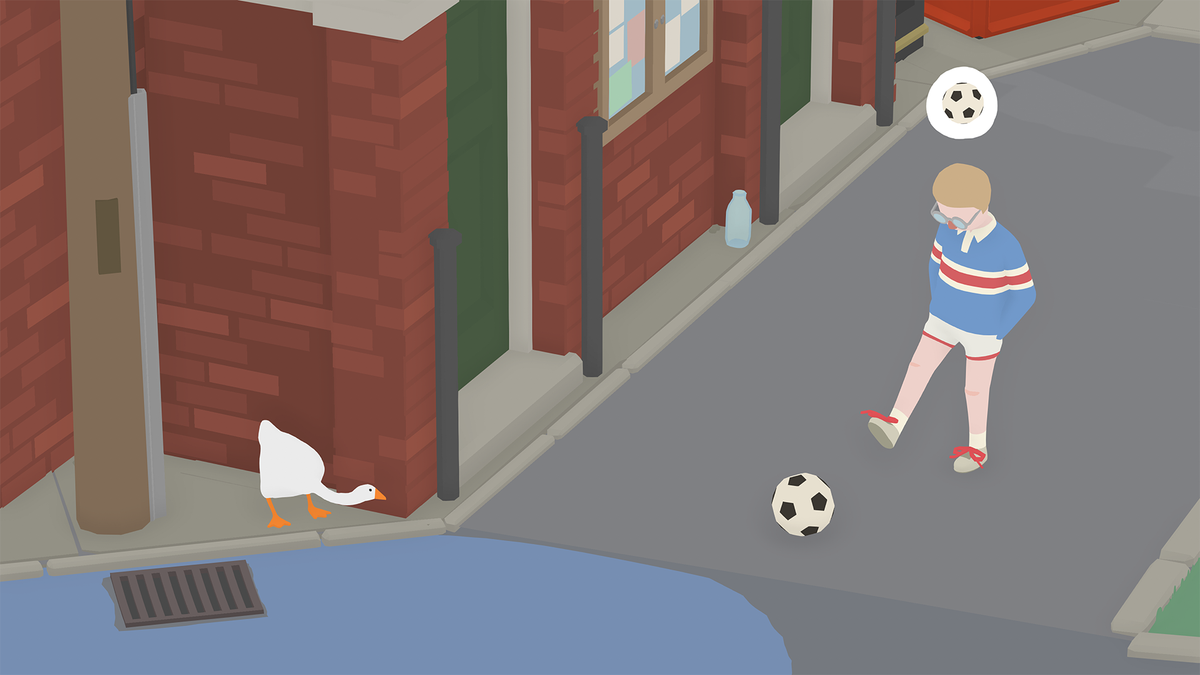
Playing the goose in Untitled Goose Game does not need a tragic backstory to sell the premise. It has a beak, an appalling attitude and a dedicated honk button. That is enough to turn an ordinary village into a series of deeply personal disagreements.
House House's game, published by Panic, mixes stealth with slapstick. Its official description puts you among back gardens, shops and the village green, arranging pranks and stealing hats. Our reading is that the smallness of those ambitions makes the comedy work. You are not rescuing civilization. You are making somebody's perfectly reasonable afternoon worse.
The ordinary village supplies the stakes
A goose carrying a stolen object is funny because the object belongs in a recognizable routine. Someone was using that thing. Someone expects it to stay where they left it. The prank gains meaning from the gap between their ordinary expectation and your extremely unnecessary intervention.
The official screenshots make that contrast clear. A person reads beside a table while a goose stands nearby holding a sock. Elsewhere, a gardener works beside a goose concealed among plants. These are domestic spaces with domestic priorities. The player arrives as an animal that has declined to respect either.
That gives the setting a useful kind of scale. A garden does not need to be enormous when a table, an object and a person already suggest a possible situation. The interesting distance is between what the villager wants and what you are about to do. The village can remain visually calm while the player starts considering something ridiculous.

Stealth becomes a question of comic timing
Stealth normally asks whether you can pass through a place without being noticed. Goose mischief gives attention another purpose: it is part of the joke. A prank needs a setup, something out of place and a reaction worth watching. Thinking about that sequence is more interesting than treating every encounter as a race to the next task.
For a first session, our recommendation is to watch a scene before rushing into it. Notice the people, the nearby objects and the space between them. Then choose a small experiment. The point is to understand what changed after your action, rather than assuming that more frantic honking will explain the situation. Honking remains a compelling proposal, obviously.
This is an editorial approach, not a hidden scoring rule. We are not claiming that the game awards points for patience or requires one approved method. The useful habit is observation: if you understand the setup, the result of disrupting it becomes easier to read.

The goose makes a readable lead character
Our interpretation is that the character's limited vocabulary helps. There is no long argument to follow before you understand the relationship. The bird wants to interfere. The humans would prefer it stopped. A honk can carry the entire disagreement without anyone needing to deliver a monologue.
The press image of a goose beneath a pub table, holding cutlery while two people stand nearby, captures that appeal. The arrangement is legible at a glance: the bird has something, the people have noticed a problem, and the table places them differently in the scene. The image invites you to imagine the next few seconds.
That is why the game is an appealing choice for players interested in small, expressive interactions. The attraction is the situation itself. If your favorite part of a game is noticing an opportunity and seeing what happens, a goose can supply a surprisingly clear purpose.

A second goose changes who shares the joke
The developer's official FAQ confirms two-player cooperation in the same levels. It is local play, not a built-in online multiplayer mode. Two controllers are required; on Switch, each player can use a single Joy-Con, so a pair can serve both players.
Our recommendation is to agree on a prank before both players improvise. Describing the plan gives each person a reason to watch the other goose. Ignoring the plan may also be funny, but it is useful to know whether your partner is helping or has started a separate criminal enterprise beside the flowerbed.
Returning later does not require preserving every displaced object. The FAQ says the game saves automatically and keeps progress while tidying the village when you return. That makes completed progress different from the temporary mess visible during a session.
Bring the goose home with Zypher
Shop Untitled Goose Game for Nintendo Switch at Zypher. Check the listing's condition and included items before choosing your copy. For another unusual playground, browse Katamari Damacy for PlayStation 2, or sell your old games to Zypher and make room for your next game night.
Sources checked October 27, 2026: House House/Panic's Steam description, the official FAQ and official press kit. Design readings and play suggestions are Zypher editorial commentary. All four images, including the featured street scene, are unmodified official gameplay press images.


