
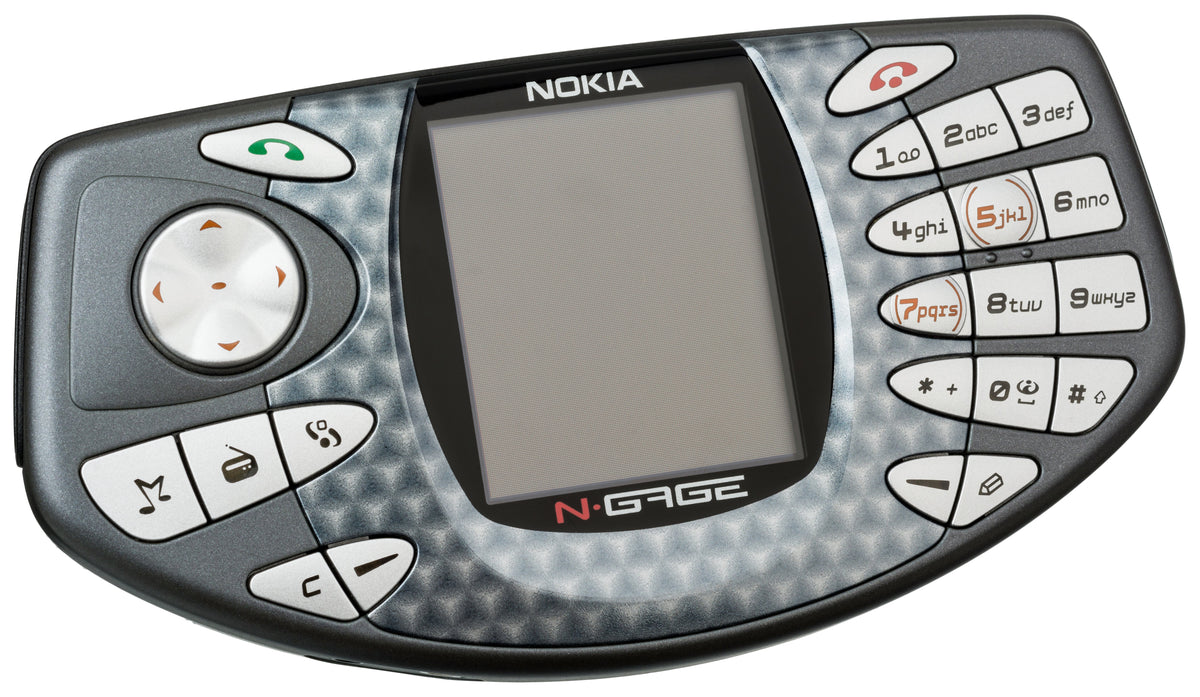
Nokia N-Gage asked you to carry your phone and your games in one device. Fair pitch. Then the original hardware asked you to remove the battery to change games. Suddenly, carrying two things sounded less unreasonable.
That awkward exchange explains more than another joke about its shape. N-Gage was a serious attempt to put dedicated game controls, physical software and connected play into a phone. Nokia redesigned it, then reused the name for a different service. Those are two chapters with different ownership problems, and collapsing them into one spectacular flop misses the useful part.
The promise: your phone was also your game machine
In its September 2003 launch announcement, T-Mobile said N-Gage would reach its stores on October 7. The carrier promoted wireless gaming features including uploading scores, downloading game guides and competing against recorded performances through shadow racing. This was a connected gaming pitch, not just a handset with a time-killer buried in its menus.
The attraction is easy to understand: dedicated controls for games, phone functions for everything else, and a community extending beyond whoever happened to be sitting beside you. Our take is that combining those jobs was a reasonable ambition. The original design made routine actions harder than they needed to be.
For physical games on other platforms, browse Zypher's game catalog by the system you actually own. A familiar title on a different platform is still a different purchase.

A game change should not require a battery change
GameSpot's April 2004 reporting described the original model's game-swap routine: remove the back cover and battery to reach the game card. It also documented the infamous calling position, with the speaker and microphone on the side of the handset. Nokia had built a phone you held differently to make a call, plus a game machine you partly undressed to change games.
The first issue matters beyond the punchline. Trying a different game is ordinary handheld behavior. Making that action a shutdown-and-open-the-back procedure adds friction every time curiosity wins. That is our design criticism, not a claim that this one inconvenience caused a specific number of lost sales.

QD was Nokia's answer to the complaints
Nokia announced N-Gage QD on April 14, 2004. Its own release explicitly tied changes to customer feedback: a hot-swappable MMC game-card slot, revised controls, longer battery life and a new speaker-and-microphone arrangement for conventional phone use. QD supported the existing N-Gage game library, so this was a hardware revision rather than a fresh software generation.
GameSpot interviewed Nokia's Nada Usina about that feedback and saw the redesigned hardware. Its report also noted a tradeoff: QD dropped the original model's MP3 playback and FM radio. A cleaner gaming proposition did not mean every feature survived.
That makes the redesign worth examining rather than treating it as a footnote. Nokia identified concrete usability problems and changed the machine. The QD announcement is evidence of a response; it is not evidence that the response restored the business. Better card access cannot, by itself, tell us how many people wanted another game phone.

The 2008 N-Gage was a service, not a third game phone
On April 7, 2008, Nokia announced the global launch of an N-Gage mobile games service. Its launch device list included the N81, N81 8GB, N82, N95 and N95 8GB. Players could try and buy downloads, maintain friends lists and participate in N-Gage Arena community features.
That distinction is essential for collectors. An original N-Gage game card and a later service download are different software purchases. Finding an old N-Gage-branded web page does not establish that it can sell you anything today, and finding a compatible-phone list from 2008 does not turn a QD into that later handset.
The brand had moved from selling a particular gaming handset to selling a gaming experience across selected phones. In editorial terms, that was a substantial change in the business proposition, not merely a smaller shell or a revised button layout.
The wind-down came with another storefront direction
On October 30, 2009, PCWorld reported Nokia's announcement that it would stop releasing new N-Gage games. The stated plan kept game sales running through September 2010 and the website and community features through the end of 2010. Nokia directed players toward its Ovi Store and described consolidating games with other mobile content in one place.
Those are the wind-down plans reported at the time, not a present-day service promise. They also give us an evidenced reason for the later platform's retirement: Nokia was changing its distribution strategy. We do not need to invent an internal budget disaster or pretend a handset joke explains a storefront decision six years later.
What is still worth collecting?
The physical hardware remains an unusually clear record of design revision. Compare an original N-Gage with a QD and the customer-feedback story becomes tangible: how you hold it, where the controls sit and how you access software. That is collector interest you can explain without attaching an imaginary investment forecast.
Before buying, establish the exact model, the exact game-card edition and what the seller actually includes. Ask for a demonstration of the intended game starting on that unit, working controls and a readable display. Confirm the charger and battery details rather than assuming a photographed phone is a complete usable setup. Check the battery's condition before use; this article is not a battery-repair guide.
Value the demonstrated machine and identified software. Do not pay extra for an old online feature simply because the original advertisement sounds excellent. Nokia's brochures describe what it intended to sell then; your purchase needs evidence of what works now.
Buy your next physical game from Zypher
Want portable skating without shopping for a Nokia? Check Zypher's listing for Tony Hawk's Project 8 for PSP. It is a PSP game, so you need the appropriate PSP hardware; it is not N-Gage software. Read the listing's condition and included-content details before buying.
You can also sell your old games to Zypher. Check the Buy List for current eligibility and condition requirements. Clear space for something you will play, not another mysterious device whose charger lives in a different decade.
Sources and photo credits
- T-Mobile: September 2003 N-Gage launch announcement.
- Nokia: April 14, 2004 N-Gage QD announcement.
- GameSpot: April 2004 reporting and Nokia interview.
- Nokia: April 7, 2008 N-Gage service launch.
- PCWorld: October 30, 2009 wind-down reporting.
Sources checked October 30, 2026. Hardware photographs by Evan-Amos, released into the public domain. Featured photograph: original Nokia N-Gage, right view. Inline photographs link to their individual source pages.


