Super Meat Boy has a wonderfully rude way of celebrating success: it shows you the mess that came before it. A completed stage can turn into a crowd of earlier attempts, with one little red survivor finally taking the route that worked. The game keeps the receipts.
That replay is a useful way into today's Classic Game Deep Dive. Team Meat's 2010 platformer is built around short courses, repeated attempts and the satisfaction of getting a demanding movement sequence right. Its lasting contribution is how it packages that difficulty. Sixteen years later, the ownership question also needs attention: the original, its later ports and its separate sequels are different purchases.
Featured image: a lava-filled chamber in the original Super Meat Boy, from BlitWorks' official port press kit. Archival gameplay; capture build unspecified. Not Super Meat Boy Forever or Super Meat Boy 3D. © Team Meat / BlitWorks.
A small red hero with a very specific destination
The premise is deliberately ridiculous. Meat Boy is trying to rescue Bandage Girl from Dr. Fetus, and the route involves walls, blades and industrial traps. The developer's Steam description promises more than 300 stages, bosses, hidden characters and warp zones. This is a platforming game whose challenges are the main attraction, with a rescue story giving the journey a direction.
Running and wall-jumping make the spaces between obstacles matter. The wall-jump gives a vertical surface an active role in the course. Alongside the ground beneath Meat Boy, the sides of a shaft become part of the movement problem. That is a distinctive starting point for a game so interested in narrow passages.
Our reading of the shaft scene below is that its route has a strong shape even before anybody moves. One side is crowded with blades; the floor turns a corner; another vertical passage opens beyond it. The visual joke is a building whose architect seems to have bought machinery before considering access. The design question is how those spaces connect.

The replay turns a pile of mistakes into a picture
In their April 2011 developer postmortem, Edmund McMillen and Tommy Refenes explain the design choices directly: remove lives, reduce the wait to respawn, keep stages short and keep the objective visible. McMillen describes the replay as positive feedback that shows players their improvement.
The important part is what the game chooses to remember. A failed attempt contributes to the eventual display rather than disappearing into a single death total. When the successful route runs alongside the unsuccessful ones, progress becomes visible as movement through the same space. You can see how much trouble one corner caused without a lecture about your performance.
That does not mean every loss feels good. Repeating a difficult section can still become irritating, especially when you understand what you want to do but cannot execute it consistently. Super Meat Boy's design reduces some of the waiting around a failure. It does not remove the effort of learning the course.
The replay also suits the game's personality. A crowd of tiny disasters is an absurd reward screen, but it is a reward screen with a purpose. It turns a sequence of private frustrations into something you can watch from a little distance.
Different rooms ask you to read different kinds of space
The industrial press screenshot below stretches the scene along a building, while a cloud of repeated figures gathers near its lower edge. Compare that with the enclosed shaft above. The arrangement of open space, walls and machinery changes what your eye needs to follow.
The industrial scene gives the course a long horizontal edge and several stacked surfaces. Elsewhere, bright lava separates the structures in a chamber that spreads across the whole frame. These examples show different arrangements within the same visual vocabulary. They illustrate layout, without establishing the timing of a moving hazard or the performance of a particular port.

The useful contrast is between the size of the objective and the amount of machinery around it. Meat Boy and the goal figure occupy tiny parts of these images. A relatively small journey can look intimidating because of the way the intervening space has been organised. That economy is part of the game's appeal to us.
The variety also extends beyond the ordinary stage. Bosses, warp zones and unlockable characters are part of the developer's advertised feature set. They give the original more to investigate than a single corridor full of blades, without requiring a first-time player to understand every secret before beginning.
From a Flash game to a distinct commercial release
The creators' postmortem traces the beginning to a Flash prototype McMillen made with Jonathan McEntee over roughly three weeks. Refenes describes building the commercial game's engine and tools, including an in-game level editor that let McMillen work directly with the course layout. Those are the developers' accounts of their process, not a claim that the finished console game was made in three weeks.
The dates help separate the versions. The Xbox Live Arcade launch announcement dates the Xbox 360 release to October 20, 2010; Steam records November 30, 2010 for its PC release. BlitWorks lists the PS4 and Vita ports on October 6, 2015, and the US and European Switch release on January 11, 2018.
That history matters when someone calls a port “the original.” They may mean the original game's design, rather than the launch executable, soundtrack or platform. Ask which meaning matters to the purchase. A familiar title alone cannot answer all three questions.

Soundtrack and multiplayer can change the edition decision
For the 2015 PlayStation releases, Refenes explained the soundtrack change himself. Team Meat could not secure the original music rights for those ports and commissioned a new score. The post names Ridiculon, Scattle and Laura Shigihara among the contributors. If a particular version's music is part of your nostalgia, verify that version before buying.
Multiplayer needs the same care. The Switch publisher's 2021 regional release information describes two-player split-screen Race Mode, including chapter and randomized-stage options. That February date concerns the listed Asian markets, not the first worldwide Switch release.
On Steam, Race Mode has a separate paid DLC listing that requires the base game. Do not turn “a version has racing” into “every copy includes racing.” Check the exact platform and package against the feature you want.
Buying the right Meat Boy in 2026
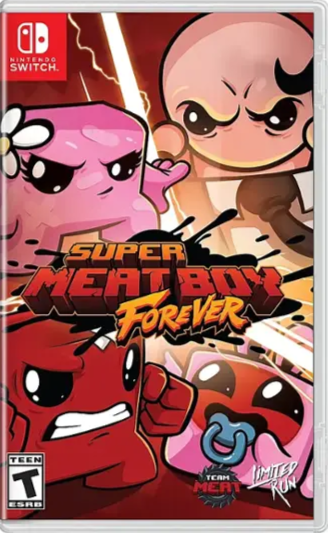
Super Meat Boy Forever is a separate game. Its developer description explicitly calls it an auto-runner, adding jumping, diving, sliding and punching around that structure. It is not the 2010 game with a longer subtitle. Super Meat Boy 3D is separate again; our 3D update coverage concerns that later title.
For a physical purchase, check the full name on the actual case and cartridge or disc, then the platform, region and listed contents. Match any download-code requirement to the listing. Do not assume a used package includes an unused code, a soundtrack, a second game or an expansion.
The current Xbox listing identifies Xbox One and Xbox Series X|S as playable systems, while the original PC game remains offered through Steam. Availability is a useful starting point; it is not a promise that every old computer, controller or historical operating system meets today's storefront requirements.

What makes the original worth revisiting
Super Meat Boy remains a sharply defined invitation: take a compact challenge seriously enough to finish it, then watch the game turn the evidence into a celebration. Its art and humor give that process a deliberately scruffy personality. Its courses keep asking for attention to the route rather than a larger inventory of equipment.
For a newcomer, start with the original game if that direct platforming structure is the attraction. For a returning player, decide whether you are chasing a particular soundtrack, racing option or hardware experience. Those are concrete reasons to choose an edition, and they leave less room for an accidental purchase of the wrong sequel.
Build the next part of your shelf with Zypher
Buy your next physical game from Zypher Trading Video Games. If you want the separate follow-up, check Super Meat Boy Forever for Nintendo Switch. It is the auto-running sequel, not the 2010 original discussed here. Read the listing's condition and included contents.
Shop Zypher's games, or sell your old games to Zypher to make room for another challenge.
Primary sources, current storefront descriptions and the exact Zypher listing checked November 1, 2026. Design readings and purchase recommendations are Zypher editorial judgment. All featured and inline images are unmodified original-game screenshots from BlitWorks' public press kit; capture build unspecified.