
Look at the floor in VVVVVV, then look at the ceiling. Both deserve your attention. Terry Cavanagh’s 2010 platformer replaces jumping with gravity reversal, so a surface above Captain Viridian can become the place he is heading. A familiar room suddenly asks a different question.
For today’s Classic Game Deep Dive, the subject is the individual 2010 game: how its gravity rule shapes the adventure, why its rooms are worth studying, and which desktop package contains the original campaign. The free Make and Play edition is useful, but buying the adventure and downloading its creation tools are different decisions.
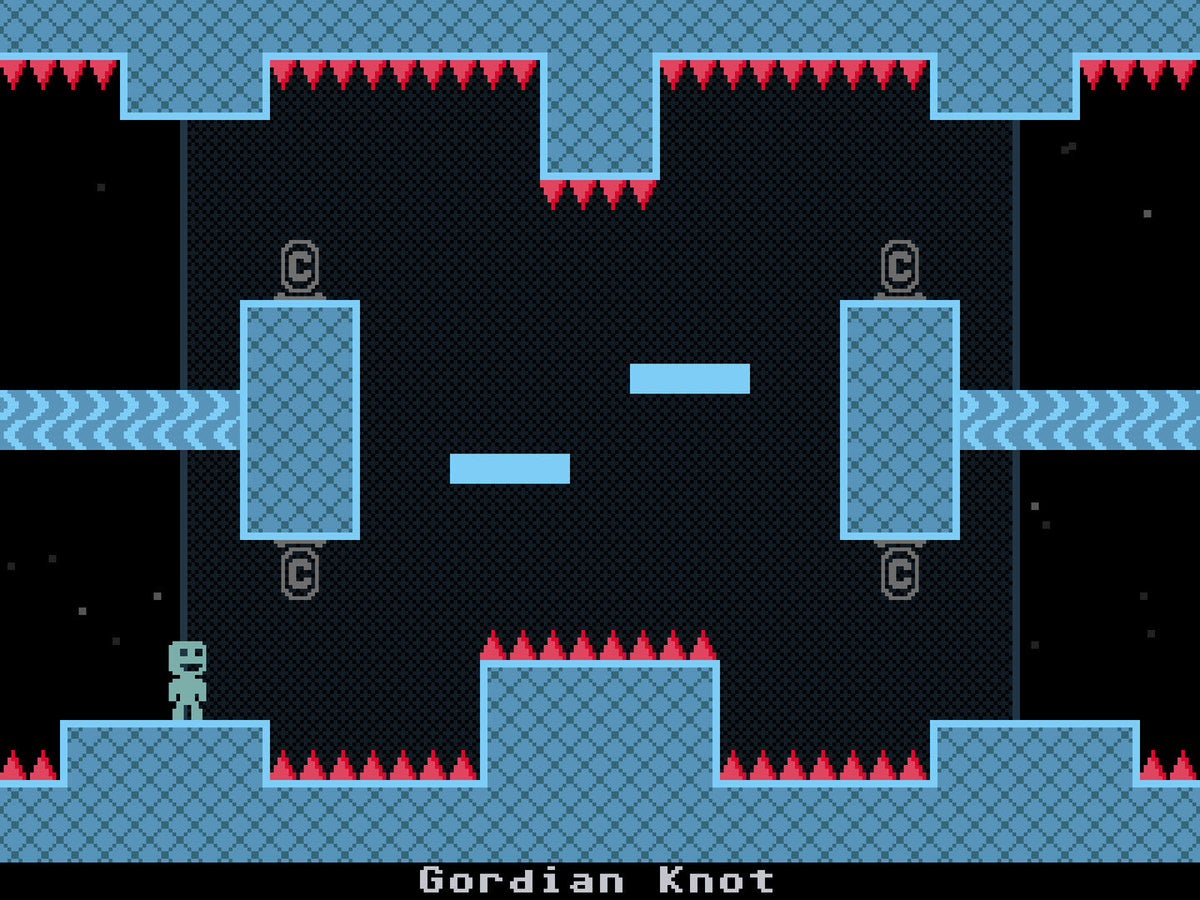
Featured image: the blue Gordian Knot room, with red spikes above and below the open space. All five images are unmodified publisher-supplied desktop screenshots; capture build unspecified. © Terry Cavanagh. They illustrate the game, not the menus or performance of a current console port.
The ceiling changes the way you plan
The developer’s Steam description identifies gravity reversal as the central mechanic. The useful way to think about it is to treat the empty space between surfaces as part of the route. In an ordinary jump, your attention often goes to the platform ahead. Here, the surface across the room’s vertical space matters just as much.
Consider the featured screenshot. Viridian stands at the lower-left. Red spikes cover portions of the bottom and top, while small platforms interrupt the middle. Our reading of the layout is that choosing a direction requires reading both ends of the journey. Moving away from one dangerous surface means approaching another part of the same room.
The room does not need a large cast of enemies to establish that problem. Its geometry already asks you to consider the destination, the path across the gap and the next safe surface. Gravity gives the empty space a direction. The floor is no longer the automatic answer to where a character belongs.
For a first visit, pause long enough to identify a safe destination before acting. Then ask what the route would look like with the opposite vertical direction. That is our suggested way into the design, not a solution to a particular room or a promise that the controls will become effortless.

A rescue mission gives the strange geography a purpose
Captain Viridian is searching for friends scattered by a teleportation mishap, according to Cavanagh’s own storefront. That gives the exploration a clear objective. The surrounding world can be abstract and hostile while the reason for continuing remains easy to understand: find the crew and bring them back.
The purple room above shows how much character the game gets from a limited picture. Viridian’s cyan figure stands apart from the architecture. The purple walls and dark patterned spaces divide the image into places to stand and gaps to consider. There is little visual clutter competing with the layout.
Room names add another layer. The screenshot calls this space A Bisected Spiral, while another is The Yes Men. Those names can give a geometric arrangement a joke or a suggestion without adding a long conversation. The official source repository credits Bennett Foddy for the room names. Apparently, even a trip through strange dimensions needs somebody to name the rooms.
The tiny smiling characters also give those arrangements somebody to worry about. Compare the cyan figure with the yellow crowd in The Yes Men: a few colours and a face are enough to separate the traveller from the strange company around him. That is our reading of the art’s economy, and one reason the minimal presentation works for this adventure.

Demanding movement with less distance between attempts
The publisher advertises frequent checkpoints alongside time trials and a no-death mode. Those features describe different ways to approach the same game. An ordinary trip through the adventure can provide repeated opportunities to solve a local problem; the special modes can ask for a more sustained performance.
Our view is that the checkpoints suit the unusual movement rule. A player learning to read ceilings has enough to consider without every error becoming a tour of earlier rooms. Keeping another attempt close helps preserve the question that caused the mistake: where was the intended landing, and which part of the path went wrong?
That does not make precision comfortable for everybody. Understanding the route and executing it are separate demands. If you enjoy exploration but dislike repeated movement challenges, take that preference seriously. A simple control idea can still ask a lot of your timing.
Use the green screenshot below as an observation exercise. The spikes beneath the lower passage are easy to notice; the spikes hanging from the large block above deserve the same inspection. In a game about changing gravity, looking only below the character leaves half the danger out of your plan. The ceiling has not agreed to be the safe option.

A 2010 game that kept receiving attention
Cavanagh’s January 11, 2010 launch post announced the completed game. In his tenth-anniversary account, he explains a small date wrinkle: it technically went live at 3 AM GMT on January 11, although he personally regards January 10 as launch day. Steam’s September 2010 date belongs to that storefront release, rather than the game’s first appearance.
The anniversary also brought public access to the source code. Cavanagh’s account distinguishes the desktop version, ported to C++ by Simon Roth in 2011 and subsequently maintained by Ethan Lee, from the mobile code based on the original Flash version. That history explains why “the old game” does not mean one identical executable across every device.
Later maintenance was substantial enough to matter to players. Cavanagh’s August 2021 version 2.3 announcement lists support above 60 FPS, graphical options, editor improvements and bug fixes, crediting community contributions after the code became public. This is historical context, not a claim that 2.3 is today’s latest build.
For us, that is part of the game’s present-day value: the original idea has a continuing life beyond its first release. It is also a reason to check the actual version you are buying or downloading instead of assuming every screenshot, guide and port describes the same package.
The commercial game and Make and Play are different packages
The official Make and Play edition is free and includes player levels plus tools for creating your own. It excludes the original campaign levels. The commercial edition includes Cavanagh’s original levels. If your intention is to play the adventure discussed here, that distinction matters more than the word “free” on a download page.
The creator’s itch.io page currently offers Windows, macOS, Linux and Android downloads. At our check, the three desktop downloads were labelled version 2.4.4; the page did not assign that same displayed version number to its Android file. Do not turn one desktop label into a claim that all ports are identical.
The official repository also says the game remains commercially available and allows personal compilation. Publicly readable code is not blanket permission to redistribute the game’s assets. The Make and Play page specifically explains that distributing those assets with a compiled version requires permission. For ordinary play, use the creator’s offered downloads rather than assuming you need to build anything.

Choosing your next visit
Choose the commercial desktop game if you want the original rescue adventure and the platform support offered on that listing. Choose Make and Play if creating or exploring player-made levels is the goal, with the understanding that the campaign is excluded. Check the requirements for the computer you intend to use; a historical minimum listed on a storefront is not a guarantee about its current client.
Put another platformer on the Zypher shelf
Buy your next physical game from Zypher Trading Video Games. For a different platforming classic, check our Super Mario 64 for Nintendo 64 listing. That is a separate N64 game, not a physical edition of VVVVVV. Read the condition and included contents before choosing your copy.
Shop Zypher’s games, or sell your old games to Zypher to make room.
Primary sources, desktop package descriptions, screenshot permission and the Zypher listing checked November 3, 2026, America/Denver, for the November 4 release. Design readings and practical suggestions are Zypher editorial judgment. Screenshot reuse follows Terry Cavanagh’s express permission for publications; no standalone music is reproduced.


