


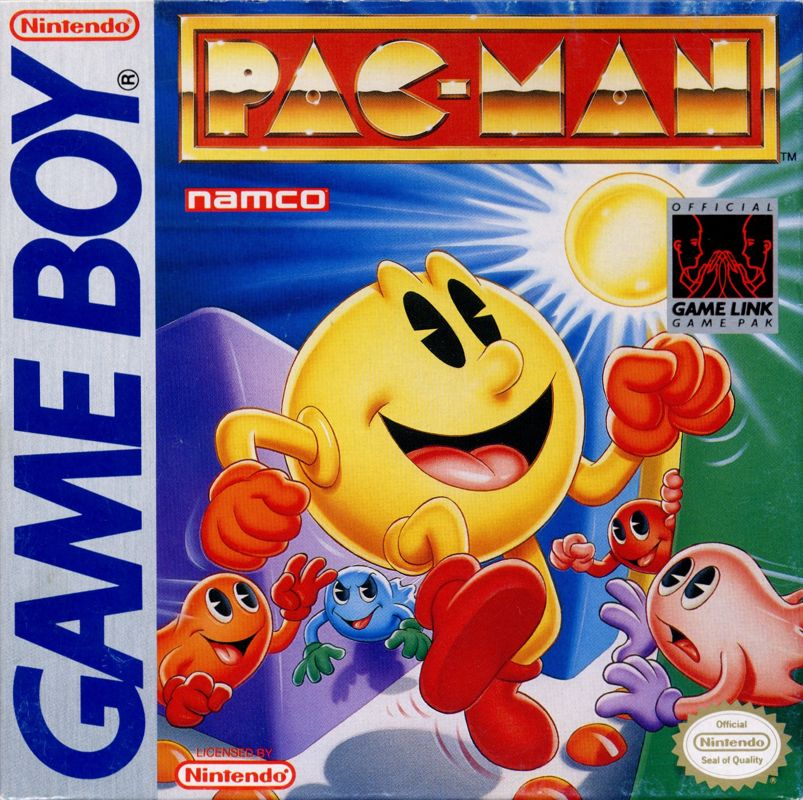



Pac-Man
About the Game
Pac-Man is a maze-chase arcade game with single-player and alternating two-player modes. You control Pac-Man, a yellow circular character who must navigate an enclosed maze while eating small dots scattered along its paths. The objective in each stage is to clear the maze of all dots while avoiding four ghosts that pursue Pac-Man through the corridors. As players progresses, the maze layout remains the same, but the game becomes more difficult as ghost behavior, speed, and vulnerability periods change.
Gameplay & Core Systems
These tunnels can be used to escape danger, as ghosts move more slowly through them than Pac-Man. The four ghosts each follow distinct movement patterns that affect how they chase players. Inky, the blue ghost, uses a more complex pattern based partly on Pac-Man’s position and Blinky’s location, making its movement less predictable. Their movement also alternates between periods of pursuit and brief scatter phases, during which they retreat toward different corners of the maze before resuming the chase. Eating multiple ghosts during the same Power Pellet awards increasing points, encouraging players to turn pursuit into a scoring opportunity.
Standout Features
- The maze also includes side tunnels that connect the left and right edges of the screen.
- Eaten ghosts return as eyes to the central ghost house, where they regenerate and resume pursuit.
- Depending on the version or settings, an extra life may be awarded after reaching a specified score.
- The game offers continuous play with no conventional ending.
- Some versions closely preserve the original arcade gameplay, while others adapt the graphics, sound, controls, display options, or bonus features to suit their platforms.
- Bonus items, usually represented by fruit or other objects, appear below the ghost house during certain stages and award additional points if collected.
- After certain stages, short comedic intermissions show Pac-Man and the ghosts in brief chase scenes, serving as lighthearted rewards between rounds.
- Power Pellet: As players advances, the ghosts become more dangerous, the Power Pellet effect shortens, and eventually the ghosts no longer turn blue.
Modes & Ways to Play
Player support includes 1-2 Players.
Presentation & Atmosphere
Early home conversions often simplified the graphics, sound, maze proportions, or ghost behavior because of hardware limitations, while later re-releases more closely emulate the arcade version.
More game data: releases, identifiers & technical details
Regional release records and identifiers for Pac-Man | Nintendo Game Boy.
Release and technical facts
| Fact | Value | Release / platform | Source |
|---|---|---|---|
| Published by | Namcot | Japan | MobyGames |
| Developed by | Namco Limited | Japan | MobyGames |
| Published by | Namco Limited | United States | MobyGames |
| Developed by | Namco Limited | United States | MobyGames |
| Number of Players Supported | 1-2 Players | Game Boy | MobyGames |
| Miscellaneous Attributes | Game Link Cable | Game Boy | MobyGames |
| Original game disc count | 1 | North America | MobyGames |
| Genre | Arcade | North America | PriceCharting |
| Also compatible on | GameBoy Advance and GameBoy Color | North America | PriceCharting |
| ESRB rating | Everyone | North America | PriceCharting |
| Player count | 1 player | North America | PriceCharting |
| Publisher | SPIG | North America | PriceCharting |
| Developer | Namco | Japan | PriceCharting |
| Genre | Arcade | Japan | PriceCharting |
| Model number | #DMG-PCA | Japan | PriceCharting |
| Player count | 1 player | Japan | PriceCharting |
| Publisher | Namco | Japan | PriceCharting |
| Also compatible on | PAL GameBoy Color | PAL | PriceCharting |
| Genre | Arcade | PAL | PriceCharting |
| Player count | 1 player | PAL | PriceCharting |
| Publisher | Namco | PAL | PriceCharting |
Regional releases
| Release date | Region / edition | Source |
|---|---|---|
| 1990-11-16 | Japan | MobyGames |
| 1991-04 | United States | MobyGames |
| 1991-04-01 | North America | PriceCharting |
| 1990-11-16 | Japan | PriceCharting |
| 1991-01-01 | PAL | PriceCharting |
| April 1, 1991 | North America | PriceCharting |
| November 16, 1990 | Japan | PriceCharting |
| January 1, 1991 | PAL | PriceCharting |
Catalog identifiers by release
| Identifier | Code | Region / edition | Source |
|---|---|---|---|
| EAN-13 | 4907892040021 | Japan | MobyGames |
| Nintendo Media PN | DMG-PCA-JPN | Japan | MobyGames |
| eBay Product ID | 1703468763 | Japan | MobyGames |
| UPC-A | 722674020060 | United States | MobyGames |
| Nintendo Media PN | DMG-PC-USA | United States | MobyGames |
| ASIN | B000035XBG | United States | MobyGames |
| eBay Product ID | 1805 | United States | MobyGames |
| upc | 722674020060 | North America | PriceCharting |
| asin | B000035XBG | North America | PriceCharting |
| epid | 1805 | North America | PriceCharting |
| model | #DMG-PCA | Japan | PriceCharting |
Data by MobyGames.com · Catalog data: PriceCharting


